Collecting, treating, and disposing of wastewater from a property is one of the most important tasks for ensuring comfortable living in a private country house. This article will describe the step-by-step process of constructing a sewer system from concrete rings yourself.
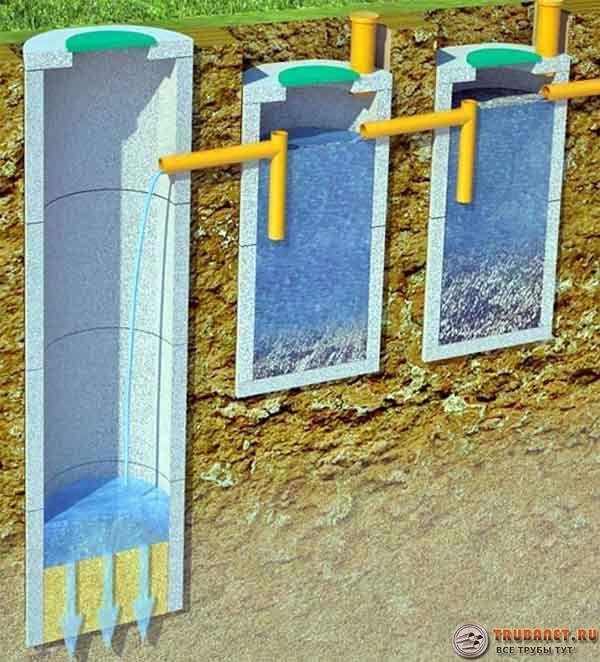
One of the most popular materials for solving this problem are concrete rings.
Devices made from such elements for private homes are the most durable, require virtually no maintenance during operation, are affordable for any budget, and are easy to install.
- External wastewater disposal system
- How to calculate the volume of a container
- An example of calculating the volume of consumption
- Sewage system diagrams
- Types of containers and their design features
- Single-chamber storage devices
- Two-chamber
- Three-chamber devices
- Preparing the excavation pit
- Installing concrete rings for sewer pipes yourself
- Ventilation for sewerage
- Prices for concrete rings
External wastewater disposal system
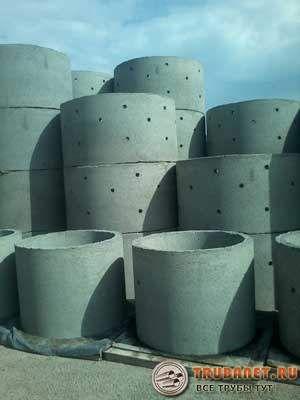 Sewer rings are the main component of the external part of a sewer system, serving as containers for various purposes in the wastewater treatment system. They are available as either walk-through, bottomless, or with bottoms. Additionally, covers, in the form of concrete slabs with a pass-through opening for maintenance, are a mandatory element. Rings with perforated walls, which house a bottom filter, are also used for filter wells.
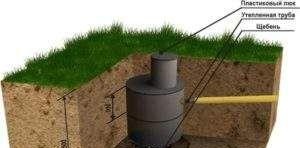
The finished tank is equipped with two lids—an inner wooden lid and an outer plastic or cast iron lid. The concrete sewer system is buried in the ground to a depth that allows only the top lid to protrude.
The advantages of using such products include the following properties:
- strength, allowing you to avoid the risk of damage when the soil freezes in winter;
- durability – high-quality products of standard quality can serve in the sewerage system for up to 50 years;
- ease of installation – DIY reinforced concrete sewerage is quite accessible to most contractors;
- cost savings on purchasing rings compared to ready-made plastic containers.
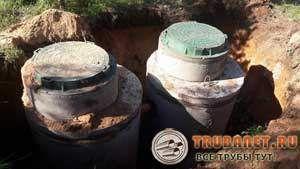
The main disadvantage of concrete sewer systems is the large volume of excavation work required, but this same property is equally inherent in any external wastewater drainage and treatment systems.
How to calculate the volume of a container
For more accuracy For calculations, we suggest using the online calculator.
In an effort to create the most comfortable living conditions in a country house, owners install all the amenities typical of urban environments, including sewerage. In most cases, small suburban communities lack centralized sewerage systems.
Therefore, each owner installs a local wastewater treatment plant (LOS), designed not only to drain wastewater, but also to purify it to an accessible degree, ensuring the safe living of not only their family, but also their neighbors.
Watch the video
This is a fairly expensive undertaking, and the greater the volume of wastewater that needs to be treated, the greater the construction costs. For this reason, calculating the required capacity when installing a DIY sewer system using concrete rings is a pressing issue.
The most popular design solutions for local sewer systems are concrete rings or one-piece plastic tanks. They are installed in series and consist of 2-4 sections, each serving a different purpose. They are connected by pipes.
Functionally they operate as follows:
- The first tank is called the accumulator and is designed to separate the solids and heavier components from the wastewater. These settle to the bottom of the vessel and are removed as they accumulate.
- The second tank is designed for biological treatment of wastewater. This is done using special bacterial cultures, which are added to the vessel as needed. A sediment called activated sludge forms at the bottom, where the bacterial population is replenished. This sludge is pumped out as needed, with a certain portion retained for further use.
- In the third section, the wastewater is aerated by passing atomized air through it using a low-power compressor. This is where the wastewater is pre-oxidized. The air also acts as a catalyst for the biological activity of the bacterial component.
- Further purification takes place in a filter well. It is constructed using concrete rings with perforated walls—one at the bottom and one at the top, a solid ring covered by a concrete lid with an opening for access.
A properly designed treatment system provides wastewater purification rates of up to 98%. This water can be safely used for gardening, car washing, and other household purposes. Activated sludge is a very effective fertilizer.
The basic basis for calculating the volume of the septic tank is the average consumption per person, which is 200 liters of water per day.
Watch the video
When calculating, this norm must be multiplied by the number of residents.
Country House Tank Capacity Chart
| Number of residents | 2 - 3 | 3 - 4 | 5- 7 | 8-9 |
| Useful volumes | 1.8 | 2.4 | 4 | 5.4 |
The table provided is applicable to two- and three-chamber septic tanks.
It should be noted that for the first sections of the sewer system, concrete rings with a bottom are used to prevent untreated wastewater from entering the ground.
The data in the table is approximate. Actual water consumption, and therefore volume, depends on the composition of the household equipment. Having a sauna, jacuzzi, washing machine, or dishwasher in the home significantly increases water consumption.
An example of calculating the volume of consumption
Let's assume there are four people living in the house permanently. Then the approximate consumption calculation would look like this:
- We determine the total liquid consumption per day – 4 x 0.2 = 0.8 cubic meters.
- Taking into account the standard for the minimum residence time of wastewater in the settling tank of at least 3 days, we obtain the size of its capacity - 0.8 x 3 = 2.4 cubic meters.
- If we assume the use of standard "15-9" rings, the internal diameter of which is 1.0 meters and the height is 0.7, we obtain the volume of the contents of one section of 1.64 m3. Thus, the full two-chamber tank will be 3.28 cubic meters.
It's worth noting that the actual volume is somewhat smaller, as the height should be measured not by the ring size, but by the distance between the bottom and the edge of the overflow hole. However, this will only be determined when designing the outdoor sewer system, and then the calculation should be verified against the actual dimensions.
Watch the video
[sociallocker]
The data obtained indicate that there is a certain reserve capacity for the external sewerage system, but this will come in handy if you have to host guests.
Sewage system diagrams
The main principle of manufacturing a wastewater tank from this material is compliance slope along the placement of individual sectionsThe slope is created by connecting intermediate elements – pipes; its value should be within 1-3 millimeters per meter of the system length.

At a shallower slope, solids in the drain can become trapped. The same effect occurs at a steeper slope—water drains faster than the solids can move. This creates a blockage in the pipe, which must be removed using specialized cleaning products.
A crucial structural element is the junction between the overflow pipes and the concrete ring body. This junction must be carefully sealed with cement mortar to prevent leaks. Otherwise, the sewer system will not function properly.
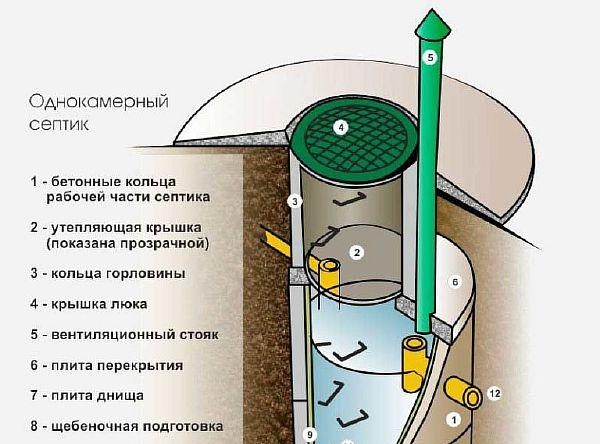
The diagram of the wastewater treatment device shows all the main design elements, the purpose of which will be described below.
Types of containers and their design features
While observing the typical device design, design solutions may vary.
First of all, it's important to understand that a settling pond poses a significant environmental hazard, and uncontrolled construction of such facilities is prohibited. Before commencing work, a design must be developed, approved by the Sanitary and Epidemiological Service, and only then can construction commence. Permits can be obtained only if the construction meets all Sanitary and Epidemiological Rules and Regulations (SNiP) requirements.
The general rules for wastewater treatment facilities are as follows:
- The main document regulating the placement of sewage tanks in suburban areas is SNiP 2.0403-85. It details the requirements for the placement of sewage facilities in relation to various buildings.

- If there are water supply facilities on the territory, the rules for their relative positioning are provided for by SNiP 2.0401-85.
- Many distances are regulated by the requirements of SanPiN 2.1.5580-00.
- Sanitary Regulation 2.2.1/2.1.1-12-03 establishes the rules for water protection zones of water supply facilities.
It's important to note that many regulatory documents contain overlapping requirements. For example, one sets the minimum distance from a septic tank to a residential building at 10 meters, while others set it at 5 meters. To avoid complications when approving a sewer system project, it's best to adhere to the higher standard.
Watch the video
The design of a local wastewater treatment facility depends on many factors, ranging from its size and landscape to the quality of the soil. Therefore, several types of settling tanks are distinguished.
Single-chamber storage devices
It's worth noting that these structures are currently prohibited, although a significant number remain in operation. Consider the water consumption standards: 200 liters per person. Even with two residents, this amounts to 0.4 cubic meters per day; even a five-cubic-meter storage tank fills up in at least two weeks.
5 cubic meters is the volume of a standard cistern. This means pumping must be done every two weeks, costing up to 12,000 rubles each time (for the Moscow region). Is this realistic? No! So, most of the waste ends up on the road, in the garden—or anywhere else. Only human waste ends up in the storage tank. And then we drink water from the well.
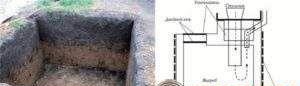
A septic tank made of concrete rings slightly increases the period between pumpings, but it would be a stretch to call such a structure a treatment facility.
Two-chamber
A two-tank concrete ring sewer system offers greater wastewater treatment options. This is due to the following reasons:
- An additional opportunity appears for the sedimentation of solid components of wastewater, settling to the bottom of the second vessel.
- The second tank can be treated with biologically active components that actively process wastewater contaminants. This is achieved by using cultures of anaerobic bacteria that break down wastewater components and render them harmless. This results in the formation of a dense bottom sediment called activated sludge. This sediment is a habitat for bacteria, whose numbers continually increase, increasing the degree of purification. As it accumulates, the tank must be periodically cleaned by pumping out the activated sludge, a portion of which is used to replenish the bacterial population.
 Since these are live cultures, chlorine must not be allowed to enter the wastewater as it passes through the chamber. This will inevitably kill the beneficial bacteria colony. If additional disinfection is desired, the purified water can be treated with bleach before discharge.
In this two-chamber storage tank design, concrete rings with a bottom are used as the reservoir for the first, storage section. The second section is installed as a filter well.
It consists of two rings stacked on top of each other, with the lower ring being perforated.
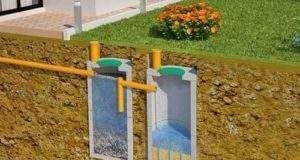
Let's take a look at the design of the filter well. Its maximum depth is no more than 2.5 meters. Moreover:
- A 30-centimeter-thick gravel bed is formed at the bottom of the pit. The material used has a grain size of 5-15 millimeters.
- Before installation, the outer surface of the rings must be treated with a waterproofing material, for which bitumen mastic is most often used.
- The bottom ring is installed on a gravel pad and wrapped with geotextile up to the perforation level.
- A bottom filter is formed using fine gravel or blast furnace slag, which has increased absorption. The layer is 15-25 centimeters thick. A similar layer of broken brick can be added on top of it.
- The same gravel is poured outside the ring up to the perforation level.
- A second ring and a correspondingly sized floor slab with a passageway are installed. A wooden cover must be made for this opening.
- The top floor slab and the manhole are installed in a standard design with a metal or plastic cover.
- To prevent wastewater leaks around the formed well, it is necessary to install a clay seal, proceeding as follows:
- the clay intended for it is poured into a cone and a funnel is made on top into which water is poured;
- the material is soaked for 24 hours;
- the clay must be mixed until it reaches the consistency of sour cream, adding reinforcing shavings to the solution;
- fill the funnel around the well with the resulting solution;
- Dry the resulting clay seal for about a month, periodically sprinkling it with water.
A hole is made for the overflow pipe from the first tank before filling the water seal, the joint is sealed with cement mortar and treated with bitumen mastic.
Watch the video
[sociallocker]
Three-chamber devices
The difference between such sewerage systems made from concrete rings is the use of an additional tank in which additional wastewater treatment occurs through aeration using a low-power compressor and an air sprayer.
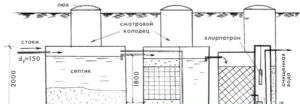
Liquid aeration is performed to activate another type of bacteria—anaerobic bacteria, which are active in the presence of atmospheric oxygen—for their purification. With their use, purification rates reach 98-99%.
This water is not suitable for drinking or cooking, but it can be used for technical purposes, such as washing a car or even watering a garden. As it passes through the soil, the water undergoes final filtration.
The water that has passed through the settling tank is disposed of in various ways:
- discharge into a drainage ditch;
- discharge directly onto the ground;
- diversion to the nearest body of water.
Preparing the excavation pit
Installing a sewer system using concrete rings requires a significant amount of excavation work. But before you begin, you need to ensure the feasibility of such an undertaking. To do this, you need:
 Conduct exploratory drilling to determine the nature of the soils at the proposed site of the settling tank. If the subsoil is clay, it's best to avoid completely treating the wastewater, as clay is practically impermeable to water, preventing the soil from utilizing its filtering properties.
- To determine the depth of underground aquifers and the level of seasonal fluctuations in liquid in them.
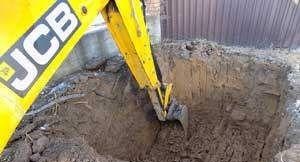
Digging a pit can be done in three ways:
- Using earthmoving equipment—an excavator—requires clear access and maneuvering space. This method allows a pit to be dug in an hour. Furthermore, the problem of removing the excavated soil is solved;
- a team of hired workers can resolve the issue within a working day;
- on your own – in this option, digging a pit can be completed in 7-10 days, depending on the scope of work.
Experience shows that the cheapest and highest quality option is to use technology.
Watch the video
Installing concrete rings for sewer pipes yourself
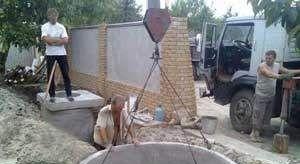 Concrete rings are heavy, which often poses a challenge for DIY installation. Installing concrete sewer rings yourself is only possible with the use of lifting equipment. These are hand hoists. However, using them is labor-intensive and time-consuming.
It is much easier, cheaper and safer to rent a truck crane for a short period of time and install the rings with its help.
Ventilation for sewerage
When wastewater is processed, especially when it contains significant amounts of fecal matter, methane is released. Without ventilation, its concentration can reach explosive levels.
In this case, ignition occurs when using electrical equipment from the slightest spark. The consequences can be fatal.
To avoid such consequences, it is necessary to install ventilation in the well chamber.
Prices for concrete rings
When planning to build a water treatment plant, everyone will first try to figure out the cost of concrete sewer rings, the dimensions of which will be chosen for the project. To do this, you need to know the markings of concrete materials.
Watch the video
In our case it is:
- KS – wall ring, size in the example is KS-12-10 – the numbers indicate the diameter and height in decimeters;
- PN – bottom plate;
- PP – lid plate.
For example, well rings of various sizes can be selected and purchased at prices ranging from 470 to 1,560 rubles.