 How to install a sewer system in a bathhouse yourself – a step-by-step guide with detailed video instructions will give you a clear idea of which sewer system to choose and how to install it correctly.
After all, a modern bathhouse on a country house plot becomes an indispensable multi-purpose utility facility with a steam room, a washroom, a toilet, and often a laundry area.
Proper drainage of a bathhouse is necessary for many reasons, but above all, to ensure comfortable use and safe living. To achieve this, wastewater must be as free of various contaminants as possible.
This article provides a clear step-by-step guide on how to properly set up this system yourself, and how to do it with minimal expense.
- Choosing the Right Sewer System Type – A Step-by-Step Guide
- Gravity sewers
- Pressure sewerage
- Cut-in sewerage system for a bathhouse
- Sewer Design Guide
- Installation of an internal sewerage system
- Installation of internal sewerage during construction
- Installing Internal Sewerage in a Finished Building – A Step-by-Step Guide
- How to build a water seal yourself
- External sewer installation - choosing a location for the septic tank
- Construction of a local wastewater treatment plant
- Preparing the trench and laying pipes
- Which pipes to choose for sewerage
Choosing the Right Sewer System Type – A Step-by-Step Guide
Before installing a sewer system in a bathhouse, you need to determine the plumbing components. Regarding the internal sewer system, it must provide the following functions. Let's take a look at them.
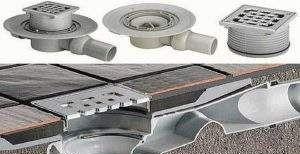
In the steam room, the only plumbing fixture is a floor drain, which collects wastewater from the floor and, through a siphon, flows into the waste pipe. The drain itself should be covered with a thick mesh to trap debris, such as from bath whisks.
The drain must be equipped with a siphon to create a water seal.
A shower is an essential part of any bathhouse. This room doesn't require any special features, other than installing a drain similar to the one used for the steam room.
Tea drinking is a traditional activity in the banya. Before the feast, it's perfectly natural to wash your hands, so a washbasin is installed in the relaxation room. It should be connected to the internal sewer system via a siphon.
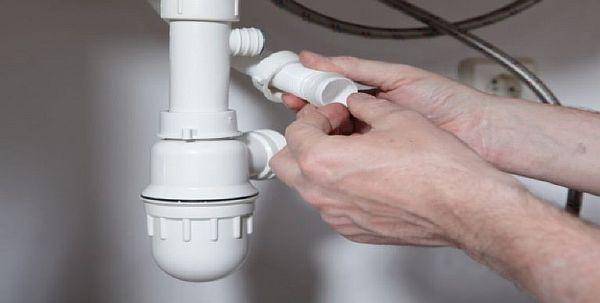
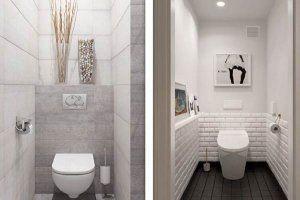
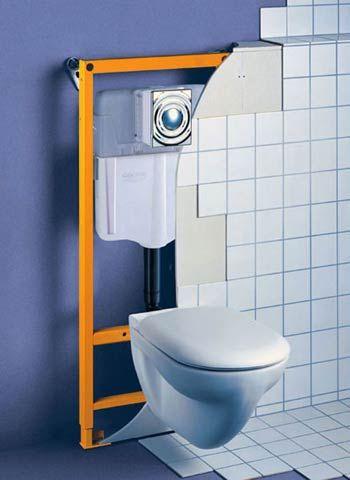
A modern banya today invites long sojourns over tea, leisurely conversation, or watching television. In such settings, a toilet is essential—the contrast between using an outdoor unit is too great. Installing and connecting a sewer system in a banya with a toilet is no different from installing an indoor plumbing system in a residential building.
A typical solution for a bathhouse is to also equip it with a laundry room.
Thus, the bathhouse contains all types of wastewater that require drainage. Consequently, the approach to choosing the type of drainage system is completely standard.
Let's take a closer look at what types of drainage systems there are and which are the most common.
Gravity sewers
In drainage systems where liquid moves spontaneously under the influence of gravity, it is essential that the pipes be sloped at each section. This slope, 2-3 degrees, is optimal for ensuring proper drainage.
If the angle is smaller, some of the debris will remain in the pipe, creating conditions for clogs. At a slope of 3 degrees or more, the water will drain quickly, failing to remove the solids.
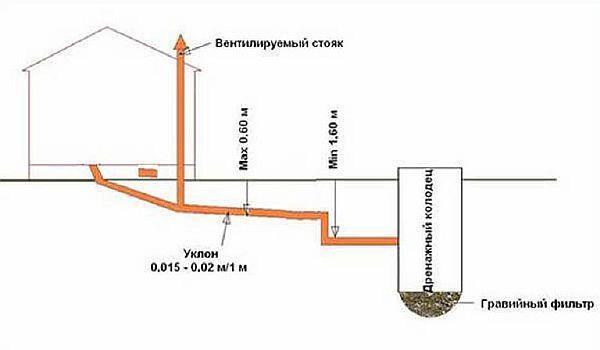
An essential condition for the proper operation of the drainage system is a waste riser, the purpose of which is ventilation.
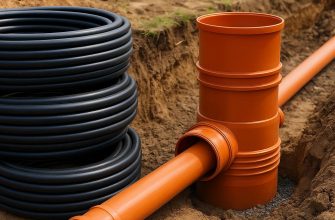
For the outdoor sewer system, 100-millimeter diameter pipes, preferably made of plastic, are used. Their advantage is that they are flexible and virtually unaffected by seasonal ground movements. The depth of outdoor sewer pipes should be no less than the frost line. Taking into account the drainage layer, they should be laid 30-40 centimeters deeper.
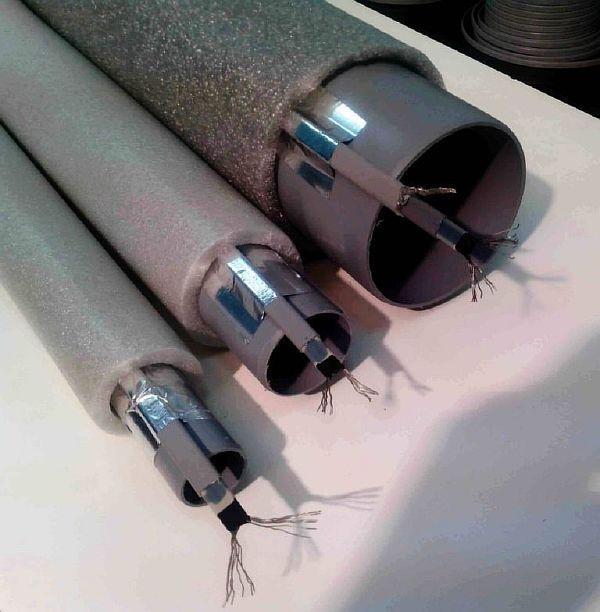
In most cases, given the natural conditions of our country, it is necessary to dig fairly deep trenches. To avoid this, a heating cable is installed on the sewer pipes, which automatically turns on when the temperature drops critically.
In this case, a burial depth of 0.5 meters is sufficient, and the pipes are insulated with porous insulation. For the sewer system in the bathhouse, plastic PVC pipes with rubber sealing cuffs are used.
The external sewer system from a bathhouse is typically quite extensive, as this property is located at the end of the property. The final point of discharge is either a septic tank with a filter well or a drain connection to the central sewer system.
It's worth noting that a filter well can't be installed everywhere. In clay soils, runoff doesn't filter, and wastewater will accumulate under the well.
High groundwater levels also prevent the use of a filtration well. If the water level in a well or borehole reaches 2.5 meters at its maximum, the device cannot be installed due to contamination of groundwater by runoff. In such cases, a filter field with infiltrate is installed, or a septic tank must be regularly pumped and its contents removed.
For small summer cottages with limited access, in some cases it is sufficient to make a sewer system in the bathhouse using a barrel.
Pressure sewerage
Such drainage structures are used when it's impossible to fit the bathhouse's sewer pipes in a single horizontal plane. This may be due to the landscape or the bathhouse's design.
To create special fecal pumps are used in the pressure networkThey can be submersible, semi-submersible or surface.
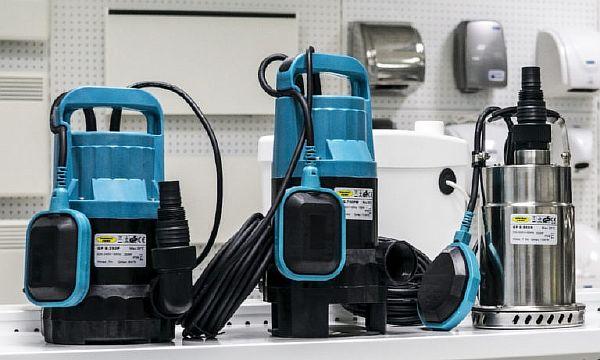
In some cases, low-power pumping stations can be used for sewerage in a bathhouse; they are conveniently installed directly next to the plumbing fixtures.
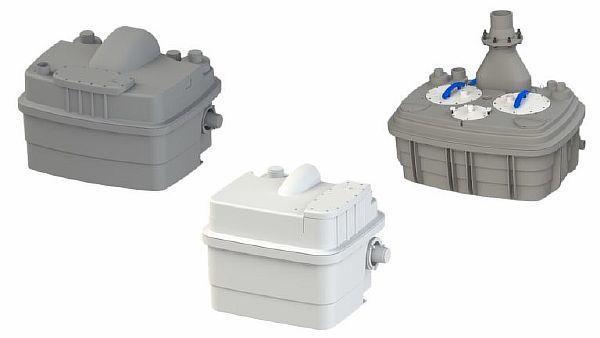
A distinctive feature of fecal stations and pumps is the presence of a grinder for crushing solid inclusions of various kinds, except for solid ones.
Cut-in sewerage system for a bathhouse
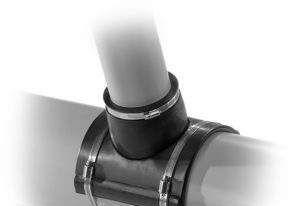 Depending on the configuration of the sewage pipelines, in some cases it may be necessary to connect the discharge pipe to the existing system. This may be necessary when installing an external sewer network or for connecting to the central city pipeline.
In the second case, a special permit from Gorvodokanal will be required, and the connection will be performed by a specialist from that organization. The user of the outdoor sewer system on the property will perform the connection independently using special clamps.
The best sewer system for a bathhouse isn't even a choice made by the developer. The type and design depend on the landscape and the architectural features of the bathhouse.
In terms of simplicity and cost, it is best to use a simple gravity-fed system that requires minimal attention during operation.
Sewer Design Guide
The basis for this project is a building plan for the bathhouse, indicating the locations of the plumbing fixtures. A competent designer will arrange them all sequentially along a single axis in advance to simplify installation and minimize costs. The sequence of actions may be as follows:
- Create a graphical representation of the sewerage system for a bathhouse, indicating the dimensions of each element of the internal wiring structure.
- Provide a connection through a siphon on each plumbing fixture creation of water seals, this article covers this point in more detail.
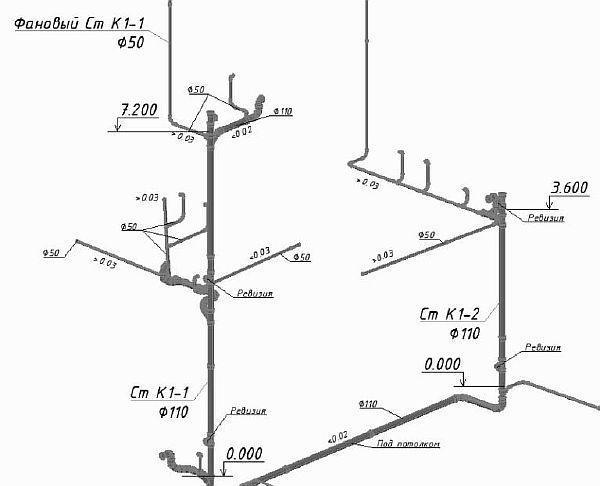
- An inspection hole is installed before connecting to the riser.
As the system moves away from the starting points, the pipe sizes can only be changed upwards:
- the drain from the sink can be made from a 40 mm pipe;
- It is better to install a drain pipe with a diameter of 50 mm from the shower room through the drain;
- The external sewer outlet line is selected to be 100 millimeters in diameter. The same applies to the connecting sections between individual sections of a multi-stage septic tank.
- A bleed valve must be installed where the drain pipes connect to the riser to prevent the water seal in the traps from being breached. Installing a waste pipe is unacceptable in most cases.
- Outdoor sewer pipes for saunas require insulation using a heating cable. This will allow warm air to flow into the system, preventing freezing, which could rupture porcelain plumbing fixtures. Therefore, it's not recommended to install a waste pipe in a sauna that would vent the air outside.
Otherwise, the design of the sewerage system for a bathhouse is no different from typical devices for a similar purpose.
Installation of an internal sewerage system
The drainage system piping is installed after the main construction work is completed, before finishing work is carried out.
Watch the video
During the design process for the bathhouse building, openings for all types of communications are already provided in accordance with the project, which reduces the cost of their installation.
Installation of internal sewerage during construction
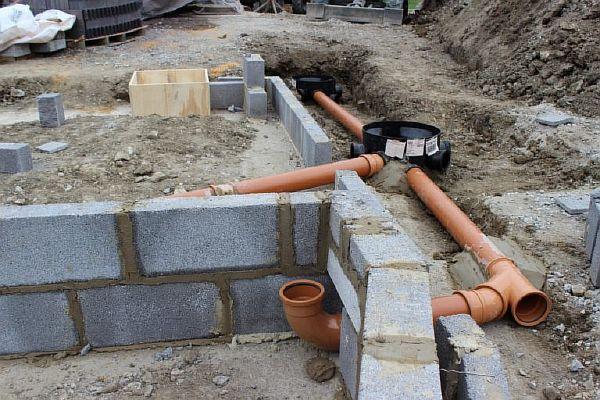 Installing the drainage system during construction provides many advantages. Wall intersections are significantly simplified, as they are created during the construction of the piers.
In addition to significantly reducing labor costs, this assembly technology significantly improves the quality of work, allowing for correct slopes and secure fixation with cement mortar.
The installed system can be securely covered with masonry or removable panels. Installation of the sewer system is carried out from the bottom up, which requires high-quality design and precise execution.
Installing Internal Sewerage in a Finished Building – A Step-by-Step Guide
This utility installation procedure is used in existing buildings during major renovations. However, the design phase takes into account the existing conditions dictated by the building's structure. Therefore, the utility lines do not always fit perfectly into the structure.
IMPORTANT! Sewer lines typically begin at the water intake points where plumbing fixtures are installed. Before installation, the network is marked out, and openings are cut in the wall for the pipes.
Watch the video
[sociallocker]
The drain in the shower compartment is recessed directly into the floor and a sealed screed is installed above it with slopes in the direction of the liquid flow.
Liquid is discharged through a drain fitted with a trap. Traps are also installed on the sink and basin to prevent odors from the sewer system from entering the living space. Commercially available sewer pipes are of a fixed size when delivered, so they must be cut to the required length before installation.
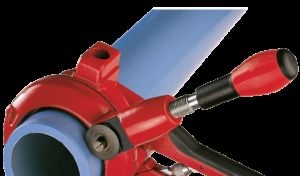
Special tools have been developed and manufactured for cutting plastic pipes. These tools ensure a perfectly perpendicular cut and prevent burrs on the edges. Pipes made of this material can be cut with a hacksaw, but this creates burrs that can damage the surface of the rubber seal during installation, creating conditions for future leaks. Therefore, the cut edge should be smoothed with sandpaper.
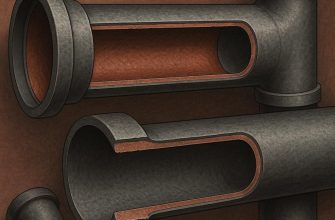
When using cast iron pipes for sewerage, they are generally not cut, but rather used whole. Firstly, cutting such pipes is quite difficult, and secondly, the quality of the cut does not ensure a tight seal.
 Pipe connections during installation are made in various ways:
- A socket connection is the simplest and most common method. The narrow end is inserted into the socket, which already has a rubber sealing ring. To ensure a tight seal, the joint is sealed with silicone sealant.
- For plastic products, adhesive or welding can be used.
- Fittings are used not only for joining but also for branching complex systems. Couplings, elbows, crosses, and other fittings are used. When using these fittings, connections with an inclination of 135 or 120 degrees, inclined toward the fluid flow, are required.
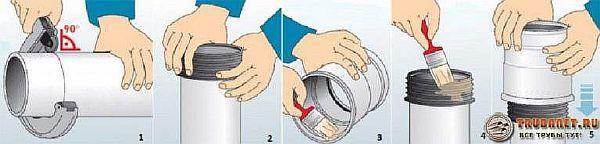
The outlet pipe is connected to a riser located in the corner of the building. It is made from a 100-110 mm diameter pipe and is routed through a corner to the outside. Please note that the outlet pipe must be installed below the frost line.
To route a pipe through the foundation, a hole must be made in it equal to the pipe's dimensions plus approximately 60-70 millimeters. After the pipe is installed, the hole is insulated with readily available rolled insulation materials.
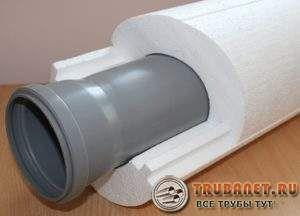
Before installation, the pipeline is insulated with a heating cable. A control system activates it at a specific temperature, close to freezing. A thermal insulation jacket made of synthetic porous materials is installed over it.
According to current regulations, the distance from a building to a septic tank must be at least 10 meters. However, there is a specific rule for bathhouses: the distance from the bathhouse to the nearest water intake must be at least 20 meters.
Watch the video
How to build a water seal yourself
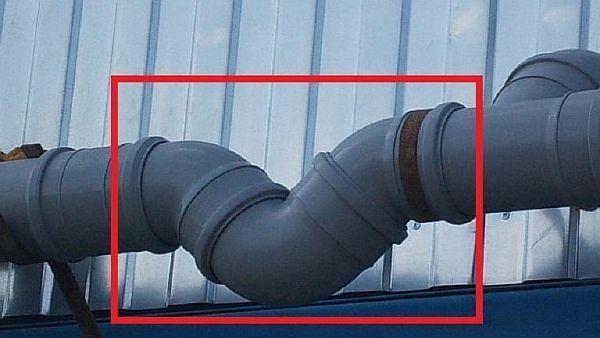
Among the many sewer pipe fittings, there's a device called a water trap. It's a curved U-shaped pipe that creates a water seal inside. This prevents unpleasant odors from the drain system from entering the living space.
Actually, every siphon has a water seal, but it's better to be on the safe side. This device in a sauna requires extra attention. Since this device is typically used once a week rather than daily, the water in the water seal can dry out.
As a result, foul odors permeate the room. Therefore, it is necessary to top up the water seal at least a couple of times a week.
External sewer installation - choosing a location for the septic tank
A bathhouse sewer system is installed in the same way as a residential one. If possible, it can be connected to the existing network, and if there's a local wastewater treatment system on the property, then to that.
First of all, the nature of the soil beneath the septic tank is important—clay, sand, or crushed stone. If the soil consists predominantly of clay, which has low permeability, filtration will not occur.
Watch the video
The filter well included in such a septic tank will only pollute the surrounding area, and it will have to be used as a simple cesspool.
If the aquifer reaches a depth of 2.5 meters during the period of maximum water level rise, a septic tank cannot be installed in such a place, as the thickness of the filter layer will not be sufficient.
Construction of a local wastewater treatment plant
The main components of such a device are the following:
 A storage septic tank is used to receive wastewater and initially process it using bacterial agents. Live cultures of anaerobic and aerobic bacteria are sold at specialized hardware stores.
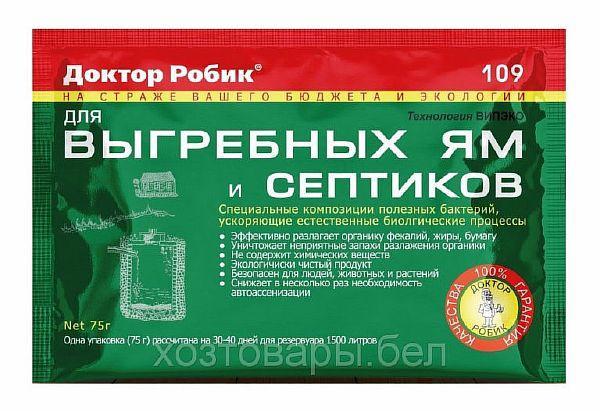
During the bacterial treatment process, the volume of the septic tank contents is noticeably reduced, and odor emission is significantly reduced.
The content is partially purified, since some of the content is in the form of solid fractions.
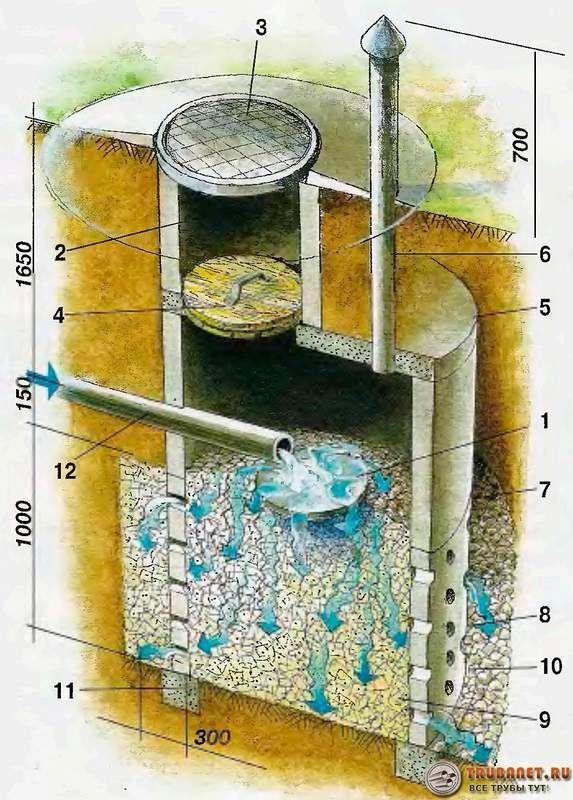
- In the next section of the septic tank, which is most often a filter well, additional wastewater treatment occurs through filtration as it passes through the soil. The filter layer consists of blast furnace slag, gravel, and broken brick, which is an excellent adsorbent.

- Another method of wastewater treatment is aeration. This is accomplished by blowing air through the septic tank's contents, which oxidizes previously undecomposed particles of waste.
- As a result, the water is further purified and becomes suitable for industrial purposes, such as watering the garden or washing a car. At the same time, the yield of garden crops increases significantly.
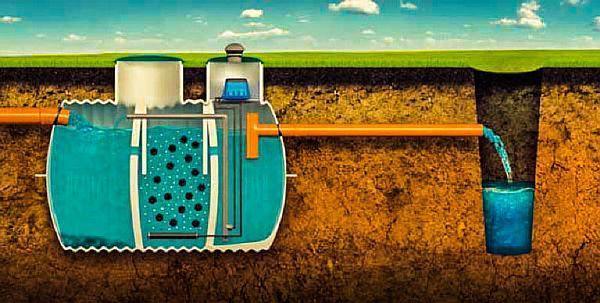
- Filter fields are used in areas where the underlying soil is clay. In this case, pre-treated water enters a drainage pipe system and is distributed drip-feed over a large area.
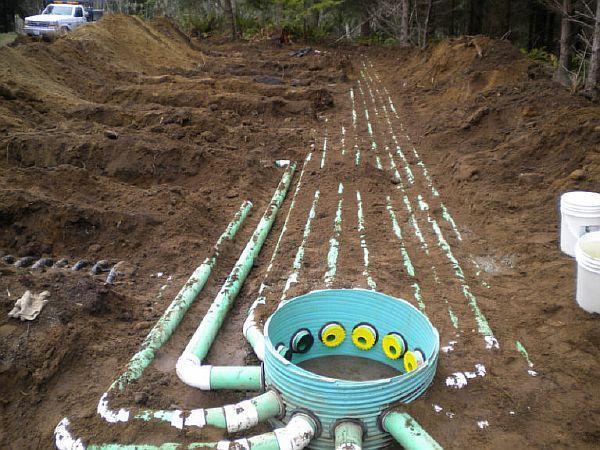
Preparing the trench and laying pipes
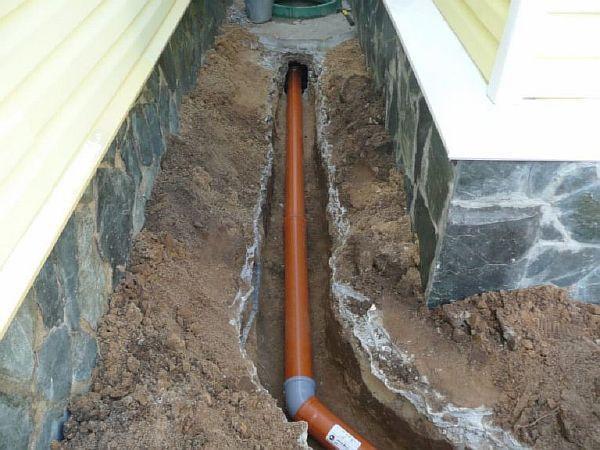 How to install outdoor sewer pipes yourself?
- They are laid in specially dug trenches. The depth of the trenches has always depended on the depth of ground freezing.
- However, today's pipe installation technologies make it possible to significantly reduce the amount of excavation work by installing heating on the pipes and insulating them, as mentioned above.
- The quality of the pipe liner at the bottom of the trench is of great importance. Since it is located in the freezing zone, it is crucial to prevent water from entering the pipe support liner. To achieve this, a drainage layer of gravel and sand is installed.
- The gravel is poured in a layer about 30 centimeters thick and compacted thoroughly. Then, a 15-20 centimeter layer of river sand is added and watered for better compaction.
- A construction cord is attached to the wall of the trench and stretched along it with a slope of 2-3 millimeters per meter of length.
- Then the pipeline itself is lowered into the trench and installed along the cord with slope control.
- After this, the pipe is carefully covered with sand, which is thoroughly compacted. Only then is the trench finally backfilled with the previously excavated soil and earth.
Which pipes to choose for sewerage
Today, this issue has been decisively resolved in favor of polyethylene products. This material is corrosion-resistant, lightweight, and easy to assemble.
Watch the video
An alternative can only be identified if there are unused materials of other types from previous construction.