Storm sewerage is a system for the organized collection and subsequent removal of melt water and precipitation from areas, as well as the disposal of conditionally clean water generated during wastewater treatment at local treatment facilities.
Country house owners are often bothered by water from melting snow and precipitation. The only effective protection against this problem is installing a storm drain system.
 We also suggest you to read with the installation of a storm drain in a multi-story building.
This is especially necessary if the underlying soil is hard, loamy and poorly permeable to liquid. On such substrates, water can persist for long periods, hindering farming and gardening.
To get rid of this phenomenon, It is necessary to create conditions for the forced removal of groundwater from the territory of a country houseFor this purpose, it is necessary to construct water collection devices.
- Drainage ditch
- Stormwater drainage in a private house – installation methods
- Installation of storm sewerage in a private house
- Combined drainage systems for a country house
- DIY storm drain system for a private home
- Designing a drainage system for a country house
- The depth of the underground part of the system
- Slope of underground communications
- Installation of a storm drain
Drainage ditch
One of the simplest and most affordable ways to drain water from a site is a drainage ditch. It's best to install one if the site slopes to one side.
It is dug to a depth below the ground freezing level. It is important to maintain a slope toward the water runoff along its entire length. The slope should be 3-5 centimeters per meter. This slope allows water to drain slowly, carrying away soil particles; otherwise, rapid siltation of the storm drain in a country house can occur. See also Rules for laying sewer pipelines in the ground.Storm drainage in a private house with your own hands
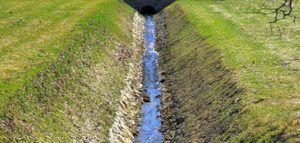 A layer of loose rock or crushed concrete is placed at the bottom of the ditch, approximately one-third of the way down. Then, add coarse gravel and sand, and cover the entire area with geotextile. This will prevent the drainage channel from quickly silting up. Ideally, the drainage ditch drains into a nearby stormwater catchment area.
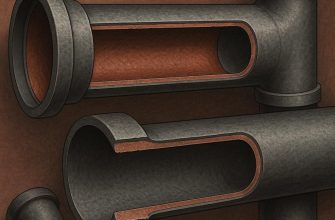
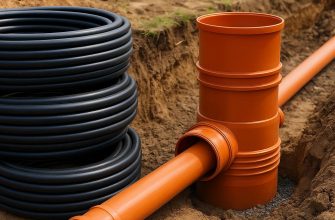
In modern conditions, pipes made of various materials—steel or plastic—are used for drainage. For greater strength, corrugated-wall pipes are used for the latter type of conductors. This design increases the radial strength of the product.
Stormwater drainage ditches on the site can also be open, which simplifies their operation.
They come in the following types:
- Perimeter - are torn off along the perimeter of the area that needs to be protected from excess moisture;
- main - this is essentially the main channel of the river, to which tributaries converge in the form of additional flows.
Stormwater drainage in a private house – installation methods
The purpose of a storm drain is to quickly remove rainwater and meltwater during periods of peak accumulation. The most common design is a surface storm drain around the house, consisting of open-topped gutters.
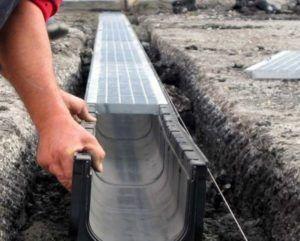 They can be cast concrete or constructed from prefabricated parts. Cast iron channels are used for long-lasting service. However, plastic channels are the most popular material for storm drains in country houses. They are lightweight, durable, and easy to install.
The trays are covered with grates on top to prevent the drainage channels from becoming clogged with leaves and other debris.
But this method isn't always effective. In some cases, it's desirable to preserve the soil layer by embedding drainage elements to a depth of about 40 centimeters. To do this, dig a trench about half a meter deep and cover it with geotextile.
As a base for the bottom of a ditch gravel is poured, then the pipe is laid. Gravel is poured on top of it again. And here's where one important point needs to be checked.
The point is that perforated pipes are used for subsurface and deep drainage, and holes are drilled into their walls. The diameter of these holes should be smaller than the particle size of the gravel. This ensures that the internal drainage passage is always clear.

In the classic version, the corrugated pipe is filled with gravel and wrapped in geotextile, overlapping the edges. The trench is then backfilled with previously excavated soil and the sod layer is restored.
Installation of storm sewerage in a private house
Above, we discussed methods for installing storm sewers on a suburban property by collecting surface water into a pipe. But this isn't enough; it needs to be removed from the property.
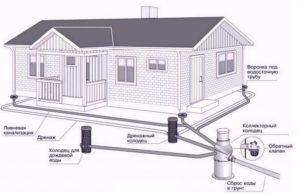
To achieve this, individual pipes are combined into a system, with a drain installed at the bottom. The drainage and storm sewer system on the site can be organized as follows:
- First of all, it is necessary to organize a storm drain on the roof, providing drainage channels through which water flows down and ends up in the drain receiver.
- Liquid enters the drainage cavities through traps with a reliable grate-type cover.
- Then it flows through pipes (diameter 100 or 150 millimeters) into a storm water inlet well.
- As the water accumulates, it enters a drain pipe, which is then discharged into a special water tank or simply off-site. Storing rainwater in an underground tank is used in areas where water resources are limited. It can then be reused for other household needs, such as watering a garden plot, washing a car, and other household uses.
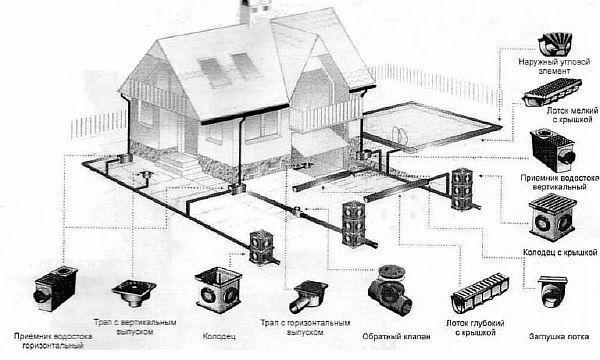
This applies to the disposal of rainwater or meltwater diverted from the house. However, it is often necessary to simultaneously drain the area, which is typical in areas prone to excessive flooding.
The drainage and storm sewer system on the site is a water supply network, the main feature of which is the presence of slopes that ensure the free flow of liquids. Mandatory design elements:
- Perforated drainage pipesDepending on the total length of the water supply system, products from 100 to 150 millimeters are used, as well as any types of fittings that facilitate installation of the drainage system.
- Inspection wells These are installed at points where the drain changes direction. They are designed to monitor the condition of pipes and clear blockages. This is done using a hose with a nozzle and pressurized water. The obstruction is washed away, restoring the free flow of water. These manholes, also known as inspection manholes, are equipped with metal or plastic covers protruding above the ground. They are used for preventative cleaning of storm drains in country houses.
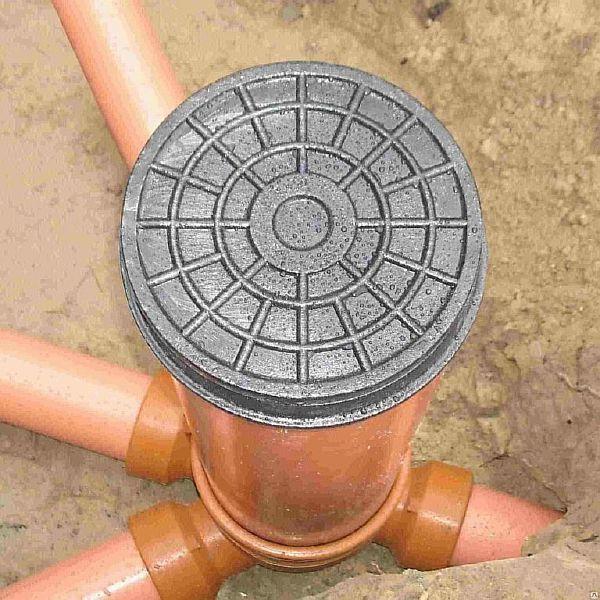
- Collector wells – are designed for servicing the system. Their diameter must allow for penetration. The device is slightly deeper than inspection wells, allowing water to settle. Therefore, it is necessary to periodically clean the well of sediment using a sludge pump.
- Filtration wells can also be used., designed to separate debris from storm drains. They are installed at intermediate points in a country house's complex storm sewer system.
Wall drainage systems, designed to divert groundwater away from foundations in heavily waterlogged areas, stand apart. The depth of such a system should always be greater than the depth of the foundation.
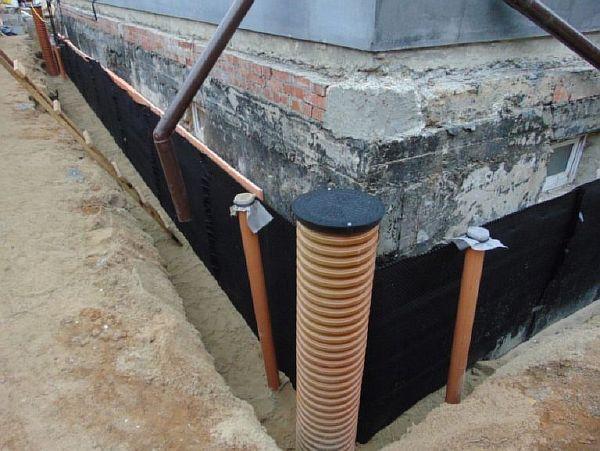
When constructing such a water collection system, the foundation itself is first insulated and waterproofed. Various materials are used for this:
- Roofing felt and bitumen mastic for waterproofing.
- Foam plastic for insulation.
Next, geotextile is laid along the bottom of the trench, with the edges folded upward. Gravel of the appropriate grade is then poured, and the appropriate slopes are created. Another layer of gravel is poured over the pipes, covered with geotextile, overlapping the edges.
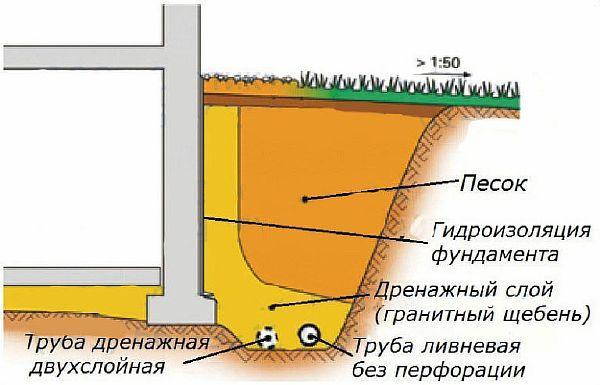
If a country house is built on a site with abundant groundwater, basement drainage is necessary. It is installed before pouring the foundation. Catch basins are installed horizontally and connected to the perimeter storm drain.
Combined drainage systems for a country house
Logically, it's inefficient to construct branches from different system branches for each circuit. Therefore, the branches are installed as common ones, into a single manifold.
- surface, for storm drainage systems around a country house;
- shallow drainage system contours under the surface of the site at a depth of up to half a meter;
- deep drainage for removing groundwater in heavily waterlogged areas of a country house.
Any of the listed types can be combined into a common system with a common storage tank.
It is not recommended to include fecal wastewater in the general sewer system. This makes reuse of the collected water impossible.
DIY storm drain system for a private home
Before purchasing materials for a drainage system, you should ensure its necessity. It's important to determine the groundwater level during peak periods.
This can be done in the spring, immediately after the snow melts, or during the autumn rains. To determine this, exploratory drilling is performed to a depth of three or four meters.
An important indicator is the water level in the water intakes closest to the site – wells or boreholes.
Having determined the need for a drainage system, it is advisable to carry out a geographic survey of the site to determine the slopes on it, and therefore the direction of the flow.
This is especially true for shallow and deep contours. Surface-mounted gutter systems for a country house can be installed using a spirit level.
Designing a drainage system for a country house
This is the most important stage of creating a drainage system for a site. It allows for a reliable calculation of the amount and composition of material costs for purchasing the components:
- Types, quantities and sizes of drainage pipes.
- The need for connecting parts – fittings.
- Types of drainage channels according to their depth.
- Number and type of trays for surface storm drainage.
- Capacity of the storage tank.
- Dimensions of pipes for the production of inspection and drainage channels.
- Calculate the need for building materials, including the quantity and fraction of gravel, and the footage of geotextile fabric.
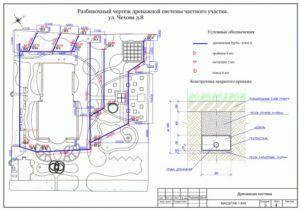
If you're developing a simple draft design for a country house's drainage system yourself, you should show it to a specialist in this area of civil engineering design. If necessary, make the appropriate changes before proceeding with the procurement of the necessary materials.
The depth of the underground part of the system
The closer the drainage pipe is to the surface, the more effectively it absorbs the moisture accumulated on the surface. The depth of the pipe can be as deep as 15 centimeters.
However, if the pipe is located in a cultivated area, the excavation depth, which can be up to 30 centimeters, must be taken into account. Shallow gutters, located at these depths, thaw fairly quickly and drain water away from the area, preventing significant accumulations.
Slope of underground communications
This indicator deserves close attention. The fact is that if the slope exceeds the standard of 3 millimeters per meter of pipeline, the nature of the runoff changes. The water in the storm drain can hardly be considered clean.
We suggest you take advantage of it Use our online calculator to calculate the slope of a gravity sewer system..
Due to excessive drainage velocity, contaminants are unable to fully drain with the liquid and are partially retained in the pipe. Gradually, the amount of sediment increases, leading to clogging.
It is possible to remove such a dense layer from the storm drain of a country house only with a jet of water under pressure.
The most dangerous phenomenon is a negative slope, as a result of which drainage can occur very slowly, and water will constantly be present in the system.
The foundation for installing the drainage system is a gravel bedding. Its placement requires special attention. Accurate measurements during drainage installation can be taken using a laser or extended construction level.
The minimum slope for a storm drain is 0.3-0.5 centimeters per meter of pipeline, the maximum is no more than 4-5.
Installation of a storm drain
The decisive factor in evaluating the selected storm drain is the volume of liquid it can handle during peak precipitation. Therefore, the determining factor in this case is the amount of precipitation in a specific area. Special maps have been developed for this purpose.

Rapid removal of water through a storm drain in a country house not only allows for free movement around the property but also protects the foundation from the destructive effects of moisture.
Water flows into the storm drain from the building's roof gutter. For effective operation, the stream must be directed precisely into the center of the receiving funnel.
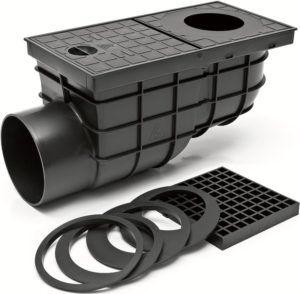 When installing these devices, it is necessary to meet a number of requirements to ensure long-term operation of these devices:
- At the installation site, a hole is dug that corresponds to the size of the device. Its depth should be approximately 30-40 centimeters greater than the vertical dimension of the device.
- Place a gravel backfill on the base, pour water over the layer and compact it thoroughly, leaving a gap of 5-6 centimeters between the body and the backfill for concreting.
- The distance between the side walls of the recess and the body should be at least 3-4 centimeters.
- Connect the water intake pipes to the storm drain and install it in its permanent location. Adjust its height so that the grate is level with the pavement around the house.
- Concrete the storm drain body, install an internal partition and a filter insert, if provided for by the design.
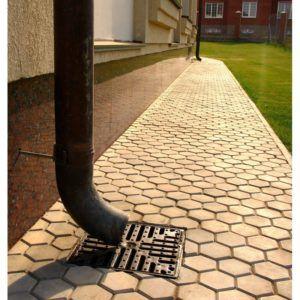 A storm drain in a private home is installed at the final stage of its installation for the entire site and is connected either to a storage tank or to a discharge device into the city sewer system or outside the site.
When embarking on such a crucial task as installing a storm drain system in a country house, it is necessary to carefully study all regulations and rules and select the right materials for installation.