A septic tank with high groundwater levels should be securely sealed (optimum wall thickness is 15-20 mm) and have a high purification rate of 95-98%. The best option is one equipped with stiffeners, a drainage pump, and an alarm.
Installing a septic tank with high groundwater levels is a rather complex, but possible, procedure. Before beginning construction, it's important to determine the exact groundwater level. This can be accomplished using both professional and home-made methods.
Based on this parameter and the required capacity, septic tank models should be selected. Prefabricated, factory-made units are best.
They are more expensive, but have the advantage of a longer service life and requiring less effort during installation.
- How to accurately determine the groundwater level
- Problems arising from high levels
- Top 10 Septic Tank Manufacturers for High Water Levels
- Choosing a location for a septic tank
- Which septic tank should I choose for my property?
- Material of manufacture
- Installation Features
- Protecting a septic tank from ground heaving and rising
- Water leaks when digging – how to solve the problem
- Tips and recommendations
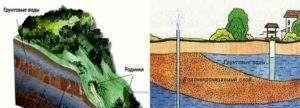
How to accurately determine the groundwater level
There are several ways to determine groundwater levels. The most effective and simple is to contact a specialized organization that conducts geological assessments.
As a result, the site owner will receive a detailed water level report, which can be used to plan subsequent construction work. However, this is a fairly expensive procedure, so it's not suitable for everyone. There are other methods for independently determining the water level. These include:
- by means of a drilling rig;
- by flora;
- by nearby water sources;
- old folk method;
- according to signs.
The first method requires a garden auger and a rod longer than 2 meters. Mark the rod at 10-centimeter intervals for a tape measure. Then, dig a hole to the maximum length of the auger.
Sometimes water appears immediately during drilling, but most often it takes a day for it to appear. The rod is lowered the entire length of the borehole, then withdrawn and the water level checked.

This procedure should be repeated several more times, recording the resulting readings. If the results differ, the lowest reading should be used. For an objective check, it is advisable to perform the procedure in the fall or early spring, when the groundwater depth is at its lowest.
The level can also be determined by the vegetation that grows in the area without additional irrigation. The image below shows the most common plants.
Free-growing sorrel and currant bushes can also indicate the proximity of water. The slope of birch, maple, and willow trees can be used to determine the minimum groundwater depth.

Quite often, nearby water sources are found: wells (even small ones dug for irrigation), ponds, etc. Their depth can also be used to draw the necessary conclusions. The presence of marshy bodies of water also indicates a high groundwater level.
You can always find out about water from the owners of neighboring plots, it is quite possible that they carried out expert assessments during the construction of houses, the construction of septic tanks or connections to the central sewer system.
There's also a folk method: remove the top layer of soil from a small area, place some defatted wool on top, and then place a fresh egg on top. Then cover the mixture with a ceramic dish and leave it undisturbed overnight.
Then they remove it and check the items. If the wool is slightly damp and there are no drops on the egg, the level is low. If there are drops on the egg, the level is high. However, this method will not give an exact reading.
High soil moisture may be indicated by an abundance of midges, mosquitoes, and other insects; a minimal number of rodents and anthills; a preference for such places by cats; and the presence of fog and dew in the morning, even in hot weather.
Problems arising from high levels
With such a feature, the owner of the site will face difficulties:
- The difficulty of installing a septic tank with a high groundwater level. Despite frequent assurances from sellers, this procedure will require a significant amount of time and resources;
- It is necessary to immediately design a septic tank with drainage, otherwise the adjacent area will turn into a swamp;
- the possibility that the sewer system will be completely flooded, as new water is continuously supplied;
- Care must be taken when installing the foundation and securing the septic tank with cables or straps. Failure to do so will result in the septic tank rising due to high groundwater levels, causing waste to spill onto the property and compromising the integrity of the system.
- Special materials will be required to construct the sewer system and ensure its tightness. For example, using concrete rings may allow liquid to seep through the walls;
- If wastewater enters groundwater, it will spread quickly across the area. As a result, well water will become unusable, and nearby bodies of water will begin to bloom. Because a large number of bacteria live in the septic tank to accelerate the breakdown of waste, if it enters human food or water, it can cause digestive problems, as well as various infections and diseases.
- When a septic tank overflows, wastewater can back up, causing pipes to burst. Fine sand and other particles can pass through the wastewater, potentially damaging the pipework and plumbing fixtures, requiring repair or replacement of appliances in the home.
Top 10 Septic Tank Manufacturers for High Water Levels
Based on customer reviews, we've identified the top manufacturers of autonomous sewer systems for high groundwater levels:
- The "Tank" septic tank is designed to prevent floating. It is designed for large volumes of liquid and handles temperature fluctuations well. These models are made of plastic, require no external power source, and have 17-millimeter-thick walls.
- "Leader." 6-chamber septic tanks with aeration and airlift. No additional bioactive agents are required.
- "Bars." Models are available with and without power. These 3-chamber septic tanks feature two levels of wastewater filtration. They are durable and designed for long-term operation.
- "Yubas." The main difference between these models is that they can be used intermittently for up to three months without any loss of performance. Ideal for country homes.
- Ecopan. Considered the best septic tank for installation in areas with high groundwater levels. These models can withstand heavy loads without losing functionality.
- "Tver." They require an additional power source and regular maintenance, but have a large capacity and handle large volumes well.
- Triton. Septic tanks must be anchored using nylon ropes or chains. They have a long service life.
- Topas. These stand-alone models are known for their high reliability and durability. They are made from modern, high-quality materials with increased wear resistance. In this article, you can learn more about them. Learn more about the operating principle of the Topas septic tank.
- Unilos. Filtration and drainage of wastewater in septic tanks is carried out in several stages. These models require little maintenance and are completely environmentally friendly.
- "Topol." They are resistant to temperature fluctuations and external pressure. Septic tanks are equipped with aeration, compressors, and airlifts. Wastewater can be removed manually or using specialized sewage disposal equipment.
Choosing a location for a septic tank
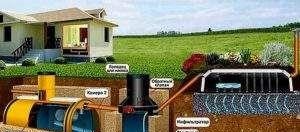
To determine the optimal location for a septic tank, it's important to review current regulations and standards. There are several conditions that must be taken into account:
- The septic tank must be located at least 5 meters away from the house or any building (See more details about the distance of the septic tank to other objects);
- the road zone should be located at a distance of 5 meters;
- The sewerage system and aeration station must be located at a distance of 30 meters from an open body of water or reservoir and 50 meters from a well with drinking water.
Which septic tank should I choose for my property?
Choosing the right model depends primarily on the required volume. Typically, a rough estimate is based on the daily water volume of the house, multiplied by three. Most often, pre-fabricated septic tanks are used for construction in suburban areas, or they are assembled directly during installation, ensuring the watertight seal is ensured independently.
Sometimes owners decide to install a surface sewer system that doesn't rely on groundwater. However, this solution presents certain challenges, as it requires numerous pumps and requires a significant amount of space on the property.
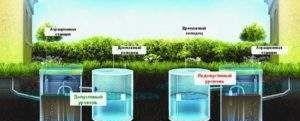
For elevated groundwater levels, it's recommended to opt for prefabricated, pump-less, full-cycle purification systems. These systems consist of multiple chambers that filter and drain wastewater.
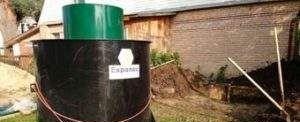 In one section of the septic tank, biological waste is processed, producing sludge and clean water. The sludge should be removed approximately every few years to prevent silting of the bottom and walls. The removed processed residue, approximately 98% purified, can be used as fertilizer.
Another advantage of this system is the complete sealing of the structure, eliminating the need for waterproofing. This allows the structure to be installed even in areas with high groundwater levels.
The following requirements can be identified for a septic tank installed at a high groundwater level:
- Tightness, i.e., the absence of cracks and joints. Drainage should not escape beyond the structure, and groundwater should not penetrate. For this reason, concrete rings or brick are not recommended as a material, as it is impossible to ensure 100% waterproofing.
- Increased strength. The outer walls will be subject to significant pressure, so the use of reinforced material is required.
- Securely secure the structure using cables, chains, or other means. This is necessary to prevent the structure from floating.
- A drainage system is required. After filtration, the wastewater should be directed to a designated field on the embankment.
Material of manufacture
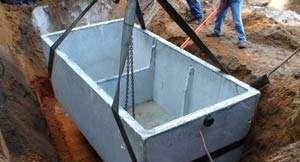 The properties of the structure depend largely on this. The main materials used are:
- Plastic isn't the most durable or reliable material, but it can be used to build a stand-alone sewer system yourself. Its advantages include watertightness and light weight, while its disadvantages include an increased risk of damage and the need for anchoring and floatation prevention.
- Fiberglass is considered an improved version of the previous option. It is characterized by reliability, strength, resistance to chemical compounds, and the ability to withstand increased loads. However, additional reinforcement remains necessary.
- Reinforced concrete is the most reliable and durable material. Such structures can function effectively for decades. A reinforced concrete septic tank is completely sealed, impermeable to liquids, does not float, and is resistant to the negative effects of chemicals. This type of system is best installed in a home with at least three residents. The only drawback is its heavy weight, which requires specialized equipment for its construction.
The best recommendation for selecting a septic tank for high groundwater levels is to install a reinforced concrete structure. They withstand high pressure well, are designed for long-term use, and are easily repaired.
Installation Features
- If the installation depth is less than 1 meter, it is essential to mount the structure on a solid concrete foundation or a prefabricated slab. It is recommended to securely anchor it to prevent movement due to strong groundwater pressure.
- If the depth is greater than a meter, then it is sufficient to create a layer of sand and crushed stone 30 cm wide. The pipeline is also laid on it to protect it from deformation due to heaving of the soil;
- When digging a pit, remember to leave a small gap between the container and the pit to prevent the soil from heaving in late fall and winter. This gap is then filled with a special mixture.
- If plastic or other similar lightweight materials are used, additional anchoring will be required to prevent the structure from floating. This is accomplished by installing metal fasteners, special lashing straps, or cables.
- The ventilation pipes of the sewer system must come to the surface and be located approximately 60 cm above the ground;
- It is essential to think about drainage; most often, a special filtration field is created or waste is discharged into a drainage ditch.
Protecting a septic tank from ground heaving and rising
Although plastic septic tanks are sealed, they require additional support. This procedure isn't particularly difficult, but it's recommended to follow the instructions carefully.
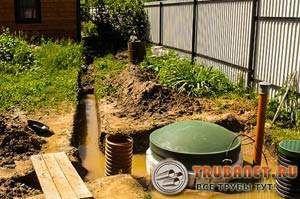 Stages of technology:
- The bottom of the pit should be leveled, then a 30-centimeter layer of sand should be placed on top, which should be well compacted.
- Install the foundation - a reinforced concrete slab, its length and width are the same as the structure.
- Install a septic tank on the slab if the groundwater level is high and attach the fastening cables.
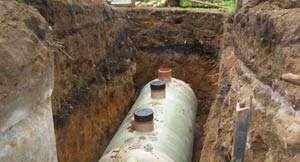
Another potential problem is soil heaving. This process involves the expansion of soil volume due to freezing, when water in the ground turns into ice. The higher the groundwater level, the more pronounced this phenomenon becomes.
To prevent the negative effects of heaving, use a mixture of sand (5) and cement (1). When constructing a septic tank with high groundwater levels, leave a small space (approximately 15-25 cm) between the two walls. Fill the resulting "pocket" with a mixture diluted with water, layer by layer, and compact it.
When backfilling, add water at the same time, ensuring both levels are equal. This will protect the septic tank from cracks and other damage.
Water leaks when digging – how to solve the problem
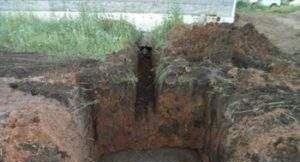 Sometimes the groundwater level is so high that water leaks even when a well is dug for testing. In such cases, the simplest solution is to postpone installation until the time of year when the depth is greatest—that is, during the hot summer.
However, sometimes it's impossible to postpone construction for various reasons, so the problem must be addressed immediately. To do this, the incoming liquid is usually scooped out while the pit is being dug.
Typically, sewer equipment is used for this purpose. A regular hose with a mechanical pump can also be used, but it must be large in diameter to remove water containing small stones, sand, and other debris.
To simplify pumping, it's recommended to first dig a trench at the lowest point, then proceed to excavating the rest of the area. This will ensure that all the water collects in one place, making it easy to pump out.
Tips and recommendations
To ensure stable and efficient operation of a septic tank in a summer house or private home with high groundwater levels, follow these tips:
- Large waste and durable debris must not be discharged into the autonomous sewer system;
- the entire system must be properly insulated and waterproofed;
- If there is no drainage, then you will need to pump out the waste liquids manually using a sewage pump or with the help of a sewage disposal service;
- It's advisable to install grease traps on plumbing fixtures (especially in the kitchen) to prevent grease from entering the septic tank. The buildup of a grease layer and sludge on the walls and bottom is the main reason the tank fills up quickly;
- If a biological treatment stage is present, the use of strong chemicals to clean plumbing fixtures is prohibited. Also, avoid introducing alkalis, acids, or alcohol into the septic tank by other means, as they can destroy the beneficial microorganisms that process waste.
Before you start installation, It is necessary to know the exact depth of groundwater levels, this can be done using a drilling rig or in another way.
A high-quality septic tank with a high level can operate without problems for many decades.