Any major construction project begins with a project plan. This allows for the layout and placement of all utilities necessary for comfortable living in the space, even at the diagram and blueprint level.
The main ones, along with gas supply, heating and garbage disposal, are cold and hot water supply with sewerage and drains.
To facilitate planning and reading of design documentation during construction, GOST developed, approved, and regulated in SNiP the symbols for all systems installed at construction sites, as well as the sanitary requirements for each of them.
They also include detailed symbols of the units required to supply water to the house, filter it, and remove it as sewage waste.
For example, the K2 sewer system is a system for draining melting snow and precipitation. The storm drain consists of the following components: a gutter pipe, a sand trap, a leaf catcher grate, a funnel, connectors, and fasteners.
- Conventional symbols on diagrams
- Features of drawing up diagrams and drawings
- Conventional symbols on drawings for water supply systems
- Sewerage: design features
- Installation of storm water drainage system
- Conventional symbols for internal sewerage
- Graphic symbols on external sewerage drawings
- Summary of the article
Conventional symbols on diagrams
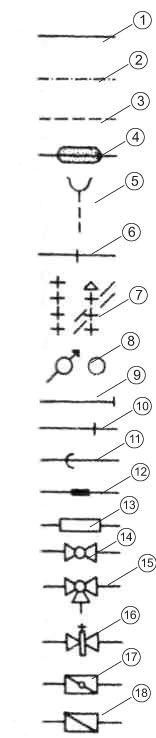
This table shows all the accepted design conventions for water supply and sewerage communications used in construction:
 |
|
 |
|
 |
|
 |
|
 |
|
Water supply and sewerage symbols are uniform throughout the Russian Federation and the CIS countries. Changing them at will is prohibited. The reason is simple: any trained plumber should be able to understand the plumbing design. This will help avoid errors in work procedures and, ultimately, ensure the most efficient use of the facility's water supply.
Conventional symbols on drawings and diagrams for plumbing installation should be indicated during the construction of any building, be it a multi-story building, a cottage, or any industrial building. They are also used in computer programs, such as AutoCAD, used in the creation of water supply and sewerage projects for facilities.
Features of drawing up diagrams and drawings
Plumbing symbols for various components are used in both facility diagrams and drawings. Both types of graphic representation of utilities essentially serve the same purpose: creating a working design, which serves as the primary document for construction work.
A diagram is a concept, the beginning of everything, most often based on a specific technical task. It can be created on any medium, including a simple notebook. All elements of the upcoming design can be recorded here very loosely, with only the assembly units and their communication links on the site indicated. For example, like this:
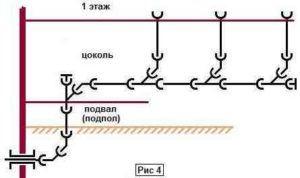 However, more informative are diagrams that show the projection of the constructed communications and the symbols for all proposed nodes. Depending on the need, two types of projections are used in diagrams: two-dimensional and three-dimensional (isometric).
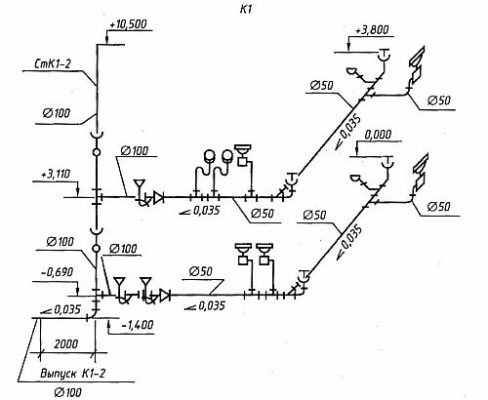
Two-dimensional (axonometric) diagrams allow you to represent an object in two planes: along length and height or along length and width:
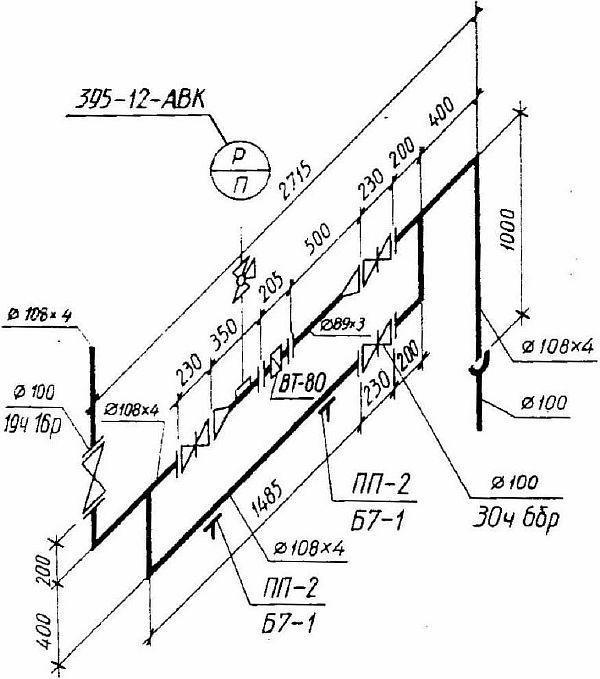
Isometric projection More informative. It allows you to immediately estimate the working area by length, width, and height:
A 3D computer image is even more visual for the designer. It makes it much easier to maintain scale and dimensions.
Having all dimensions in all three planes, drawn to a given scale, transforms a detailed and carefully executed diagram into a drawing. All drawings in construction projects are produced on paper. This makes them more convenient for use on-site. On large construction sites equipped with computers, the information is duplicated on dedicated websites with the ability to view each drawing section in 3D.
The project's main objective is to create a plan that takes into account all the details of the cold and hot water supply to the facility and its subsequent sewerage.
 The specifications of the proposed drawings are also important, particularly information about the wells present at the construction site and the topography of the area. Furthermore, the project must include all certified materials required for the work.
All symbols on the drawings must comply with GOST standards. Otherwise, it will be impossible to carry out installation work accurately. It is also necessary to take into account the requirements of the SPDS (design documentation system for construction) for the development and maintenance of documentation for the installation of plumbing fixtures at construction sites. Only in this way can one be sure that the home's water supply and sewerage systems will operate efficiently and safely.
Conventional symbols on drawings for water supply systems
Before developing a water supply project for any building, and in particular for a country house, the entire group of factors that may affect the functioning of the water supply system is identified.
These factors primarily include the presence or absence of a centralized water supply network near the construction site and whether it could cause pressure drops. If there is no network, a local water supply system with a storage tank is designed.
The process of creating a project goes through several stages:
- Based on the total number of water consumption points in the house and on the site, the maximum load on the water supply system is calculated.
- Methods are being developed to compensate for water supply when pressure in the central or local network drops.
- A drawing is being made.
- The equipment is selected according to the chosen scheme.
To correctly place plumbing symbols on the design drawings, the designer must understand the components of the water supply system. The number of plumbing components and the materials used for plumbing fixtures may vary in cost and quality, but this doesn't change anything fundamentally.
The conventional symbols for pipeline diagrams and the corresponding plumbing system components in all cases remain approximately as follows:
- well (or other source);
- pump;
- storage tank with a tee;
- two drain pipes: one for domestic water supply, the other for technical water supply (garden, vegetable garden);
- home water filtration system with tee;
- two drain pipes: one for cold water, the other for hot water.
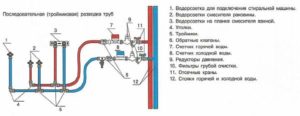
Conventional graphic symbols for pipelines are intended to show the hot and cold water piping system.
Cold water From the filtration system's tee, it flows into a manifold installed in the house. From there, it is distributed through pipes to the existing plumbing points.
Hot water is fed to the heater and then distributed to the points in the same manner. This diagram clearly demonstrates this:
Sewerage: design features
The sewerage system in any home or business is divided into indoor and outdoor modules. The former covers treatment inside the building, while the latter provides external sewerage around the home.
The indoor sewer module consists of a network of pipes connected into a single system. This module has only one outlet from the house, connected to the outdoor module via a check valve, which prevents the system from overflowing if the outdoor tanks overflow.
An external sewer system typically consists of a cesspool with a septic tank, into which all internal and external wastewater from external sewer connections is discharged, including a storm drain, if there is one on the site.
Installation of storm water drainage system
Stormwater drainage in a multi-story building – its design is examinedWhat types are there, who provides maintenance, and installation features
During the design process, a number of calculations are performed. The main ones are:
- determining the location of plumbing fixtures inside the premises and methods of connecting them to the sewerage system;
- Selecting drainage methods (forced or self-draining). In the case of self-draining drainage, the slope of the pipes and their markings are calculated.
In addition, the project takes into account:
- Environmental requirements for the area adjacent to the house: a cesspool with a septic tank cannot be located near wells with drinking water;
- A method of sewage disposal. It can be either autonomous, with disposal through a cesspool, or centralized, with waste removal through a nearby community sewer system.
Conventional symbols for internal sewerage
An indoor sewer system is designed to drain wastewater from all plumbing fixtures within a building. Water generated by the activities of its inhabitants generally moves naturally through pipes installed at a certain slope. In rare cases, forced movement is required.
To prevent unpleasant odors, each plumbing fixture is designed with a water-tight trap. The end of the pipe connecting all the outlets is routed through the wall to the outside of the building.
The designation of the sewerage system must take into account both internal and external sewerage networks.
Internal sewerage includes signs indicating:
- branches from all sanitary facilities located in the premises;
- risers that allow wastewater to be pumped from the upper floors to the lower floors;
- collectors that collect wastewater from various sources;
- exhaust systems;
- treatment plants;
- ventilation pipelines;
- cleaning pipes;
- hydraulic seals that prevent unpleasant odors from entering from the sewer system;
- sewer plugs.
In this case, the sewer plug must be marked. If there are multiple plugs, the location of each must be indicated on the drawing.
The internal sewerage system in residential buildings is designed using isometric pipelines with symbolic representations, primarily as a system for household waste. It also includes drainage systems connected to storm drains or special gutters around the building's perimeter. A special siphon is installed where wastewater exits the house.
If you decide Make a storm drain in your private home yourself, we offer step-by-step instructions with a video tutorial, diagrams, and projects.
The conventional designation in the axonometry of the sewer system includes elements that are the source of sewage waste:
- equipment for sanitary facilities (baths, sinks, toilets, bidets);
- dishwashers and washing machines;
- Industrial equipment with wastewater systems.
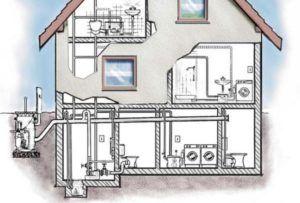 The flushing devices are connected to the water supply. Wastewater is directed into the external sewer system through traps, which also serve as hydraulic seals—U-shaped pipes filled with water. Each trap is connected to a pipe with inspection holes in case of a blockage.
The drawing also shows the sewer drain inlets and their fittings, which are used to divert wastewater to cast iron or plastic risers—tees, elbows, and crosses. The drawing also shows an attic outlet for the riser pipe, which connects to the roof and prevents the building from becoming contaminated with unpleasant odors.
Graphic symbols on external sewerage drawings
Outdoor sewerage systems cover water treatment and drainage outside the home. They can be combined, semi-separate, or separate. Combined sewerage systems are designed to collect all types of wastewater in a collector and then direct it to a treatment network.
Semi-separative sewerage is designed to drain all rainwater without separating it into contaminated and clean parts.
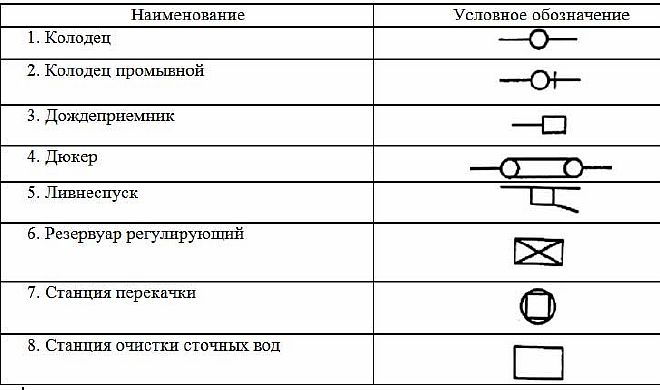
Conventional sewerage symbols on the drawings of the separation system include storm and domestic networks.
Storm drains collect rainwater or industrial wastewater and discharge it into a sewer well or reservoir without prior treatment.
The sewer network, designed for domestic needs, passes atmospheric precipitation or industrial wastewater through a special filtration system.
- devices for receiving wastewater;
- pipes for water drainage;
- external sewer riser;
- exhaust ventilation pipe;
- hydraulic shutter;
- outlet;
- yard sewerage network;
- sewer well with cover;
- drainage funnel;
- internal sewer riser.
Each of these elements has a specific function in the system of receiving, transmitting and cleaning sewage and storm water, and therefore must be installed both in the house and on the adjacent site.
Summary of the article
The importance of symbols in construction design practice is difficult to overestimate. During the study process, a large amount of information is processed, not only concerning the equipment being installed on site. It's important to create a drawing that is understandable to those directly performing the work: it must be easy to read.
This is precisely what symbols are for. They can be alphabetic or numeric, but the most visually appealing is the graphical, symbolic version.
Pictograms used by the project manager allow the contractor reading the drawing to easily identify which element of the system being created should be installed where. This significantly simplifies the process of installing the water supply and sewerage systems on-site.
A great advantage of symbols is that they can be used to indicate on a drawing, in accordance with GOST, not only plumbing communications, but also the plumbing itself: sink, faucets, bathtub, shower, toilet.