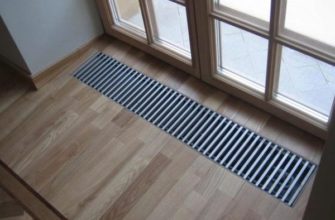
A built-in floor radiator is a heating device with a unique yet simple design, concealing its structure from view, with only the grille visible.
This installation method solves several problems at once:
- hides batteries, thereby saving space;
- heats the room effectively;
- prevents condensation from forming (which may occur in rare cases);
- helps reduce heating costs.
Usually installed in tandem with panoramic windows.
- What are underfloor heating radiators?
- Where can the design be applied?
- In the apartment
- In a private house
- Design features and operating principle of built-in convectors
- Types of heaters
- Electric
- Water
- Advantages and disadvantages
- How to select correctly - the main criteria
- How to install?
- Where are underfloor radiators installed?
- Built-in radiators or underfloor heating – which is better?
What are underfloor heating radiators?
An in-floor heating radiator, or simply an in-floor radiator, is an invisible radiator of the convection type. It resembles a tub-like enclosure with a heat exchanger, which is installed into the concrete floor screed during interior construction.
Corrugated tubes made of anti-corrosion material are used to install the device into the floor covering. The radiator's key feature is that the fins and the circuit are tightly connected, with no gaps between them.
The design may be with or without a housing. This component does not affect the installation process.
Radiator sizes range from 90 cm to 3 m, giving you plenty of choice. You can choose a model that's tailored to your room's dimensions, ensuring it will adequately heat the surrounding space without negatively impacting the interior or taking up unnecessary space.
Where can the design be applied?
Previously, underfloor heating radiators were installed in high-traffic areas. For example:
- museums, galleries;
- offices;
- warehouses and nurseries;
- commercial buildings of impressive area.
These types of heating devices are now being used in residential buildings. This is because they circulate air more efficiently, reducing heating costs and maintaining the desired temperature for comfortable living.
If you've decided to install an in-floor heating system in your apartment, it's important to remember that such a system wasn't included in the apartment building's design. Therefore, any changes to the heating system are considered a redevelopment, which requires approval.
Specifically, the apartment owner must contact the cadastral authorities to obtain permission to install the innovative radiator.
The scheme is as follows (in order):
- Drawing up a redevelopment project (can be done by a cadastral engineer);
- Review of the plan by members of the interdepartmental commission;
- Obtaining permission;
- Carrying out work on installing an in-floor radiator;
- Acceptance of equipment into operation.
In the apartment
In an apartment building, it is prohibited to install any type of radiator. Only those with an operating pressure of at least 16 atm are suitable (pressure testing 25 atm).
In this case, the heating is central, so it is important that the heating device can withstand water hammer, pressure surges that cannot be predicted, and different water temperatures.
In a private house
Private homes are considered the optimal choice for in-floor radiators. The heating is localized, meaning there's no risk of flooding the neighbors below, and the pressure is low.
You can choose any model. The first thing to pay attention to in this case is corrosion resistance. The batteries and components should be neutral to the antifreeze added to the system.
It is recommended to give preference to batteries with an operating pressure of 10 atm (16 atm pressure test).
Design features and operating principle of built-in convectors
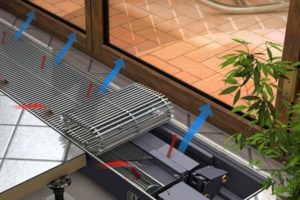
In-floor heating systems are called convectors for a reason—it's precisely this process (convection) that heats the room. The radiator operates by moving cold air downwards under the floor covering, heating it up, and then returning upwards.
Improved models with a built-in fan are available on the market. These units are more efficient and heat the air in the room more quickly. This process involves mixing cold and warm air currents.
The ventilation system can be switched off. Modern radiators have become even better—they now feature noise-absorbing elements, meaning the fan doesn't irritate your ears.
A radiator is a heating element, the material for its production can be:
- stainless steel – for rooms with high humidity;
- Galvanized - for moderate or dry areas.
Air masses circulate through the grille. There are two types:
- rolling (in rolls);
- linear.
Material:
- marble;
- tree;
- any type of steel;
- aluminum.
Expensive models of in-floor radiators have additional features:
- condensate drainage;
- automatic microclimate regulation;
- Remote control and programming of work.
Types of heaters
There are several types of in-floor radiators. They are classified based on the system's design features.
Don't know which heater is best to choose? We offer Comparative analysis: convector vs. radiator, let's take everything apart!
Electric
These heating devices are characterized by closed heating elements containing fins. These fins can be made of copper or steel. Radiators undergo several stages of testing before being released for sale.
Safety requirements are met; additional equipment includes fuses that protect the system from failures.
Electric radiators built into the floor are an ideal solution for rooms without central heating.
Water
A radiator resembles a metal tube with fins. It is connected to the central heating system via pipes. The primary raw materials used to manufacture the device include steel, copper, and aluminum.
Advantages and disadvantages
The fact that the radiator is hidden from view is a factor that appeals to many property owners. It's recommended to explore other advantages to determine whether installing such a system is worthwhile.
Advantages of an in-floor radiator:
- Long service life. You can go for years without worrying about replacement or repair.
- High performance at low cost.
- Reliability, trouble-free operation and environmental friendliness.
- The radiators do not spoil the appearance of the room, and the visible grille can be easily integrated into the interior.
- Space-saving. You can also choose models for smaller living rooms.
- This heating device is an ideal solution for areas with panoramic windows where it is not possible to install a conventional radiator.
Along with its advantages, the in-floor system also has its disadvantages. These are as follows:
- The installation involves increasing the height of the ceilings.
- High cost compared to floor and wall models.
- The radiator is not suitable for rooms with ceilings higher than 3 m.
- Difficult to install. Only experienced professionals can handle the job.
- If the model has a forced convection option, the energy consumption will increase.
- Some appliances contribute to the spread of dust.
How to select correctly - the main criteria
The most important parameter when choosing an in-floor radiator is the power required for operation. The second consideration is whether forced convection is required or whether a simpler model is sufficient. The choice is then based on the following factors:
- Pressure in the heating system or pipes. The first indicator is used by private homeowners, while pipe pressure is used by residents of apartment buildings. This information can be obtained from the housing office (or, for private buildings, an engineer can be called to your home).
It is possible that the set pressure level will not be enough to heat the room properly and installing underfloor heating will be pointless. - Subtleties of connection. Are adapters needed to change the diameter of pipes from one to another? This is an extra expense.
- Air humidity in the room where the device will be installed. Decide what material the radiator should be made of.
- Heating system type. There are single-pipe and dual-pipe heaters. Each type requires a specific heating unit model. The manufacturer indicates these features on the packaging.
How to install?
Before installing an in-floor heating radiator, you should properly assess your abilities and capabilities. This work requires experience and knowledge. If you have both, follow these steps:
- Connect the coolant, i.e. pipes, or extend the cable for the electrical underfloor heating system.
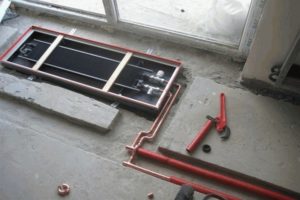
- Install a niche channel for the heating device.
- Fill the floor.
- Mount the battery into the floor.
- Adjust the height of the appliance. The kit usually includes special screws for this purpose.
- Secure the structure, seal it, and insulate the space between the metal box and the channel walls.
- Make a clean finishing floor.
- Connect the system. There are two options: to the central heating system or to the electrical network.
- Seal all cracks with silicone sealant.
- Cover the battery with a grate.
Once the heating device is installed, check the system for proper operation and adjust the heating temperature.
The video below clearly shows the installation process for an in-floor convector:
For in-floor installation, it's recommended to contact specialized companies. Their technicians will ensure 100% correct operation and provide a warranty on the work performed.
Where are underfloor radiators installed?
The position of the in-floor radiator in relation to the window opening depends on the intended purpose of the device:
- As a thermal curtain. The fan should be located closer to the room, not the window, and direct the flow of warm air towards the glazing.
- Convector, i.e. full heating of the room. Location: near the window opening, so that the cold masses emanating from the glazing are directed into the room through the heat exchanger.
Manufacturers recommend installing the radiator with a 10-25 mm gap from windows, depending on the interior design. The distance from walls should be 10-20 mm. This is primarily necessary for ease of installation and operation of the radiator.
Built-in radiators or underfloor heating – which is better?
System "heated floor" and in-floor heating radiators each have their own strengths and weaknesses. The former is the most suitable solution for private homes and apartments, as the system cannot be installed in offices, warehouses, or commercial spaces where linoleum or parquet flooring is used as the finishing surface.
Moreover, using underfloor heating in non-residential buildings is pointless. A comfortable temperature is set to keep your feet warm.
In-floor heating can be installed anywhere, regardless of the type of flooring. However, the surface temperature will not be as high as with underfloor heating, and there's a risk that walking barefoot will be uncomfortable.
In-floor heating radiators are an innovative system that has begun to be used in residential buildings. Installation in an apartment requires permission. If you obtain it, you can fully heat the room and save money on utilities.