There are a huge number of heating systems and variations. However, most homes, both urban (central heating systems) and rural, use hydronic heating.
Water is considered an ideal heat carrier for heating systems.
The main reasons for using water in radiators
The first and most important reason is that water is the cheapest and most versatile heat transfer fluid in the world. It is the safest for the environment and humans, even in the event of a heating system failure. Finally, the third reason is its high specific heat capacity, which is 4200 J/(kg * °K).
A water heating system is a rather complex design, but its main advantage is practicality and economy.
Why is water better than antifreeze?
There's a belief that it's better to use antifreeze rather than water as a coolant. This is because water, unlike antifreeze, freezes at sub-zero temperatures. This increases the risk of damage to pipes and heating radiators.
The fear of losing heating in winter is not accidental - find out how change the radiator in winterEven during the heating season, the system experiences downtime or power outages, which leads to pump shutdowns and subsequent cooling of the water.
On the one hand, antifreezes have many advantages:
- lower crystallization temperature than water;
- additives in antifreeze prevent corrosion, scale and other negative processes;
- There are safe varieties (propylene glycols, glycerin antifreezes).
On the other hand, boilers and heating systems are designed for the physical and chemical properties of water, not antifreeze. This leads to the following disadvantages:
- Antifreezes have a higher density and viscosity, which requires high-power pumps;
- specific heat capacity is lower than that of water;
- there is a risk of leakage if the sealing materials are incompatible with the antifreeze composition;
- increased expansion coefficient when heated, which requires a larger expansion tank;
- The most common is toxic ethylene glycol, which can be harmful to the health of humans and pets;
- the risk of corrosion (some manufacturers add special substances – inhibitors – to their products to reduce its impact);
- It is necessary to avoid contact of antifreeze with zinc if it is present in fittings and pipes (otherwise, an insoluble sediment is created, leading to the destruction of the heating system);
- There is no warranty from the manufacturer when using antifreeze.
Water is more suitable for heating systems than antifreeze. However, its quality is important. Distilled water is recommended.
The principle of a water heating system
There are two types of water heating systems. They are as follows:
- With forced circulation. This option requires a circulation pump, which requires a stable power supply for continuous operation.
- With natural circulation. This system is independent of external factors. The system's structure is quite complex: it requires a specific radiator configuration, taking into account the pipe slopes and diameters, which must vary to maintain the coolant flow rate and the required pressure in the system.
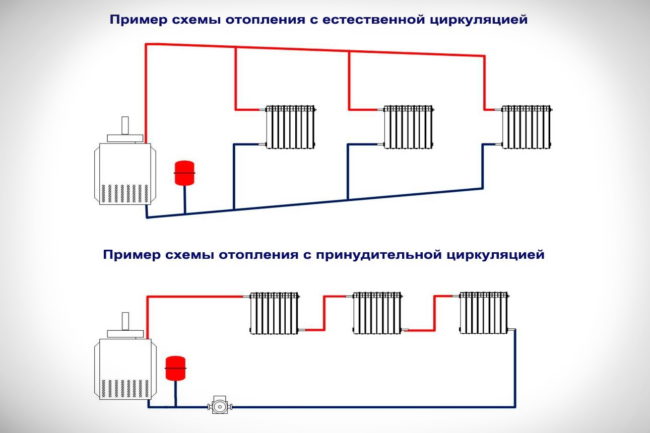
Water is heated in the boiler. Different parts of the heating system experience different liquid densities, causing it to move. This is because hot water is lighter than cold water and rises up the pipes.
Water is ubiquitous, making it a relatively inexpensive coolant. It also transfers thermal energy quite easily. It also has a number of other advantages over synthetic fluids, which are often toxic to humans. These combined properties make water popular for use in metal and cast iron radiators.