Long gone are the days when all types of heating radiators were limited to a very limited selection of heating devices. The first of these, which appeared in the twilight of the Russian Empire, were cast-iron radiators. These were cast vertical cylinders, connected by bridges, of an unsightly appearance.
During the Soviet era, when five-story panel buildings—Khrushchev-era buildings—were being intensively built, their hot-water heating systems were equipped with low-power converter-type units. Other designs also existed, but their number was so small that they are not worth mentioning.
Nowadays, with civil construction in the hands of private capital, not only has architecture itself come to be realized in a wide variety of forms, but heating devices, like all other related equipment, are now produced in a wide range of different models. It can sometimes be difficult for modern consumers to understand their advantages and disadvantages and make the right choice.
In this article, the reader will find useful information about the different types of heating radiators, their technical characteristics, the materials they are made of, their pros and cons, and how to correctly calculate the optimal number of sections.
Visitors to the website will also learn about the different types of radiator connections and installation details. Here, they can evaluate the appearance of radiators and find out the approximate cost of heating units from reputable manufacturers.
- Steel radiators
- Tubular
- Panel
- Technical characteristics of steel radiators
- Pros and cons
- Aluminum batteries (cast, extruded and anodized)
- Technical characteristics of aluminum batteries
- Pros and cons
- Cast iron radiators
- Technical characteristics of cast iron radiators
- Pros and cons
- Copper batteries
- Technical characteristics of copper radiators
- Pros and cons
- Bimetallic radiators
- Technical characteristics of bimetallic radiators
- Pros and cons
- Skirting convectors
- Technical characteristics of water-heated skirting boards
- Pros
- Cons
- Technical characteristics of electric heated baseboards
- Pros
- Cons
- Floor convectors
- Technical characteristics of water floor convectors
- Choosing the optimal heating radiator for an apartment or private home
- Radiators for an apartment
- Radiators for a private home
Steel radiators
Steel radiators are structures made of articulated flow-through vessels called sections. A single radiator can contain two or more of these sections.
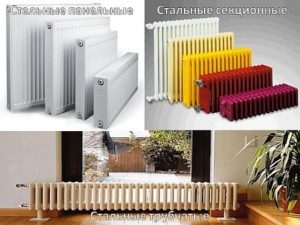
There are two types of steel heating devices produced: panel and tubular batteries.
Tubular
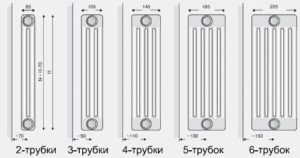
In appearance, they resemble their cast iron counterparts. The sections are also connected piece by piece with fittings to form a single heating unit.
The peculiarity is that they can be blocks from 2-pipe to 6-pipe sections.
Panel
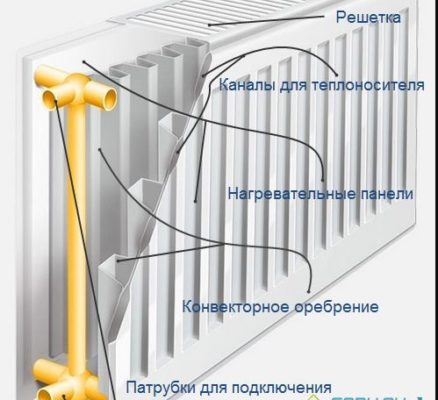
Panel radiators come in a variety of designs. They are stamped steel panels with vertical channels connected to upper and lower horizontal vessels. They can be single-row, double-row, or triple-row, with a single- or double-row convector between the panels.
For increasing heat transfer Manufacturers often equip their devices with fins on the outer sides of the panels. These fins, made of thin sheet steel, promote convection (heat transfer).
Technical characteristics of steel radiators
| Heat transfer | 65 watts or more |
| Working pressure | 8 – 15 atmospheres |
| Coolant quality | Radiators are intended for individual heating systems only. |
| Center distance | The distance between horizontal channels varies from 120 to 2930 mm |
| Coolant temperature | 110 – 1200 WITH |
| Connection type | Can be one-sided, bottom, top or diagonal |
| Dimensions | Batteries and panels can be of any length, but the thickness is limited to 225 mm. |
| Durability | With high-quality water, 20 years or more |
Average cost per 1 m2 Depending on the configuration, steel panels from Prado, a well-known Izhevsk manufacturer of heating appliances, range from 1,500 to 3,000 rubles or more. The appliances have an attractive appearance and are usually painted a neutral white.
Pros and cons
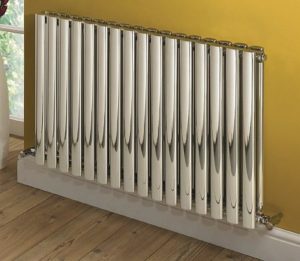
Their advantages include high heat output, simple design, light weight, and attractive appearance. Like all custom-made products, tubular steel appliances are popular with owners of expensive country houses.
The disadvantages include: susceptibility toCorrosion, so draining the radiators is essential in summer. Also, steel panel radiators cannot withstand water hammer, limiting their use to standalone heating systems.
Aluminum batteries (cast, extruded and anodized)
Aluminum radiators have high thermal conductivity due to the physical properties of this metal. Aluminum heating units are designed for use in private homes with independent heating systems, where the quality of the coolant is high and where significant water hammer is avoided.
Currently, there are three types of aluminum radiators available on the heating market, differing in their manufacturing technology:
- cast radiators – are manufactured by casting an aluminum and silicon alloy under pressure;
- extrusion batteries – radiator sections are extruded into moulds using an extruder at high pressure;
- anodized radiators – made from purified metal (98% aluminum) with subsequent anodic oxidation of the internal surfaces of the batteries, which provides 100% protection against corrosion.
Technical characteristics of aluminum batteries
| Power (heat output) | Up to 230 watts |
| Working pressure | From 6 to 16 atmospheres |
| Coolant quality | Radiators are intended for individual heating systems only. |
| Maximum heating of the coolant | 1110 WITH |
| Dimensions | 380-590 mm/80 mm/81-100 mm |
| Service life | 20 years and more |
The cost of one aluminum section ranges from 250 to 700 rubles. Assuming that 1 m is needed for heating2 living space requires 100 watts with a radiator output of 180 watts to heat an area of 60 m2 30 sections of batteries will be required (1 section heats 2 m2 area). Therefore, purchasing aluminum heating appliances will cost between 7.5 and 21 thousand rubles.
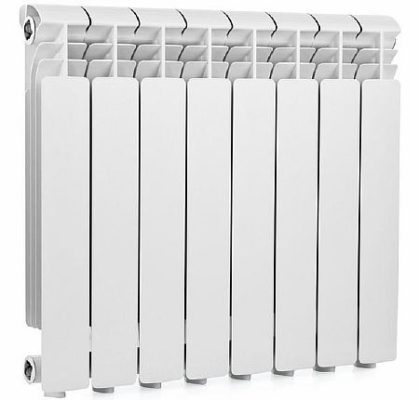
Based on the analysis of ratings of efficient aluminum radiators, the best manufacturers of these products are determined.
These are: the Finnish company Aquilo FMK, the Russian company from Orenburg Rifar, the Italian company Global and the company Thermal from the city of Zlatoust.
Pros and cons
The advantages of aluminum radiators, which determine their success in the heating radiator market, include highly efficient heat transfer, light weight, and attractive appearance. The convection heating method prevents dust accumulation in the converter grates.
However, it's worth noting such drawbacks as the devices' sensitivity to coolant quality and their intolerance to water hammer. Non-anodized models can quickly rust if left unused during the summer.
Cast iron radiators
Despite the disdainful attitude toward old cast-iron radiators, the preference for products made from this metal remains high. Of course, modern devices are far from the same Soviet-era radiators as the MS-140 model.
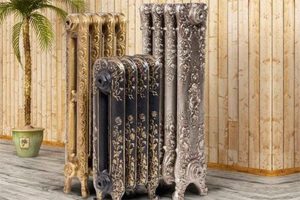
Modern cast iron radiators have long been exclusive luxury items. Designers infuse their appearance with Empire, Baroque, and Classical style embellishments. Gold or silver radiators with embossed patterns on the section faces, as well as decorative, shaped legs, transform these radiators into works of industrial art.
Technical characteristics of cast iron radiators
| Heat transfer | Up to 175 watts |
| Working pressure | Up to 16 atmospheres |
| Coolant quality | Doesn't matter |
| Maximum heating of the coolant | 1200 WITH |
| Dimensions | By number of sections |
| Service life | 50 years and older |
Along with the more expensive models, cast iron radiators with the same parameters as the old Soviet MS 140 series radiators are available. One such section costs 750 rubles. Therefore, the price of the radiator depends on the number of sections. A 5-section radiator will cost the buyer 3,750 rubles. In addition to the traditional heating element shape, the plumbing market offers cast iron ST1 series radiators in a modern design for 9,600 rubles for 12 sections.


The Lugansk Thermal Engineering Plant has been and remains the primary manufacturer and supplier of the MS 140 series cast iron radiators. Other manufacturers of cast iron radiators include Konner, Roca, Demir Docum, and Retro Style from China, Guratec from Germany, Santekhlit OJSC (Bryansk), and Dekart OJSC (Novosibirsk).
Pros and cons
Cast iron radiators of all types and models can be connected using any connection scheme. Pipes are connected from the side, bottom, top, or diagonally, depending on the chosen coolant circulation principle within the radiator.
The low cost of affordable models (MS 140 and MS 90) allows them to be used in large quantities for heating factories, workshops, and public buildings, as well as for repairing heating systems in older apartment buildings. Exclusive new-generation cast iron radiators are becoming focal points in the interiors of wealthy homes.
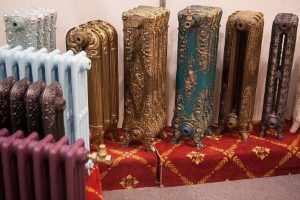
The disadvantages include the high cost of exclusive models and the fragility of cast iron.
Radiators can burst when water freezes inside them or when subjected to excessive mechanical stress. The high inertia of cast iron radiator elements results in slow heating and cooling. The latter is rather an advantage.
Copper batteries
All types of copper heating radiators look attractive and complement any interior. At one time, copper heating devices were unfairly forgotten, as copper is a rather expensive material.
Affluent individuals can afford to purchase and install copper radiators in their homes. Copper is the best material for plumbing fixtures. Radiators made from this non-ferrous metal have superior technical characteristics.
Technical characteristics of copper radiators
| Heat transfer (power) | 100 – 235 watts |
| Working pressure | 14-16 atmospheres |
| Coolant quality | Purified water or antifreeze |
| Maximum heating of the coolant | 1500 WITH |
| Dimensions | By number of sections |
| Service life | 50 years and older |
There's no set average price for copper radiators. Manufacturers set specific prices for these types of heating radiators on a case-by-case basis. For example, a 2190-watt radiator in a wooden casing with dimensions of 830 x 200 x 110 mm and a 130 mm center-to-center distance can cost between 18,000 and 40,000 rubles, depending on additional options.
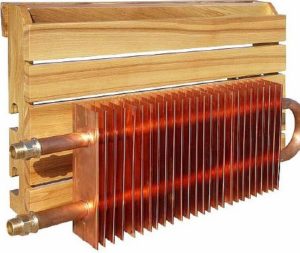
Almost all devices have a plate or tubular structure with different connection types. Installing batteries requires specialized skills from the installer.
Pros and cons
All of the above information can be considered advantages. Is the high cost of copper products a disadvantage? If so, it's practically the only one for these types of heating radiators.
There are also copper-aluminum radiators, which are not entirely made of copper. They are also quite efficient, as aluminum has relatively good heat transfer. However, the silvery metal is more vulnerable to damage from poor-quality heat transfer fluid. Therefore, the collectors and heat-conducting channels in these radiators are made of stronger and more reliable copper. These radiators are less expensive than units made entirely of copper.
Among the most renowned manufacturers of copper heating appliances are the Polish company Regulus, which produces copper sectional radiators in wooden casings, and the Ukrainian company Termia, which produces copper-aluminum radiators. Also highly regarded are the copper-aluminum convectors from the Russian company Izoterm.
Bimetallic radiators
The idea of combining the two metals in a single heating device was to combine their positive qualities – the corrosion resistance of stainless steel and the high heat transfer of aluminum.
Bimetallic heating radiators are highly sought after worldwide due to their attractive price-quality ratio. Steel pipes containing a circulating coolant are housed in a multi-lobed casing made of aluminum plates.
Technical characteristics of bimetallic radiators
| Power (heat output) | Up to 230 watts |
| Working pressure | From 6 to 16 atmospheres |
| Coolant quality | Radiators are intended for individual heating systems only. |
| Maximum heating of the coolant | 1110 WITH |
| Dimensions | 380-590 mm/80 mm/81-100 mm |
| Service life | 20 years and more |
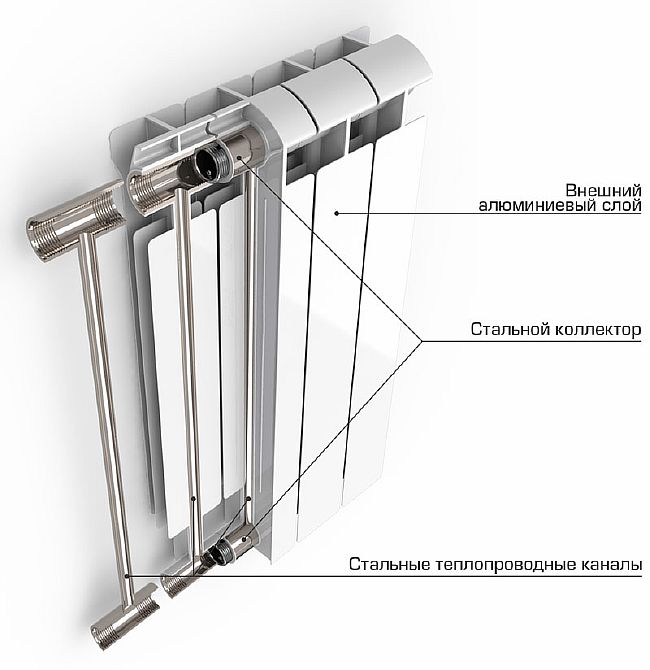
Bimetallic radiators can be used with all types of heating network connections. By varying the location of the plugs and fittings, single- or double-sided side, bottom, top, or diagonal connections to the hot water heating pipes can be used.
Regular ratings of bimetallic heating devices serve as a marker of the best manufacturers of these products. Analyzing the 2021 data, the following companies stand out in this regard: Rifar, Halsen, Global, Royal Thermo, and Rommer. The average cost of bimetallic radiators ranges from 600 to 1,250 rubles per section, depending on the manufacturer's prestige.
Pros and cons
The advantages of bimetallic radiators include high build quality, efficient heat transfer, and trouble-free operation throughout their entire service life. There are no significant discrepancies between practical performance and the manufacturer's stated technical specifications.
Resistance to aggressive substances in centralized heating systems is noteworthy. The long service life of the units, up to 25 years, is noteworthy, thanks to the use of wear-resistant steel elements in the radiators. This is also supported by the bimetallic radiators' resistance to strong water hammer (up to 40 atm).
One drawback is the excessive fragility of the aluminum housing. Another inconvenience is that you often have to purchase additional plugs, hangers, and valves. Reviews also include complaints about the quality of the battery paint.
Skirting convectors
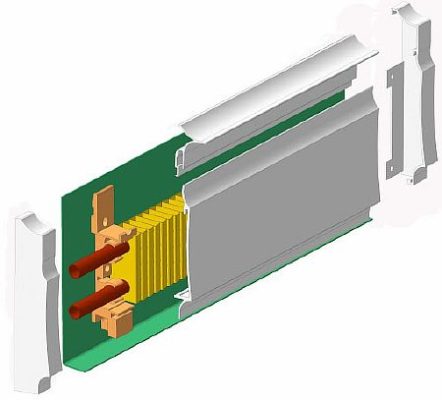
Convectors called "Warm Baseboard" come in two varieties: electric and hydronic models. They resemble a regular baseboard in appearance, occupying its space or being positioned next to it. The heat exchanger is concealed by an aluminum or plastic casing. Baseboard convectors are typically small. The heater's height is typically no more than 140 mm and its depth no more than 30–50 mm. The convector can be wall-mounted or stand on legs.
Thermal skirting boards differ from radiators in that they heat the walls, creating a thermal curtain. As a result, heat is distributed evenly throughout the entire room.
Connection to the hot water heating pipes can be done in the same way as with conventional cast iron radiators. The interior of the baseboard consists of copper pipes with aluminum fins or petals, equipped with a bleed valve.
Technical characteristics of water-heated skirting boards
| Thermal power | 110 - 700 W/m (approximately) |
| Working pressure | 16 bar |
| Maximum heating | 1300 WITH |
| Coolant | Water or ethylene glycol |
| Service life | 15 – 20 years old |
Pros
The advantages include the following:
- fast heating of the room;
- uniform distribution of warm air throughout the entire room;
- Thermal skirting boards can be installed on any floor base;
- a small amount of water is required to circulate the coolant.
Cons
The main consumer complaints about water-heated skirting boards come down to its high costThe high price is explained by the use of expensive materials such as copper.
Depending on the model, a water-heated baseboard can be purchased for between 15,000 and 30,000 rubles. The most well-known manufacturers of water-heated baseboards include Techno Board, Turbo-Tech, STN, Orion, and Mr.Tektum.
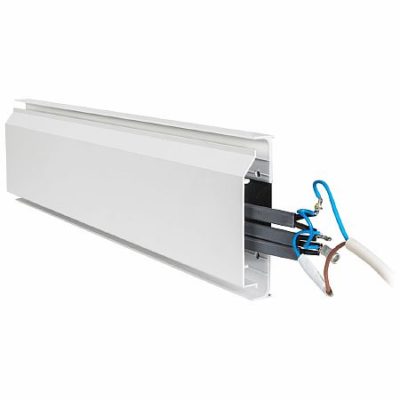
Electric baseboards differ from hydronic heaters in that they use heating elements (TENs) instead of water pipes. Installation is quite simple: the baseboard is attached to the wall and plugged into a power outlet.
Technical characteristics of electric heated baseboards
| Power | 140 – 500 W/m. |
| Operating voltage in the network | 230 in |
| Maximum temperature | 400 WITH |
Pros
Electric baseboards are attractive due to their energy efficiency. After the walls have fully heated up, energy consumption is significantly reduced. Electricity is consumed only to maintain the desired temperature.
Cons
Electric skirting boards are installed in permanent residences and are completely unsuitable for summer cottages. They can be purchased for an average of 6,000 rubles per linear meter. Well-known manufacturers of thermal skirting boards in Russia include Techno Board, Turbo-Tech, Charley, Orion, and Mr.Tektum.
Floor convectors
There are two types of in-floor convectors: hydronic and electric. Built-in floor heaters draw in cold air and release it into the room preheated. Convectors are typically installed in the floor beneath panoramic glass walls or large display windows. Like baseboard heaters, warm air rises in a vertical curtain, preventing cold air from penetrating through the glass from outside the home.
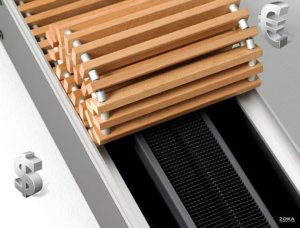
In-floor electric heaters are similar in their technical characteristics to heated baseboards with heating elements. Hydronic convectors are powered by a separate boiler or water heater installed in a private home.
Technical characteristics of water floor convectors
| Heat transfer | 200 – 300 watts/running meter |
| Maximum heating | 1000 WITH |
| Operating temperature range | 450 WITH |
| Coolant | Water, antifreeze or glycol |
| Service life | 15 – 20 years old |
Well-known manufacturers of this type of heating equipment in Russia include Techno Board, Turbo-Tech, Charley, Orion, and Mr. Tektum. The average cost of a hydronic in-floor convector is approximately 6,000–7,000 rubles per linear meter.
Choosing the optimal heating radiator for an apartment or private home
From the above material, it is clear that the conditions for heating an apartment and a private house can differ significantly, and, accordingly, the options for choosing the type of radiators can also be different.
Radiators for an apartment
Replacing a heating radiator This can occur during a major apartment renovation or due to a leak or breakdown of an old heating unit. When choosing a radiator, you need to understand and consider the features of the central heating system:
- sharp changes in water temperature;
- contamination and acidity of the coolant;
- threat of water hammer.
Based on this, cast iron, anodized aluminum and bimetallic batteries are best suited for heating apartments.
Radiators for a private home
The advantage of autonomous heating systems is that homeowners can use special ethylene glycol-based fluids instead of water. This eliminates the risk of corrosion inside the radiators.
The absence of water hammer also makes it possible to install steel panel and tubular, aluminum-copper, copper and other types of heating radiators.