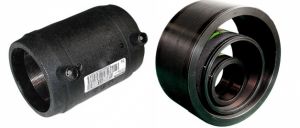
 During pipeline installation, it will be necessary to use connecting elements that can ensure the tightness of the system.
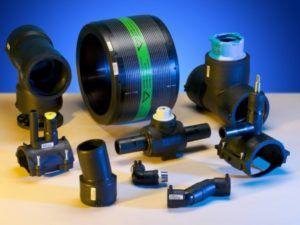
To facilitate the welding of plastic materials together, it is advantageous to use electrofusion couplings for polyethylene pipes.
This type of fitting is equipped with an integrated electric heating system. These products are divided into several types, each with its own specific application.
A coupling connection is used to connect different types of polymer pipes used in cold water supply systems.
This can be either artesian or industrial water. They are also often used in the construction of pipelines for transporting natural gas and chemicals, which do not interact with HDPE polymer.
Characteristics of connecting elements
The PE100 SDR11 coupling performs well as a connecting component for systems with an internal pressure of 16 atmospheres, provided the temperature of the transported liquid does not exceed 40°C. The heating element of this type of product produces a viscous melt of the polyethylene.
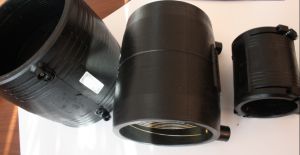
Once the connection is complete and has cooled completely, the pipeline parts become one monolithic structure.
The PE100 SDR11 coupling, like other fittings, is equipped with a chip displaying a barcode. It contains detailed instructions on the material, including heating time, required current, and complete cooling time.
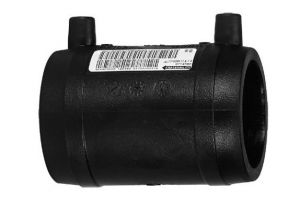
This type of coding is not only convenient but also practical, as the code is scanned in seconds, and the welding tool is automatically adjusted to the required parameters for high-quality work.
The PE100 electrofusion coupling is equipped with a spiral made of a special alloy that prevents contamination and ensures high-quality welding work.
The metal from which the coil is made does not provide temperature compensation, so welding work is carried out quickly and results in the formation of a single monolithic structure.
Installation
The PE100 coupling is installed as follows. An electric current is applied to the heating coil, which melts the walls of the polyethylene pipe, creating a high-quality joint. The entire installation process follows these steps:
 The material is prepared before connection. The polyethylene pipe is cut at a right angle. Even the slightest unevenness or roughness is not allowed. The connection area is thoroughly cleaned of dirt and debris;
- A fitting of the appropriate size is selected. After this, all parts of the structure should be degreased with an acetone-containing substance or other solvent available;
- The fitting parts are secured in a special fixture. The distance between the fastened sections, which are inserted into the fitting, should not be wider than the wall thickness of the polyethylene tube itself. The PE100 connecting element often has special limiting protrusions to facilitate proper installation.
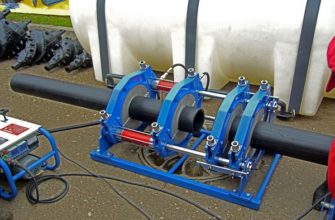
- The PE coupling is welded using a special machine for joining plastic components. Welding is performed automatically; after scanning a barcode, the machine automatically sets the appropriate temperature and current;
- After completing the work, the seam must be tested for strength before bricking up the system or laying the structure in the ground. This test involves introducing air into the pipeline at a specific pressure.
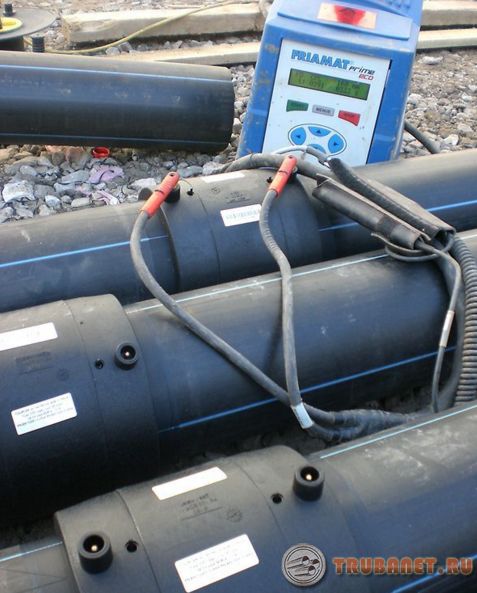
The PE100 SDR11 connecting element, according to its nomenclature, must withstand a nominal pressure of PN16. Products of this brand are considered the most commonly used.
Compression couplings
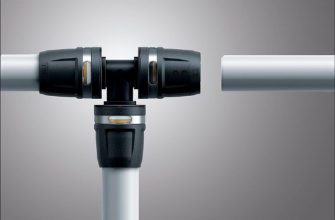
Compression fittings for polyethylene pipelines are most often made of polymers, but the collet or sleeve is made of metal. The body for connecting with the PE pipe is molded from plastic.
The maximum diameter of compression couplings considered cost-effective is 6 cm. It is impractical to connect polyethylene pipelines with a cross-section larger than 6 cm using compression couplings, although manufacturers produce models with a diameter of 10 cm.
Compression coupling for polyethylene pipes (collet) allows the connection to be assembled and disassembled, and the design with the sleeve makes the connection permanent.
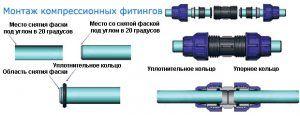
This must be taken into account when constructing a pipeline, especially if it will be walled up or buried in the ground.
Since this connector for polyethylene pipes secures their ends to its nipple using a crimping element, the press coupling connects the pipeline components using a sleeve, which is compressed using a special vice. While the nut can be unscrewed, the sleeve cannot be aligned.
Video 1 - testing of compression couplings
Classification of electrofusion fittings
There are several varieties of fittings such as electrofusion couplings for polyethylene pipes, their sizes varying from 2 to 31.5 cm.
It's not advisable to connect larger diameter pipes using couplings—it's impractical. It's better to use other types of fittings.
Electrofusion couplings for polyethylene pipes vary in their characteristics, regardless of size. Some are used for sealing plumbing systems, others for gas systems.
However, today, electric-welded products of a universal type are already being produced, which can be used in pipelines for any purpose.
Video 2
Scope of application
Electrofusion couplings for polyethylene pipes cover a wide range of applications. Sizes most commonly used range from 2 to 11 cm. They are an indispensable element during the installation of pipeline systems of any purpose and the construction of engineering structures.
The PE100 coupling is mainly used when performing repair work in confined spaces, for example, in a trench.
Due to the minimal amount of time required for welding, the PE100SDR11 product is an ideal solution for emergency response situations.
It is also used during the installation of branched pipeline systems and when creating additional branches from already installed water supply system.
And in any other cases when it is not possible to perform a butt-welded joint.
Video 3
The PE100 SDR11 installation technology can be used in a wide range of temperature conditions, allowing installation and repair work to be carried out in both the winter cold and the summer heat.
Choosing the Right Electrofusion Fittings
Today, the construction market offers a vast selection of PE electrofusion couplings from various manufacturers. Initially, it's worth paying attention to customer reviews and professional recommendations.
Video 4
When installed correctly in accordance with all GOST standards and regulations, couplings for polyethylene pipe products provide reliable service for many years. Using these fittings ultimately creates a uniform, leak-proof structure.
The main thing to remember is that the final result is influenced by both the quality of the connecting element and the welding machine.