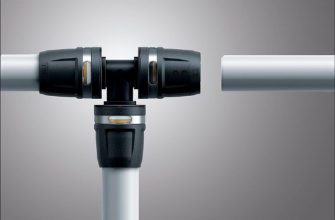
A compression fitting is a compression-type crimping component used to install HDPE pipes without the use of additional tools. They come in various shapes, with internal and external threads. The fitting consists of a body, a sealing ring, a clamping ring, a compression sleeve, and a clamping nut.
Today, plastic pipes are steadily gaining popularity, and their high-quality installation requires specialized connecting devices. Compression fittings are used to install HDPE and PE systems. and PVC pipes.
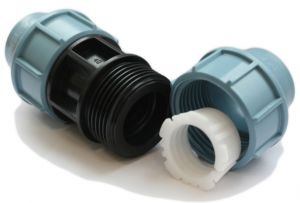 Compression fittings for polyethylene pipes guarantee complete tightness at the junction of connected sections of the PE system without the use of a welding machine.
This component can connect pipeline components that include branches, turns, and pipes of varying cross-sections. It also facilitates the rapid dismantling of a specific section of the structure in the event of a failure or rupture.
These connectors are supplied ready for installation. No pre-treatment is required other than chamfering.
General information
Compression fitting for installation of polyethylene and HDPE pipelines consists of:
- clamping cover;
- rubber sealing ring;
- compression ring;
- bushings for pressing.
The compression ring and the rubber seal inside it are the primary connecting elements between the two pipes. Their simple design allows for quick installation.
A large number of assemblies and disassemblies does not affect the performance characteristics of the fitting.
Installation or repair work of a pipeline using such connecting elements is so simple that there is no need to seek help from professionals.
It's entirely possible to do all the work yourself. Any high-quality plastic compression fittings for connecting polyethylene and HDPE pipes should have certificates of hygienic safety, which guarantees their use in drinking water systems.
Before purchasing, it is recommended that you ask the seller to provide quality certificates and relevant documentation permitting the use of materials in systems that handle any food liquids.
Features of the connecting element
Connecting elements for HDPE pipes and for the installation of polyethylene pipelines are products of high strength and a long service life.
They have a wide range of cross-section sizes from 1.6 to 11 cm, which makes it possible to equally well combine the constituent elements of systems with different cross-sections.
The polymer used to produce compression fittings for connecting polyethylene and HDPE pipes allows the products to remain completely unaffected by any chemical environments.
They connect parts of the hot water supply system equally effectively and have no contraindications for contact with drinking water and other food liquids.
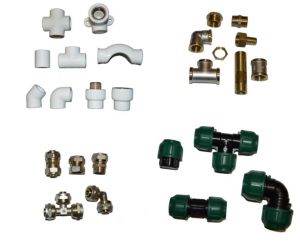
Data is used connecting elements mainly used in plumbing installations for low-rise buildings and when wiring water supply on the streetFittings are used wherever their connection is required.
At a temperature of about +20 degrees, they connect HDPE pipes with a cross-section of up to 63 mm and withstand internal pressure of up to 16 bar.
When connecting large diameters, it is advisable that the pressure does not exceed 10 bar.
Storage and use
Video 1.
There are no specific storage conditions for fittings, the main thing is to protect them from UV rays. However, when it comes to polypropylene products, which are increasingly used, sunlight does not cause any harm to them.
Sub-zero temperatures will not affect the quality of the products, but when storing in a heated room, place plastic compression fittings at least one meter away from any heating device.
Compression couplings for polyethylene pipes are manufactured in various sizes. and shapes, with threads on the inside or outside of the part.
Each of these elements can be used for both installation and repair of water supply systems using durable polyethylene grades PE80 and PE100, which are used for transporting both drinking water and liquids for technical purposes.
Polyethylene components are often used when creating an automatic irrigation system on a plot or flower bed.
Installation instructions
Video 2.
When using plastic fittings for PE pipes or polyethylene systems, it is important to follow all manufacturer recommendations regarding their installation and use, as well as the instructions for use issued by the factory.
If the pipes comply with all regulations, then their connection should not cause any problematic consequences.
Fittings with a diameter of 16-50 mm are installed without the use of any plumbing tools, while for connecting pipes of a larger diameter it is worth using a chain wrench.
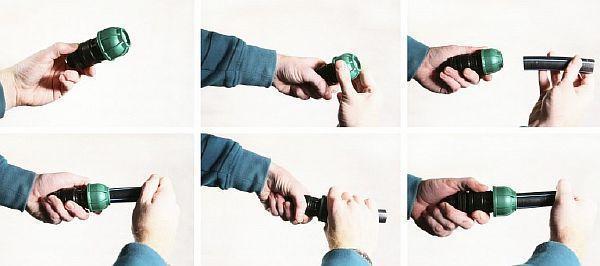
In order to make the connection correctly, it is recommended to follow the following instructions:
- Using any sawing tool, cut the pipes at a right angle to the required size;
- The joints should be cleaned of burrs and sawdust, while also being slightly rounded. The joint should be completely clean and free of visible cracks or unevenness;
- the blue nut is removed from the fitting and placed on the pipe, and the white clamping ring is installed so that its thick part faces the tail of the pipe;
- The pipe is inserted into the connecting structure until it stops, and the same procedure is performed with the ring. The blue nut is tightened initially with bare hands and then tightened further using a special tool.
Benefits of using them
Plastic compression fittings guarantee a hermetic connection of pipelines made of PE, PP and HDPE components, thanks to a special sealing system.
They do not require constant checking and tightening, so they can be used when installing underground water pipes or anything that will subsequently be embedded in concrete.
HDPE plastic compression fittings withstand operating pressures of up to 16 atmospheres within the system. They are easy to install, and the quality of the connection is not affected by any additional preparation.
The technological features allow for quick connection and reduced installation costs. The connection is corrosion-resistant, hygienic, and durable, while perfectly connecting plastic parts of different diameters.
These connecting elements are complete. This means that any component of the product can be replaced using parts from the same product group.
It is worth noting that the ring designed for axial clamping is made of durable yet brittle polyamide, and if it breaks, the fitting can no longer be used and must be disposed of.
Video 3.
The seal is made of rubber-like plasticized polyethylene. The main body of the fitting is polypropylene.
To ensure maximum strength for a product with a thread cut into the internal diameter, some varieties are equipped with an external steel collar.
They are compatible with every PE pipe made of low density polyethylene (40, 80, 100) and are manufactured in accordance with all regulatory requirements.
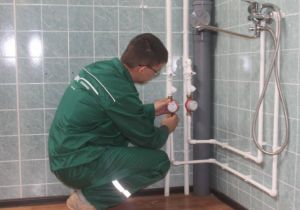 In practice, many professionals involved in the installation and repair of plumbing systems have become convinced of the reliability of compression plastic fittings, which are integral parts of any polyethylene or HDPE plumbing system.
In addition to the fact that compression fittings for polyethylene pipes are not affected by sudden temperature fluctuations or chemically active environments, they can operate without interruption for half a century.