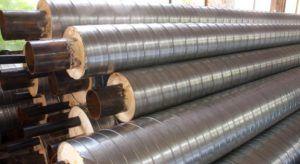
 Insulated pipes have been produced in Russia since the early 1990s. This technology, imported from Europe, has proven itself to be highly reliable. Easy installation and use make these pipes suitable for a wide range of applications.
This protective coating is the optimal solution for increasing the pipeline's resistance to corrosion manifestations and harmful environmental influences. Insulating galvanized steel pipes also increases the operating temperature range of the transported medium and reduces heat loss.
Insulation is used in the installation of heating pipelines Duct and ductless methods. Modern types of thermal insulation, tested and certified, are used for galvanized steel pipe materials. These products will be described below.
To reduce heat loss, increase durability, and significantly reduce repair costs, polyurethane foam is used as insulation. It is made from environmentally friendly materials such as Vorateka 100 and Izolan-345. It offers excellent thermal insulation properties (almost 100%) and offers many more advantages than mineral wool.
See also: VUS insulation of steel pipes
Scope of use of insulated pipes.
- Gas production industry.
- Oil production industry.
- Food industry.
- Chemical production.
- Domestic and housing sphere (installation of water and heat supply networks).
Advantages of insulating galvanized rolled pipes.
- Efficiency.
- Reliability.
- Safety.
- Practicality.
- Versatility.
PPU pipe is high quality
In the mid-twentieth century, polyurethane began to be actively produced, and experts now confirm the fact that insulation made from this material maintains extremely high performance characteristics over a long period of time.
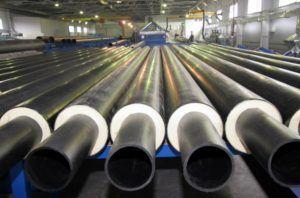
The properties of polyurethane foam materials are obvious:
- light weight;
- strength and adhesion to steel;
- high water protection;
- minimal water absorption;
- long service life;
- ability to work at temperatures up to +150 degrees;
- seamless coating;
- non-toxicity;
- resistance to mold and mildew growth.
Galvanized steel pipe with polyurethane foam insulation is manufactured in accordance with GOST 30732-2001 and ensures zero heat loss in the pipeline. All products are thoroughly tested at the factory. This ensures the high quality of the supplied products, ensuring their use for over thirty years.
Polyurethane foam (PUF) pipe insulation is widely used in the installation of heat, water, and oil pipelines. These structures are distinguished by excellent technical performance.
Let's take a look at them:
- low thermal conductivity;
- low heat loss and water absorption percentage;
- reduction in construction costs in general;
- reduction of time spent on construction.
Galvanized steel pipe with polyurethane foam insulation is a proven and reliable solution for installing a water or heating main to a residential or industrial building.
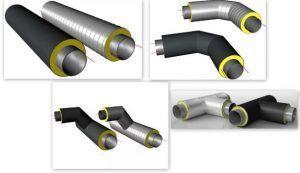 In the construction industry, polyurethane foam is known as "construction foam." It is considered a new-generation material and has become a worthy competitor to glass wool and mineral wool.
These products are manufactured using the technology described above. First, a standard steel blank is taken, then fitted with a polyurethane foam jacket. Finally, a galvanized coating is applied.
Thickness of galvanized insulation
Galvanized rolled tubular materials are manufactured in accordance with GOST 30732-2006. They are characterized by high quality and significantly reduce heat loss.
Video
- standard;
- reinforced.
The required coverage size is determined based on the technical specifications, taking into account internal and external factors.
The table provided shows how much to overlap galvanized insulation on a steel pipe.
| External volume of the pipe (cm) | Wall thickness (cm) | Nominal value of the volume of galvanized protection | Minimum dimensions of galvanized steel
(cm) |
| 3.2 | 0.3 | 100; 125; 140 | 0.055 |
| 3.8 | 0.3 | 125;140 | 0.055 |
| 4.5 | 0.3 | 125; 140 | 0.055 |
| 5.7 | 0.3 | 140 | 0.055 |
| 7.6 | 0.3 | 160 | 0.055 |
| 8.9 | 0.4 | 180 | 0.06 |
| 10.8 | 0.4 | 200 | 0.06 |
| 13.3 | 0.4 | 225 | 0.06 |
| 15.9 | 0.45 | 250 | 0.07 |
| 21.9 | 0.6 | 315 | 0.07 |
| 27.3 | 0.7 | 400 | 0.08 |
| 32.5 | 0.7 | 450 | 0.08 |
| 42.6 | 0.7 | 560 | 0.1 |
| 53 | 0.7 | 675; 710 | 0.1 |
| 63 | 0.8 | 775; 800 | 0.1 |
| 72 | 0.8 | 875; 900 | 0.1 |
| 82 | 0.9 | 975; 1000 | 0.1 |
| 92 | 1 | 1075; 1100 | 0.1 |
| 102 | 1.1 | 1175; 1200 | 0.1 |
| 122 | 1.1 | 1375; 1400 | 0.1 |
| 142 | 1.2 | 1575; 1600 | 0.1 |
The standard sizes and dimensions of the sheath shown in the table are manufactured in strict compliance with the standard. Spiral-wound outer protection with larger wall thicknesses is also available.
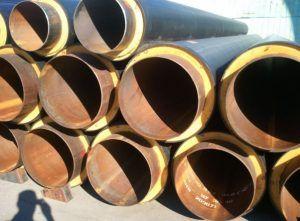
The length of the casing pipe can vary. It depends on the specific length of the steel product. Taking into account unprotected areas, it ranges from 150 to 210 mm.
On small diameter products, the thickness of the protective layer can be from 32 to 45 mm, and on medium and large sized options it ranges from 50 to 92.5 mm.
This casing is manufactured according to GOST 14918-80 standards from rolled steel strip. High-performance equipment is used in production. This ensures a high level of precision when cutting blanks and strong external and internal bonding seams during rolling.
Plasma cutting machines are used for cutting steel sheets and shaped parts. These units are equipped with self-diagnostic systems, allowing for cutting accuracy down to 0.05 cm.
When producing rolled tubular products with galvanized insulation, small unprotected areas are left on both sides of the blanks. These areas are used to secure the parts together.
After joining the rolled pipe materials, any uninsulated areas must be insulated. Specially designed kits are used for this purpose.
Video
Galvanized coating is used to protect the insulation layer on externally installed pipelines. It can also be used on pipelines running in continuous and semi-conductive ducts.
Why use polyurethane foam in steel pipelines?
- Minimizing heat loss. Experts estimate it to be around two percent. Previously, a 25% heat loss rate was considered the norm.
- Reducing annual highway maintenance costs.
- Reduced network installation time. Working with fiberglass takes more time.
- The service life of these highways is more than 30 years.
- Polyurethane foam is an environmentally friendly material and does not harm the environment.
- Low water absorption rate, much lower than that of glass wool.
- Possibility of installing UEC.
When talking about galvanization, it should be noted that we are not talking about the internal pipe through which hot water is transported, but about a thin layer of galvanized coating over a layer of polyurethane foam.
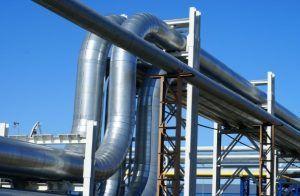
Galvanized steel is ideal for overhead power lines. In this situation, galvanized steel excels at its primary function—corrosion protection.
What should you pay attention to when purchasing these products?
All products in this product line differ significantly in the following parameters:
- Length.
- Inner tube diameter.
- O.D.
- Dimensions of polyurethane foam coating.
The thickness of the pipe walls must be specified when ordering.
Video
UEC system
The remote monitoring system deserves special attention. Its operation is based on the change in electrical conductivity of the insulation when it becomes wet.
In such products, signal wires are laid between the waterproofing and the steel pipe.
When leaks occur in wires, their resistance changes. This signal indicates damage to the water supply or heating network under the insulation. Constant monitoring via the ODK system helps avoid the expense of troubleshooting.
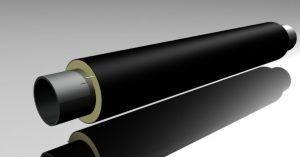
This system allows you to detect the following defects:
- Broken copper signal wires.
- Wetting of the thermal insulation layer due to damage to the tightness of the galvanized pipe or casing.
- Identify the defect without interrupting the pipeline operation.
In this case, she can:
- Remember and save the measurement results.
- Exchange data with a personal computer.
The advantage of a remote monitoring system is that it allows for continuous monitoring of the actual condition of steel network components under insulation, which means reduced repair costs and the timely elimination of accident consequences.
After all, it's cost-effective to plan repairs as needed. This system allows for monitoring the quality of installation work both before installation and during use.
Video
The technology for insulating galvanized steel pipes, thanks to the high level of adhesion of the thermal insulation material to the main product, allows for high-quality performance and a long period of effective operation of the galvanized steel system.