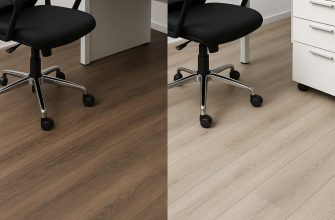
Electric underfloor heating brings comfort and coziness to your home. It can be installed under a variety of flooring materials. Laminate flooring and electric heating are an ideal combination, as the product is cold and uncomfortable to walk on without additional heating.
Laminate flooring can be installed over electric heating mats and infrared film underfloor heating. The flooring must be specifically labeled as compatible with underfloor heating.
By reading this article, you'll learn about the different types of electric underfloor heating systems and understand which one is best suited for a bathroom or living room with laminate flooring. You'll also learn how to install underfloor heating under laminate flooring yourself.
- Types of flooring for laminate flooring
- Infrared film
- Installation
- Carbon rod
- Pros and cons
- Installation
- Carbon solid
- Cable - pros and cons
- Installation of cable flooring
- Heating mats
- Mounting mat
- Amorphous metal
- Installation
- Installation of sensors: temperature, thermostat
- Comparison of electric floors: which one to choose?
- How to choose laminate?
- Laying laminate flooring
- Top manufacturers
- Teplolux
- Unimat
- Devi
- ReXva
- Caleo
- Heat Plus
- Rehau
Types of flooring for laminate flooring
Electric underfloor heating is a heating system that warms the finished surface. It can be installed in any room, and, as a bonus, it doesn't disrupt the interior design, as it's hidden beneath the flooring.
Electric heating options include cable and infrared. Each type has its own advantages and disadvantages. They operate by converting electrical energy into heat.
Infrared film
Infrared underfloor heating is a thermal film with carbon heating elements that emits infrared waves. The product comes in widths from 30 to 100 mm and is available in various wattages. This model has been on the market for several years and is popular because it saves up to 20% on electricity.
Advantages of infrared electric film:
- ease of installation and operation;
- does not affect the height of ceilings, since the film thickness is only 1 mm;
- does not harm human health, since it practically does not emit electromagnetic waves;
- It is not afraid of mechanical loads, so it can be installed under furniture.
This type of electric heating does not contribute to the release of formaldehyde, which is contained in the glue of the lamellas, since it is heated by infrared rays.
Almost the only drawback is the high price. However, due to the ease of installation and cost-effective operation, the overall cost of the device is not much different from other types.
Installation
To begin installing an electric infrared heated floor under laminate flooring, you need to prepare a project and purchase materials.
Step by step process:
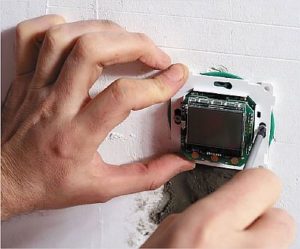
- Installing a thermostat: the device is mounted at the planned location, and a cable placed in a corrugated pipe is laid from it to the film.
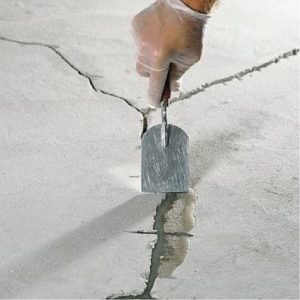
- Preparing the subfloor – leveling and cleaning.
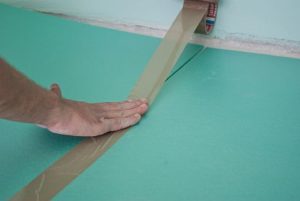
- Laying the hydro and thermal insulation material - the polyethylene film is laid with an overlap on the walls, and the thermal insulation sheets are glued together with tape.
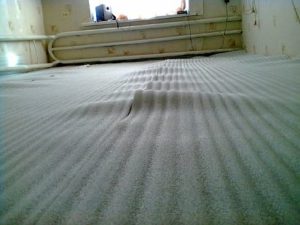
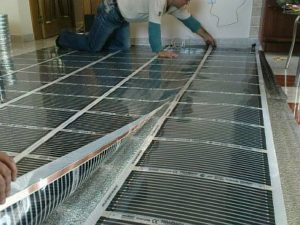
- When placing the thermal film, the copper contacts should face down, and the strips should be connected with clamps. Place the film carefully to avoid damage. Cut strictly along the designated lines.
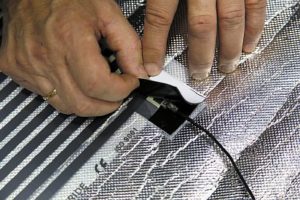
- Connection - the cable is connected to the heating elements with terminals, the connection points are insulated with bitumen tape; recesses are made for the contacts to prevent them from protruding into the thermal insulation material.
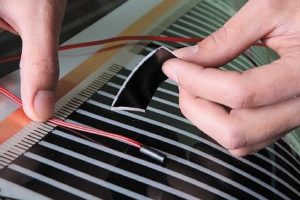
- Installing a temperature sensor - it is placed in the corrugation on graphite strips and connected to the thermostat.
- System testing – heating of each film is checked.
- Film protection - covered with a special material such as "Izospan", which protects it from abrasion.
- Laying the final finishing material - laminate.

Carbon rod
A carbon rod TP is a device consisting of self-regulating carbon rods arranged in parallel. It can regulate the heating level in a room depending on the ambient temperature.
It works on electricity, when it is supplied, infrared waves are emitted, they generate heat and warm the room.
Pros and cons
Thanks to the parallel connection of the rods, even if one fails, the entire structure continues to function. Furthermore, rod-based underfloor heating tolerates moisture well.
This model can be installed under laminate flooring, either with or without screed. The main drawback of installing under screed is the labor-intensive and time-consuming nature of the work.
Installation
Installing a rod-type electric underfloor heating system under laminate flooring is similar to installing a film system. You start by installing the thermostat and cutting a groove (channel) in the wall for the cable.
Next, the subfloor is prepared—leveled and cleaned. A two-layer thermal insulation underlay—foam and polyester film—is laid on top.
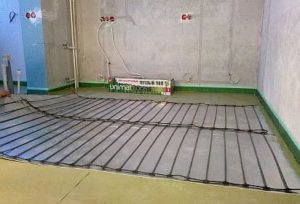
The next step is to lay the rod mats, secure them to the insulation, and then connect the device. This involves installing a temperature sensor, and connecting the wires from it and the mat to the controller.
Filling the rods with concrete or tile adhesive is carried out after testing the system., the screed layer is made no more than 3 cm.

Only after the solution has dried can you begin installing the laminate.
Carbon solid
Solid carbon underfloor heating is a new model of heating system. A continuous layer of carbon is applied to the film. The mats consist of 13 layers—three for heating and 10 for safety, five on each side.
This type is safer, more environmentally friendly, and power consumption is significantly lowerHowever, since it's a relatively new addition to the construction market, it's not often used. Its downside is its short lifespan, about 15 years.
The installation process is similar to laying any carbon mats, but DIY installation is easier, as it is done without pouring a screed.
After preparing the base and laying the insulation, the film is laid. The strips are joined by soldering, which is much more reliable than conventional fasteners.
Additionally, the film can be cut anywhere and placed under furniture. Laminate flooring is installed floating.
Cable - pros and cons
An electrical cable is a single-piece cable laid in a "snake" or "snail" pattern. The structure is usually filled with a concrete screed, at least 30 mm thick.
Advantages of this device:
- low cost;
- the ability to heat the room evenly;
- durability.
Disadvantages of the cable type:
- high energy costs;
- the need for grounding;
- installation complexity requiring experience;
- it takes a long time to warm up the room;
- the dismantling procedure is labor-intensive, since it is necessary to remove the screed;
- significantly reduces the height of ceilings due to the thick screed.
Cables are rarely installed under laminate flooring. Furthermore, a drawback of this heated system is that if one section fails, the entire system becomes inoperable.
Installation of cable flooring
Installation should begin with installing the thermostat and punching grooves - this is dirty work and must be done in advance.
Then you can proceed directly to the installation of the "pie" of the electric cable floor, the process is as follows:
- the base is leveled - there should be no cracks or unevenness;
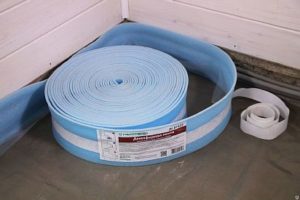
- a damper tape is installed around the perimeter of the room;
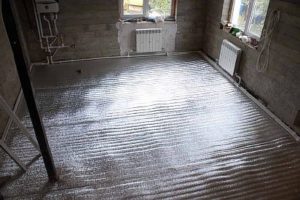
- the thermal insulation material is laid with the foil side up and secured with adhesive or mounting tape;
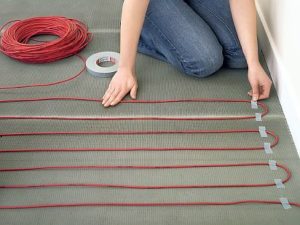
- a mounting or metal tape is spread out and fixed onto the insulation; it is intended for securing the wire;
- the heating cable is placed - it is laid according to the planned scheme, with an indentation from the walls of at least 5 cm, and secured with tape;
- a temperature sensor is installed at a distance of 50–60 cm from the wall, the wires leading to the thermostat are placed in a corrugated pipe;
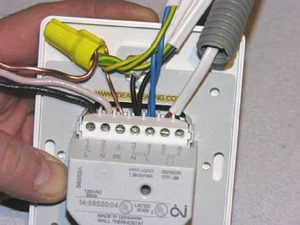
- the system is connected - the cable and wires from the sensor are connected to the controller;
- Technological holes are made in the insulation - they need to be made every 40 cm;
- a concrete screed is poured - you can use a ready-made mixture or prepare it yourself, the solution is leveled;

- a thin underlay is laid - it serves as a sound insulator;
- laminate flooring is being laid.
Before pouring the screed, you need to check the device for functionality.
Heating mats
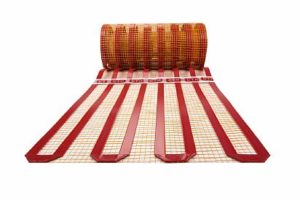
A matte heating system is a thin cable attached to a mesh. It's recommended for rooms with low ceilings, as installation doesn't require a thick concrete slab. Furthermore, laying laminate flooring on this type of system is easy.
The main advantage of mats, which distinguishes them from conventional cable heating, is that if one section fails, the entire unit continues to heat. However, their price is higher.
Mounting mat
The process of laying mats:
- installation of a thermostat - mounted at a height of 30 cm from the floor;
- punching grooves for the cable from the regulator;
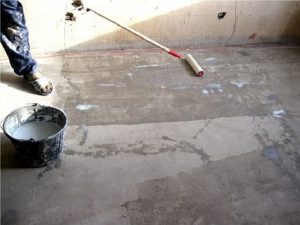
- preparing the base - if there are significant differences in level, it is necessary to pour a thin layer of leveling mixture;
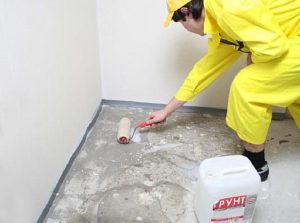
- priming the concrete surface - this will improve the adhesion of the adhesive to the concrete;
- installation of the sensor - it is placed in a prepared groove, the sensor is first placed in a corrugated hose, at the end of which there is a plug;
- sealing the groove with the sensor with mortar;
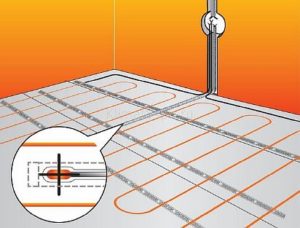
- laying insulation - a thin material with a laminated surface, the sheets are laid tightly, glued with tape, windows are made in them for the glue to penetrate;
- placement of mats - they are placed on planned areas, the stripes should not overlap each other;
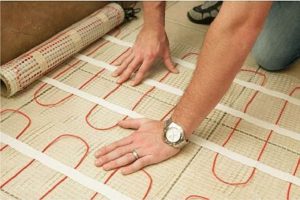
- connection - cables from the mat and sensor are connected to the thermostat;
- checking the operation - for this, voltage is applied for a certain period of time;
- application of tile adhesive or concrete mortar - a layer of 8 - 10 mm, while not allowing the formation of air voids;
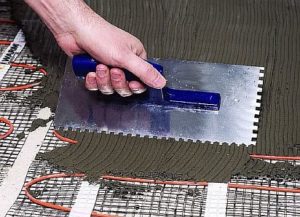
- laying the underlayment - it serves as sound and heat insulation only after the solution has dried;
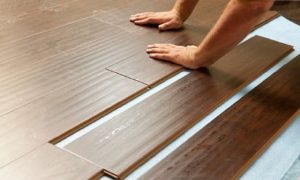
- installation of laminate.
Amorphous metal
The basis of this design is an amorphous metal alloy, which has:
- high efficiency;
- increased resistance to moisture and corrosion;
- strength and flexibility;
- electromagnetic safety;
- good level of thermal conductivity.
These properties make the floor universal; it can be laid under various coverings, including laminate.
Advantages of a device based on metal alloys:
- uniform heating of the room;
- easy installation;
- efficiency in energy consumption;
- Possibility of installation under furniture;
- warranty period up to 25 years.
Installation
Installation of amorphous metal flooring is much easier than installation of other systems.
A substrate is laid on the prepared concrete base, on which heating mats are placed, laminate is laid on top; a concrete screed is not required.
Connects to a thermostat that is installed on the wall.
Installation of sensors: temperature, thermostat
A thermostat is a device for controlling room heating and regulating temperature. The device can be mechanical or electronic.
If the controller is mounted on a wall, the wires are concealed within a plastic conduit. For internal installation, a recess is made to accommodate the conduit, and grooves are punched for the wires.

It is placed on the wall 1 - 1.5 meters from the floor, preferably near electrical outlets, and also away from windows.
The temperature sensor is the core component of the heating system. It's small, with two wires running from it that connect to the controller.
The device's operation depends on the accuracy of the temperature sensor's readings. Therefore, choosing its installation location should be done carefully.
It should be positioned at least 60 cm, or preferably 1 meter, from the wall, in the middle of the film or between the cable loops. For cable floors filled with screed, the temperature sensor is placed in a corrugated hose; this will protect it from the screed and simplify the replacement process.
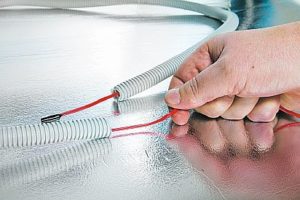
This device is very fragile and breaks frequently. But it's inexpensive, so the costs are negligible.
Comparison of electric floors: which one to choose?
The first step when choosing an electric heating system is to calculate the required floor elevation for each model. If your ceilings aren't high, or you don't want to raise the floor, it's best to choose models that don't require a screed, such as infrared systems or thin cable mats.
If the ceiling height allows, a cable-based screed system can be used. This type of screed system requires a thicker cable than a mat, at least 20 mm of insulation, and a minimum of 30 mm of screed. Concrete mortar up to 50 mm thick can be poured; this type of structure is stronger, but the heating time is significantly longer.
When choosing a heating system, it's important to match the laminate flooring to the heating system, as they must be compatible. This product can emit formaldehyde when heated, so it's important to check whether the model is compatible with underfloor heating. Infrared systems are an advantage in this regard, as they use infrared rays for heating.
How to choose laminate?
Laminate is an MDF product with a polymer face. When choosing laminate for underfloor heating, consider the following:
- The presence of a symbol indicating that the product is resistant to high temperatures and meets European Union standards.
- The amount of harmful substances should not exceed the norm, otherwise the material will release harmful substances when heated.
- Thermal resistance - the higher the better.
- The thickness of the slats - the thicker they are, the less heat enters the room.
Also, the method of joining the panels is important. If they're glued, they're not suitable for underfloor heating. Avoid very cheap products—they're of low quality.
Laying laminate flooring
The principle of laying laminate flooring depends on the type of underfloor heating:
- Cable-type flooring: The final flooring can only be laid after the screed has completely dried. An underlayment—thin polystyrene sheets or a special insulator—is placed on top. Laying laminate directly on concrete is possible, but the sound insulation will be reduced.
- Film-based flooring—since it's installed without a screed, a thick polyethylene layer is laid to protect the conductive material from mechanical damage and moisture. The laminate is then laid on top of this.
In all cases, the finishing coating is assembled in a standard manner: the panels are fastened together by snapping the locking joints.

Top manufacturers
When choosing an electric underfloor heating system, you should give preference to manufacturers who have been producing their products for several years.
Teplolux
TechnoLux is a Russian company that produces cost-effective, efficient devices for supplemental and primary heating. They offer a variety of models, including cables, mats, and rugs. They are inexpensive and easy to install. However, the thermostat in these systems quickly fails.
Unimat
Unimat (Korea) produces infrared core floors with increased moisture resistance. The systems are energy-efficient, affordable, and come with a 20-year warranty. However, this type of heating system cannot be used as a primary heating system at temperatures well below freezing.
Devi
Devi is a Danish manufacturer. The company produces high-quality cable products at an affordable price. Their heating devices are easy to install, don't dry out the air, and come with a warranty of over 20 years. A drawback is their high energy consumption.
ReXva
ReXva (South Korea) produces infrared self-regulating floors. They come with a thermostat and sensor. Their key feature is the ability to automatically lower the temperature in areas prone to overheating. Their advantages include energy efficiency, moisture resistance, and extending the lifespan of laminate flooring. The price is high, but the quality justifies it. Their drawbacks include dust attraction.
Caleo
Caleo is an infrared floor made in South Korea, designed for quick, dry installation. It offers good heat transfer and comes complete with all necessary installation components. Its only drawback is its fragility.
Heat Plus
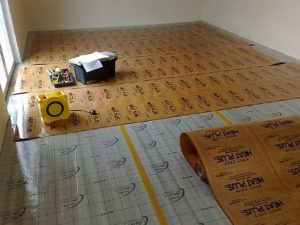
Heat Plus (South Korea) is a flexible infrared film with carbon strips. The device emits long-wave infrared rays that are harmless to humans. The film is universal—suitable for both floors and walls, durable, and can be used without a thermostat. Its drawback is its high cost.
Rehau
Rehau (Germany) produces a two-core self-regulating electrical cable of a specific length. It features increased resistance and a double insulating coating on the outside. The price of this product is high, but its quality justifies it.
If you decide to install electric underfloor heating under your laminate flooring instead of hydronic, you should familiarize yourself with the specifications of not only each heating system brand but also the descriptions of each laminate flooring model. By comparing the pros and cons and ensuring the compatibility of the heating system with the finished product, you can choose the right model for your apartment.