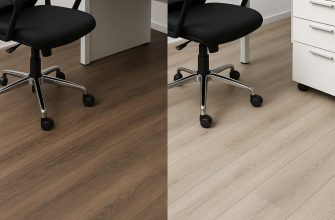
Film-based underfloor heating is becoming a popular method for heating apartments due to its ease of installation and efficiency. Like any heating method, it has its advantages and disadvantages.
Installing and connecting IR film does not require any specialized skills or experience, so you can do the procedure yourself, but we have prepared a guide for you an article that describes the connection process step by step.
When installing, follow the manufacturer's instructions and the general installation plan to ensure the process goes smoothly and quickly. It's important to install the film carefully to avoid accidentally damaging the heating elements.
- Advantages of film-based underfloor heating
- The principle of operation of underfloor heating
- Technical characteristics of heating film
- Calculation of materials and preparation of tools
- Instructions for installing film-based underfloor heating
- Preparing the premises
- Laying thermal film
- We install a temperature sensor
- Installation and connection of the thermostat
- Selecting the finishing coating and installation
- Video instructions on how to install underfloor heating
Advantages of film-based underfloor heating
The advantages of installing film floors include:
- low energy costs due to high-quality heat transfer, efficient room heating and low power consumption;
- no need to create a concrete screed for the finishing coating;
- Safe for children, pets, and all home residents. The heat wavelength is up to 20 microns, which is not harmful to the apartment's occupants;
- You can install a film-based underfloor heating system yourself; you don't need to hire professionals or purchase expensive equipment; just follow the instructions;
- If you connect the heated floor correctly, it can last up to 30-40 years;
- When moving, the film can be removed and reused in a new apartment or private home. This distinguishes it from other heating systems. The main requirement is the use of laminate, parquet, linoleum, or carpet as a floor covering (these types of flooring are easily removed and do not damage the infrared floor).
- The film provides space heating through infrared radiation. Unlike other heating methods, it does not reduce air humidity. This promotes the well-being of residents.
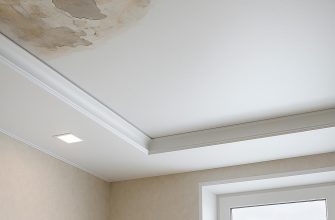
It's worth noting that electric film underfloor heating can be used as more than just a heating system. This design can also be used by installing the film under ceiling or wall finishing materials due to its thin thickness.
The principle of operation of underfloor heating
Film-based underfloor heating operates using infrared radiation. This technology is quite common today, used as a heating element under laminate, linoleum, carpet, parquet, and even ceramic tiles. Under certain conditions, this method can also be used to heat wood floors. The film can also be installed in wood or plasterboard suspended ceilings.
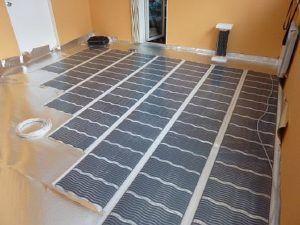
Infrared heating from the floor is perceived by people as solar heat due to the similar nature of the source. The design consists of several sheets of film, which are laid in a specific manner on the floor surface. In addition to the main material, the kit includes the necessary cables and rods. After installation, the floor is connected to the household electrical network, and the floor covering is installed.
The operating principle differs slightly from standard convection heating technologies. In fact, infrared radiation does not heat the air, and therefore, no energy is wasted on heating furniture and other objects located outside the heating zone.
Technical characteristics of heating film
Before purchasing a film floor, we recommend carefully examining the models available on the market to select the best option in terms of quality and cost. This requires understanding the differences and technical specifications of the various options.
When purchasing thermal film, it is advisable to pay attention to the following characteristics:
- Power – always indicated per linear meter. Typically, a suitable value is 44-68 W;
- melting point - 130 degrees is indicated, however, during operation it should not rise above 55 degrees Celsius;
- percentage of IR radiation in the overall frequency spectrum – a value above 95% is recommended;
- material thickness – the most common thickness is 0.4 mm;
- The length and width of the film sheet – in most cases 8 x 0.5 m. Determined based on the area of the room.
Calculation of materials and preparation of tools
Tools required for installation:
- single-sided and double-sided construction tape for fixing the base and film;
- hammer drill;
- grinder and a cutting disc for cutting stone;
- scissors;
- spatula with teeth;
- pliers;
- building level;
- brush with a wide base;
- mixer for construction purposes;
- container for mixing solutions.
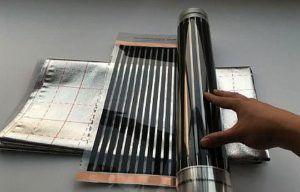
To install underfloor heating, you will need to prepare the following materials:
- a heat-insulating underlay that is placed under a warm film base;
- A film made of polyester and heating components. The components are carbon paste, connected by copper bridges;
- A temperature sensor and thermostat, which provide the ability to automatically adjust the temperature of the film-based underfloor heating system. These elements also provide temperature control based on environmental factors;
- bitumen insulator for protecting electrical connections;
- terminals that connect the contacts of electrical network wires and underfloor heating cables.
It's also necessary to prepare the finishing materials used as the floor covering. If the film strips are not the right size for the room, they can be cut.
However, this procedure must be carried out with extreme caution, having first made sure that the manufacturer of the specific model allows this to be done.
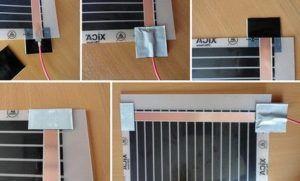
Please note: when connecting cable contacts, it is essential to use only the terminals provided. Tin-plated connections and soldering of any cross-section to the underfloor heating strip are prohibited.
When soldering, the busbar conducting the electricity heats up significantly, increasing the risk of damage to the wire contact point. In many cases, this can lead to failure of the entire wiring system. Installation and connection should be made using crimp connectors.
Instructions for installing film-based underfloor heating
A brief step-by-step instruction consists of the following stages:
- Create a plan to indicate the location of furniture and installed appliances. It's important to consider the room's square footage and the total power of all heating system components.
- Mark out the room footage according to the diagram.
- Prepare the base for laying.
- Installing a base layer that acts as thermal insulation will significantly reduce energy costs by preventing the concrete beneath the floor from heating up.
- Install a film-based underfloor heating system.
- Install the temperature sensor and thermostat.
- Connect the heated floor to the network and check its operation.
- If there are no problems identified in the previous stage, polyethylene should be placed to act as a protective coating and sound insulation.
- Lay the final floor covering.
Before beginning installation, it is recommended to carefully and thoroughly review each step of the procedure. Correct installation is only possible if the technician strictly followed the instructions.
Preparing the premises
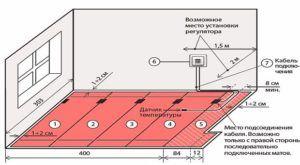
Before preparing, it's essential to draw a room plan, including the IR film connection diagram and furniture placement. When drawing the plan, be sure to adhere to scale and mark the dimensions of all interior elements and the width of the sheets of material used for the IR film floor heating.
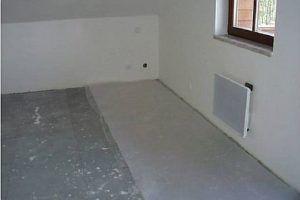
When preparing the old floor surface, it may not need to be removed. Complete removal of the flooring layer is only necessary if the screed is damaged and has significant deformations.
Building codes define the permissible difference in elevation of the original surface. It is 20-30 mm per linear meter, regardless of the alignment of the spirit level or the applied ruler.
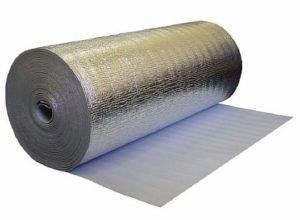
The next step is to install thermal insulation. This will prevent unnecessary heat loss on the floor and concrete slab below (this is especially important if you have a basement). Thermal insulation materials such as Penofol (Izolon) or cork backing can be used—learn about the different types and what type is best. What kind of underlay is suitable for what kind of flooring?.
The first option is made from polyethylene, which, when foamed, forms a cellular substance that is impermeable to liquids. The second is a mixture of cork wood and suberin (a specialized substance that imparts viscosity).
It's best to use a foil-coated underlayment; it will reflect infrared radiation from the film-based underfloor heating, increasing heating efficiency. This underlayment provides waterproofing and directs heat back into the room.
To install the floor underlay, lay it across the entire surface, tightly against the walls. Then, secure the resulting joints with construction tape. When using thinner material, the sheets can be secured with special staples.
Laying thermal film
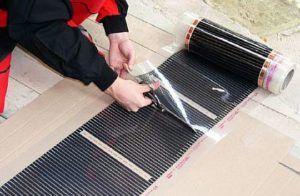
Using the prepared diagram, the DIY technician should calculate how many pieces of film will be needed. The material should then be cut with scissors; the maximum length of the piece should not exceed 8 meters.
Underfloor heating can be installed either longitudinally or transversely. Both options are acceptable, so the choice should be based on budget (i.e., calculating which method will save on heating elements). Experienced installers generally recommend laying the strips longitudinally, as this reduces the number of connection points.
The film must be installed with the side facing up, where it is marked (or if specified in the manufacturer's instructions). The installation method varies by manufacturer. For example, some models require installation to maintain a 1 cm gap between the copper bars. The main rule during installation is to avoid bending the carbon strips to a right angle.
Once installed, the film flooring will need to be secured with double-sided tape. The final step is to seal the cut areas with a bitumen compound.
We install a temperature sensor
The temperature sensor is placed in a 16 mm diameter corrugated tube, which is then positioned under the heating element. It is important that the tube containing the sensor be placed on a thermally insulated base; only then will the mechanism display the correct value.
There are two main rules when choosing a location: the temperature sensor should be installed close to the thermostat, and the distance from the wall should be more than 0.3 meters.
To avoid unevenness in the installation area, the technician typically makes small grooves in the insulation material and coating.
Installation and connection of the thermostat
The thermostat can be installed anywhere, but the main requirement is that it should be protected from direct sunlight. It is recommended to consider in advance which side and line (at least 80 cm above the floor) the device will be located on, as this will affect the installation of the IR film.
To reduce the length of cables used for connection to the electrical network, the heating components of the film underfloor heating should be placed with their contacts facing the wall where the controller is planned to be installed.
There are two installation methods: external and internalIn the first case, the thermostat is mounted directly on the wall, while in the second, it is installed in a specially created wall niche. The concealed method is considered the most common, as it eliminates the need for space.
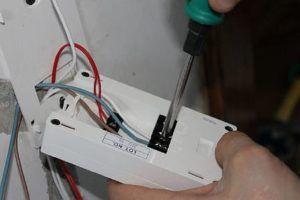
The niche and channels for the wiring are made small (about 20 mm deep). The wires are laid, and the electrical box is installed. The rest of the process is similar to installing an electrical outlet: simply connect the required wires to the corresponding contacts, using the color as a guide, and connect the sensor wire terminal. This completes the connection of the film-based underfloor heating system, and you can begin finishing work.
Selecting the finishing coating and installation
After connecting the floor, it's important to check the system's operation. It should be tested and the obtained values compared with the test data. It's also a good idea to check the heating temperature of each component.
If the section isn't working or isn't heating up enough, it needs to be replaced. Be sure to check the electrical contacts for a burning smell or sparks.
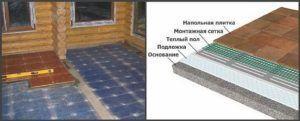
The advantage of the film system is that there is no need to create a concrete screed. If laminate or parquet is used as the finishing coating, you just need to cover the film with soundproofing material and you can place it on top.
When using a softer covering (carpet, linoleum), it will be necessary to add a layer of fiberboard or plywood. This will prevent early failure of the film-based underfloor heating and eliminate the need for reinstallation.
Thus, using polyethylene infrared film as a heating system is a convenient and effective way to heat a room. The efficiency of such a system is quite high, and the heated base can be installed quickly and without any experience. The key is to follow the manufacturer's instructions and guidelines.
Video instructions on how to install underfloor heating
Video: Connecting Underfloor Heating
Watch the video: Connecting an infrared floor
Video: DIY Flooring in 1 Hour