Frame houses on stilts are quick to construct and inexpensive. However, they lack a solid foundation, which leads to cold floors. Therefore, underfloor heating is recommended for these houses.
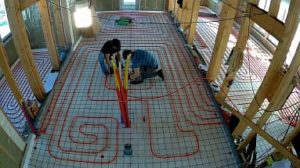
If you're planning to build a frame house on stilts, you'll find this article interesting. You'll learn about the pros and cons of underfloor heating systems. We'll also discuss which model is best and explain how to install the heating system yourself.
- The pros and cons of underfloor heating in a stilt frame house
- What type of underfloor heating should I choose?
- Installation of heated floors on piles
- Water
- Cable mats
- Subfloor installation
- We produce flooring
- Floor insulation
- Technology for insulating the floor under the house and the first floor
- The process of insulating the basement
- Installation of water-heated floors in polystyrene screed
- How to calculate the load on wooden floors from screeds
- Installation of electric underfloor heating
The pros and cons of underfloor heating in a stilt frame house
Underfloor heating is an artificially created heating system that can provide comfort in a home. There are two ways to insulate a home with underfloor heating: using hydronic or electric systems. We'll explore the advantages and disadvantages of these systems, specifically for installation in a frame house, which doesn't have a solid foundation but rests on screw piles.
The main advantages of heated floors in a frame house on screw piles:
- uniform heating;
- saving useful space;
- there is no movement of air, therefore there is no movement of dust and microbes;
- they improve the appearance since there are no heating radiators;
- have a convenient way to maintain temperature due to automation and regulators;
- long service life - especially for water ones.
In addition, since frame houses on piles do not have a solid foundation, the advantages of heated floors include the fact that they cut off the cold air that moves under the floor.
An additional advantage of electric types, especially infrared systems or cable mats, is ease of installation.
Let's consider the disadvantages: they are expensive and cannot be installed into thick concrete screeds. Furthermore, complex calculations are required.
Electric systems pose a fire hazard when used in conjunction with wooden houses. However, with proper installation procedures, the risk of fire is minimized. The disadvantages of hydronic heating include the risk of leaks and the heavy weight of the screed in which the "pie" is laid.
What type of underfloor heating should I choose?
Before choosing a heated floor model, you should decide whether it will be your primary or secondary heating. If it will be your primary heating, you'll need a more powerful system.
Electric floors (cable or infrared) can be installed anywhere, but hydronic floors should only be installed on the ground floor, as there is always a risk of leakage. Furthermore, pouring a screed results in a heavy structure and is not recommended for frame buildings, as it places additional stress on the piles.
When choosing a model, the following are taken into account:
- climatic conditions;
- geological features of the region;
- house design;
- heat loss level.
In terms of energy savings, hydronic heating is more cost-effective; heat is generated by moving a hot coolant through pipes. The coolant is heated in boilers, which often run on gas or solid fuel.
However, the installation process is more labor-intensive and costly, but this investment quickly pays for itself during operation. Furthermore, it's worth noting that lightweight systems have been developed specifically for frame structures.
Electric heating systems (heating cables, mats, or film) are easier to install and lighter, especially infrared film. Electric floors can be installed without screed, using a dry method, or with a layer of tile adhesive. However, since they are electrically powered, they are more expensive to install.
Installation of heated floors on piles
We will consider the simplest and most convenient technologies for installing water and cable heating.
Water
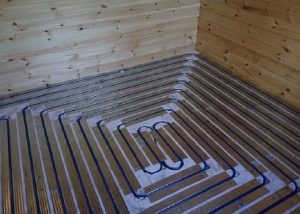
There are two methods for installing water-heated floors: in a floating screed or using a flooring system (wood or polystyrene). A 16 mm metal-plastic pipe serves as the heating element.
For frame houses on piles a "dry" screed is better suited Made from polystyrene foam mats, as they are lightweight compared to concrete. The "pie" of such a hydrofloor consists of:
- even base;
- waterproofing;
- damper tape;
- polystyrene boards with grooves;
- special aluminum reflectors;
- pipeline;
- second layer of waterproofing;
- gypsum fiber sheets;
- floor covering.
The coolant is heated in a boiler, which can be gas or solid fuel.
Cable mats
Although an infrared system is easier to install, we will be considering a cable floor installation, as the film is only suitable for installation on the second floor. Its power will be insufficient for heating the first floor of a house on stilts, which lacks a solid foundation.
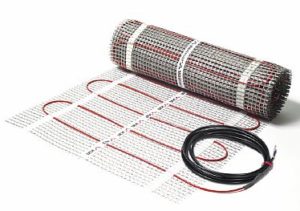
Cable mats are wires secured to a grid with a standard pitch. A unique feature of the installation is that they can be installed within a layer of tile adhesive. Simply prepare the base and cover it with waterproofing material and insulation, on which the mats are placed.
In addition, to regulate the temperature level, you will need a thermostat and a sensor.
Subfloor installation
The subfloor is a level surface located between the blocks, onto which the final finishing material is installed. Since overloading the piles is undesirable, a durable but light material is required.
There are several suitable options for arranging the foundation in a frame house:
- OSB is a durable material, but vulnerable to water damage. It requires treatment with a special protective compound. The weak points of this type of flooring are the joints.
- Chipboard is easy to install, but it's also susceptible to moisture. It's also less environmentally friendly than OSB.
- Multilayer plywood – only moisture-resistant types (FC or FSF) are suitable. They contain formaldehyde resins, which make the material more resistant to aggressive environments.
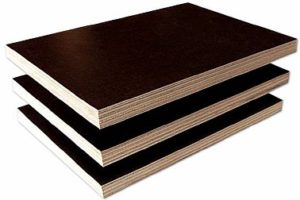
Boards up to 10 cm thick are often used for flooring construction. This results in a durable and reliable floor.
We produce flooring
When choosing flooring material, it should be not only durable but also lightweight. It's best to minimize the load on the supports. It's best to choose wood—aspen, oak, or coniferous. The wood should be dry and undamaged. It should be treated with an antiseptic before installation.
The floor in a frame house on a pile foundation is made up of two layers: a base and a wood slab. It should be installed immediately after the pile foundation and grillage are installed.
The work consists of several stages. First, the frame is constructed using 10 x 10 cm beams. These are installed on piles and connected with screws. If the distance between them is more than 3 m, additional posts are required in the middle.
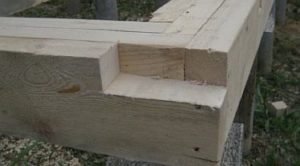
Joists measuring 10 x 25 cm are mounted on the beams at 50 cm intervals. To install them, grooves are made in the frame, into which the joists are inserted and secured to the base with screws. The joists are then sheathed from below with 3 x 3 cm boards.
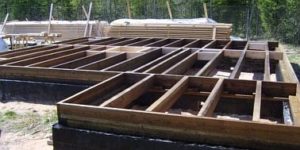
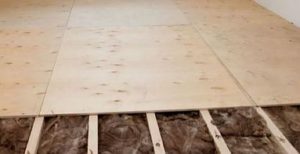
To make the structure more durable, slats are nailed onto the joists at 150 cm intervals. OSB or plywood decking is installed on top of these slats. Waterproofing and thermal insulation are first installed in the joists.
Floor insulation
It is recommended to select thermal insulation from the following types of materials:
- Mineral wool is a basalt fiber board. The material is environmentally friendly, non-flammable, has low thermal conductivity, and a water absorption rate of 2%. When using mineral wool, the boards should not be treated with water-based paint.
- Extruded polystyrene foam is currently the leading material. EPS is resistant to deformation, flexible, easy to install, and does not absorb water. Its main drawbacks are its high price and flammability.
- Expanded clay is a budget-friendly alternative to sheet insulation. It is fireproof, but slightly inferior in thermal insulation to the above-mentioned types.

- Polystyrene foam is inexpensive and has good thermal insulation properties. However, its structure deteriorates when exposed to cold and moisture.
Mineral wool is the most suitable material for a frame house on stilts. It's lightweight and doesn't place significant loads on the floors. A layer as thin as 10 cm is sufficient to provide good thermal insulation for the building.
For thermal insulation of the first floor, the best option is expanded polystyrene foamIt creates a rigid coating that protects against moisture and other impacts. Expanded clay is recommended for baseboard insulation—it's inexpensive and high-quality.
Technology for insulating the floor under the house and the first floor
To ensure warmth in a frame or log house, it's important to properly insulate the ground floor. Polystyrene foam boards are suitable for insulating the lower floors of a house on stilts. Standard sizes are 1 meter by 120 cm.
The technological process is simple:
- the slabs are laid along the joists;
- the slabs are screwed to the joists with long screws, while boards are placed across the joists;
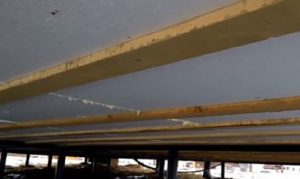
- all joints are sealed with foam from the house;
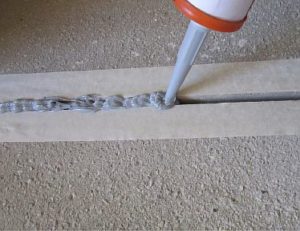
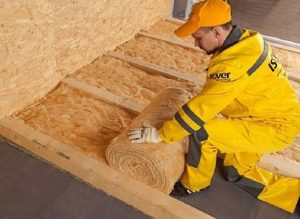
- 200 mm of insulation is laid between the joists on the house side. Mineral wool is suitable;
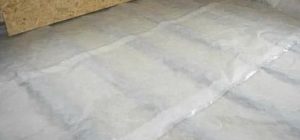
- vapor barrier is laid;
- The subfloor is installed - inch boards or chipboard.
With this insulation option, the dew point will be inside the house, so it will be warm inside.
The process of insulating the basement
High-quality basement insulation plays a major role in creating a comfortable atmosphere in a home. If cold air masses are prevented from penetrating beneath the building, heat will naturally be better retained inside.
Insulating a basement is done in the same way as insulating walls. However, in addition to the vertical placement of the insulation material, it must also be placed under the blind area.
Basement insulation technology:
- the soil under the house is compacted and a 10 cm sand cushion is poured;
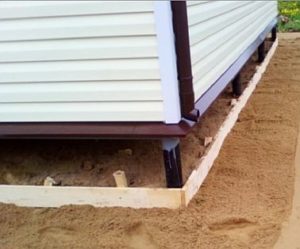
- for the base, a 15 cm thick frame is prepared and covered with plywood from the inside;
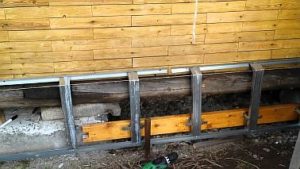
- a vapor barrier is laid from the blind area to the top of the base, its seams are sealed with tape, and the material itself is attached to the boards with a stapler;
- along the beacons with a slope away from the house, expanded clay is poured onto the blind area, 10–15 cm thick;
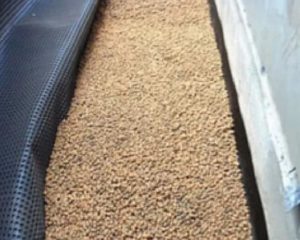
- on top of expanded clay concrete screed is being poured;
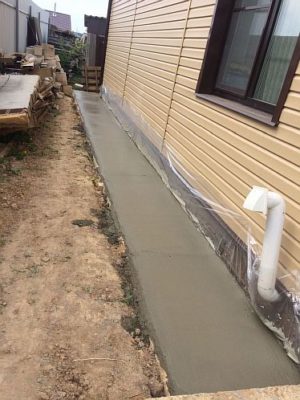
- after the cement has dried, 50 cm high boards are nailed to the outside of the base;
- a hydraulic layer is laid inside the resulting well;
- expanded clay is poured in and covered with the edge of a waterproofing film;
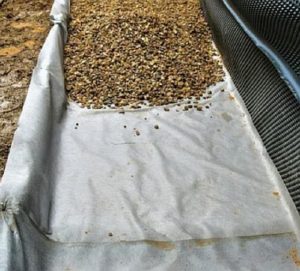
- The base is covered with boards to the end and covered from above.
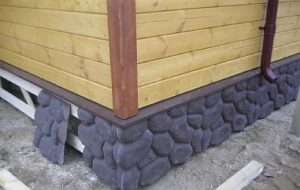
A house on piles insulated in this way will be inexpensive, but will provide good frost protection for the building's foundation.
Installation of water-heated floors in polystyrene screed
We propose installing a heated hydronic floor with polystyrene screed in a frame house on stilts. The installation diagram is as follows:
- The rough base is being cleaned.

- If the heating system is installed during construction, this assumes the floor is level. If the room has already been used, the surface must be leveled.
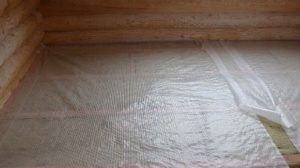
- A thick polyethylene film is laid on the base to act as a waterproofing layer. It is overlapped and secured with a stapler.
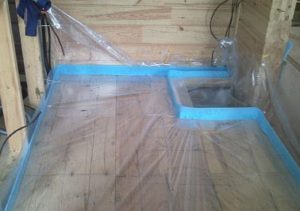
- A damper tape is glued along the walls - it will compensate for expansion when heated.
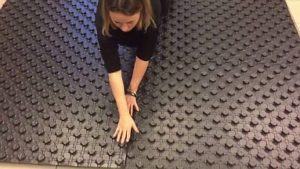
- Polystyrene mats with studs are laid and connected using locking joints.
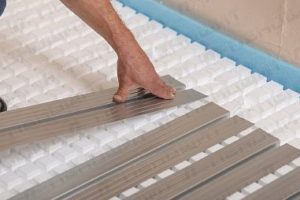
- Metal plates are placed between the grooves; they are designed to properly distribute heat.
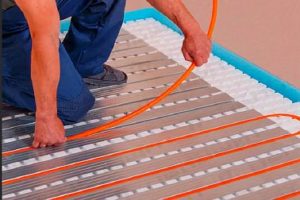
- The pipeline is laid out in the grooves of the plates according to the “snake” or “snail” pattern.
- The second layer of polyethylene is placed.
- The structure is covered with two layers of gypsum fiber sheets. The joints are sealed with adhesive. The second layer is laid in a staggered pattern.
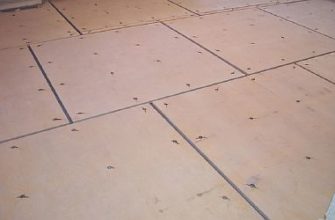
Before covering the "pie" with gypsum fiber sheets, the pipeline must be connected to a power source. In private buildings, this is the boiler equipment responsible for heating the coolant.
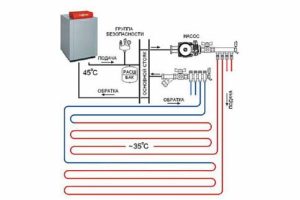
The pipes need to be connected to the boilers through the mixing and distribution groupIt is used to adjust the temperature level and distribute the coolant throughout the circuits. After this, the system is pressure tested, and only then can the structure be covered with plywood and the final finishing applied.
How to calculate the load on wooden floors from screeds
If underfloor heating is installed in a screed, the load on the joists must be correctly calculated to ensure they can support the weight of the concrete.
To calculate the load, the average weight of 1 cubic meter of concrete is taken with a margin of 2,300 or 2,500 kg. The total volume of the screed is calculated by multiplying the area of the house by the height of the screed. For example: area 87 m2 and a 6 cm tie.
87 x 6 = 5.22 m3
The mass of the screed is 5.22 x 2500 = 13000 kg.
13000 x 87 = 150 kg per m2.
It is better to do the load with a reserve, so that m2 could withstand a weight of not 150 kg, but more.
Installation of electric underfloor heating
When installing any electric floor, you need to begin by choosing a location for the thermostat. A flush-mounted electrical box with the wiring connected is prepared in this area. A vertical groove is made into the floor for the wiring.
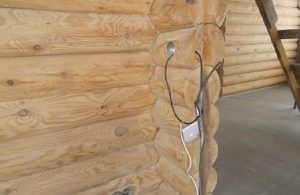
After that, we can move on to laying the "pie" itself. We'll be installing underfloor heating in a frame house using cable mats. The special feature of installing the mats in a frame house is that they are laid directly on the finished surface.
- The surface is cleaned of debris and treated with primer.
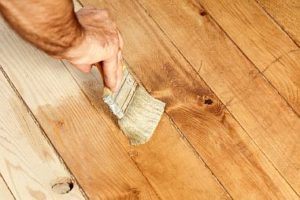
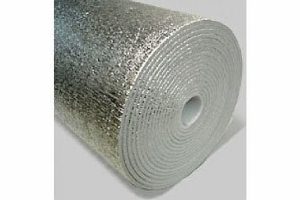
- A reflective backing is laid.
- Mats are laid out.
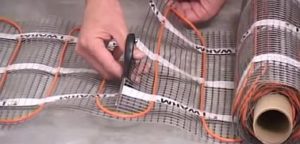
- A temperature sensor is placed precisely between the heating wires. It is inserted into a corrugated pipe and laid in a pre-cut groove.
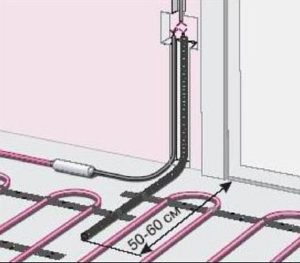
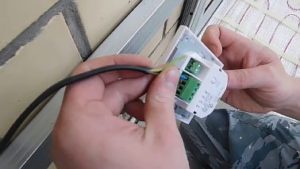
- A thermostat is mounted in the prepared place, to which wires from the sensor and the floor are connected.
- The system is being tested.
- The mats are filled with a layer of tile adhesive.
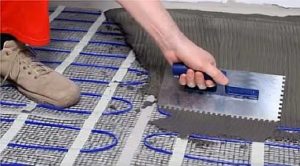
Typically, this type of heating is installed under ceramic tiles. Even in severe frosts, a properly designed heating system can provide comfortable heating in a frame house on stilts.
Installing heated floors, especially on the ground floor, will prevent cold air from entering through the floor, and the house will be warm and cozy.


How much does it cost to install 1 square meter of this type of underfloor heating?
Hello. It all depends on the region. The approximate cost will be: routing of supply pipes with thermal insulation (price per 1 running meter): from 150 rubles; laying insulation, heat-reflective underlayment, mesh on the sub-base (price per 1 m2): from 500 rubles; pipe installation (price per 1 running meter): from 90 rubles; installation of thermal insulation (price per 1 m2): from 250 rubles; installation of comb: from 3,500 rubles; connection of the same to the general heating system: from 4,500 rubles; hydraulic testing from 3,500 rubles.
Hello, thanks for the article!
But I have a question. We're planning to build a 150mm timber-frame house near Moscow. We're currently considering a heating system. The house is planned to be two-story, with an area of 84 square meters. The company that's doing the work says the underfloor heating on the first floor will be sufficient to heat the second floor as well, and that installing radiators there won't be necessary. But I doubt the heating on the first floor will be sufficient for the second floor... Could you please tell me if this is sufficient?
Thank you in advance for your reply.
Hello! According to the laws of physics, heat rises, which seems sufficient to warm the second floor of a frame house, but practice shows otherwise. Heating only the first floor can be considered in southern regions with mild winters. In the Moscow region, underfloor heating alone is insufficient to heat the second floor of a frame house without radiators in winter.
Remember about heat loss through windowsWith the onset of frost, it will be necessary to install oil radiators for auxiliary heating, which will increase energy costs.
Leaving the second floor without radiators is possible if you don't plan to use the rooms as living quarters in the winter. This will create another problem: condensation. Warm air from the first floor, saturated with moisture vapor, flows up to the second floor. Without heating, condensation begins to form in the cold rooms. Constant dampness will accelerate the growth of fungi, which can destroy the wooden elements of the frame.
Despite the additional expense, it's advisable to heat the second floor. For more accurate and qualified assistance, consult with heating engineers or third-party engineers who specialize in heating frame houses.