 The concept of "heating" is often associated with the cast-iron radiators that used to be found in every apartment. These radiators took a long time to warm up, but they retained heat in the house for a long time and generally functioned well; the only drawback was their unsightly appearance.
With the advent of new materials and technologies, everything has changed. These days, underfloor heating systems, which use a heating line installed in the floor, have become a worthy replacement for old radiators. These days, all new buildings are equipped with such underfloor heating systems.
Having decided to install underfloor heating pipes under a screed, it's important to determine which type of pipes will provide reliable, long-term service. This decision may seem straightforward at first glance, but experience shows that it depends on many factors.
We also suggest you read the article - How to choose underfloor heating for tiles, where we'll take a detailed look at the different types of heated floors, their pros and cons, and how to install them.
The operating principle of a "warm floor"
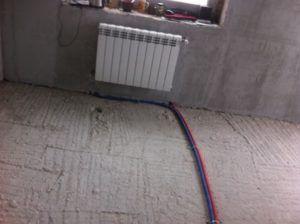 Why is laying heating pipes in screed considered the right choice? There's an easier solution: replacing the radiators. Yes, it's easier, but it doesn't necessarily mean it's more efficient than this type of installation, because the laws of physics still apply.
Heating systems operate completely differently. Traditional radiators emit heat, which then travels through the walls to the ceiling. This means the ceiling warms up first.
The air then moves to the lower region, but it arrives cold. This creates the following situation: the ceiling is warmer, while the temperature below is much lower. The same principle applies to convection.
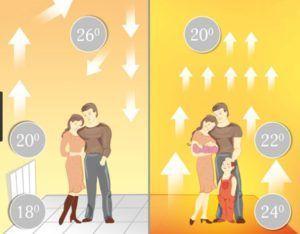
Installing underfloor heating changes everything. The warmth is concentrated at the bottom and then cools as it moves upward. This heat distribution significantly improves home comfort. Consequently, this system appears to be the most efficient.
Underfloor heating: advantages and disadvantages
Before concealing heating pipes in a concrete screed, it's important to thoroughly examine all the pros and cons of this heating system. These should not be ignored, as this will ensure a wise investment.
Let's consider the advantages of an underfloor heating system.
- Long period of use.
- Uniform heating level.
- The concrete floor pouring system is cheaper to maintain than traditional options.
- Easy care.
- No moisture.
- Economical use of space.
- Complete safety (installation of the system in a concrete screed prevents children from getting injured or burned by hot pipes).
- The required level of humidity is constantly maintained in the air.
There are not many disadvantages of the network under the screed, but you need to be familiar with them.
- First of all, when laying the heating main under the screed, the height of the room is reduced.
- Repairing pipes is not as easy as in traditional cases, because it is not easy to find the leak in a hidden pipeline.
- Installation in specific locations is not possible, such as stairwells and the like.
IMPORTANT! These structures can be built without restrictions in private homes, but an apartment will require a different approach. In multi-apartment buildings, it's important to ensure the central network can handle the heavy hydraulic load.
The shortcomings must be carefully examined, and one must be prepared for the possibility that the heating system in the screed may leak sooner or later. It's important to remember that pipe leaks in such structures are not easy to detect.
Even after identifying the leak's location, repairing it won't be easy. Therefore, it's important to approach the job with full responsibility.
What types of materials can be used and which cannot?
Before laying the screed, you need to determine which heating pipe materials are best suited for installation in the floor. There are many options—you can choose copper, or you can opt for an inexpensive and practical material like plastic, which, if installed correctly, will perform perfectly.
Metal-plastic products are also worth considering. Which is the best choice? To answer this question, let's take a closer look at pipes made from these materials.
Pipe products for laying in the floor must have the following properties.
- High strength index.
- Resistance to corrosive formations.
- Impermeability to oxygen, which causes corrosion of steel parts of the heating network.
- Good heat dissipation.
- Low expansion coefficient.
- Environmentally friendly.
The following materials fully meet the listed requirements for laying in the floor under the screed: polyethylene, polypropylene and metal-plastic.
Polyethylene pipes and other types of pipes used in screeds have their own advantages and disadvantages, therefore, before hiding them and making a screed, each material must be thoroughly studied.
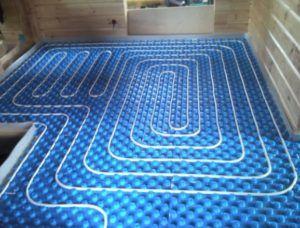 Polypropylene pipes For installation in screeds, they offer the advantage of being inexpensive. However, these products have not found widespread use. This is because polypropylene pipes hidden in screeds have a number of significant disadvantages.
For example, the polypropylene (PP) range features an eight-diameter bending radius. When installing a polypropylene underfloor heating system, this affects the distance between adjacent main lines.
If the diameter of the polypropylene main pipe is 15 mm, the branches will be 120 cm apart, which will negatively impact room heating. Also, polypropylene hydronic underfloor heating can only be installed at temperatures above 15 degrees Celsius. Polypropylene products are inexpensive and have many positive characteristics.
Polyethylene pipe rolling materials Only cross-linked pipes are suitable for this task. Cross-linked polypropylene is strong, reliable, and resistant to high temperatures. However, these pipes do not hold their shape well in concrete floors. Therefore, securing them requires a large number of fasteners.
Experts speak highly of metal-plastic products. Metal-plastic pipes used in screeds have a long service life.
Metal-plastic products have only recently appeared on the market, but have quickly established themselves as leaders. The special three-layer construction of these rolled pipe materials allows them to last up to 30 years.
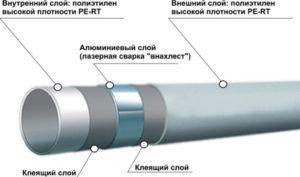
The disadvantages of metal-plastic pipelines include the relative complexity of installation work at home. Hide metal-plastic heating pipes under the floor screed It's not difficult if you have some experience in this type of work.
Metal-plastic pipes are joined using press fittings, so it's important to exercise caution when clamping. Laser or ultrasonic welding is not used for this type of pipe at home.
If the joint is not tightened properly, leaks can occur. If it's too tight, the fitting will fail and need to be replaced.
And here is the pipe rolling made of copper It's ranked among the undisputed leaders. It's far superior to its polyethylene counterparts. Cross-linked polypropylene and metal-plastic are also inferior to copper. In this case, there's only a long list of positive characteristics.
Copper products have one drawback. They are too high cost, which becomes the reason that not everyone can afford to use a structure made of this material for laying under a screed.
When talking about a “warm floor” system, we need to remember such a material as metal. Metal tubular products Experts call it an unjustifiably risky undertaking. The water in the heating system is often saturated. chemicals, and the metal can just can't resist before this aggressive influence.
Ultimately, corrosion occurs in the metal structure, leading to further leaks. Hard water is also detrimental to metal.
Therefore, plastic and copper products are a more practical solution for floor installation. Therefore, metal pipe materials are not recommended for this type of installation.
Preparing the premises
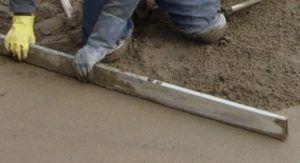 Before sealing the heating pipes in the floor screed, all other utility connections must be located and windows and doors installed. It is recommended to remove furniture from the room and dismantle the old heating system, unless this work is being carried out in new buildings.
Surface irregularities are allowed within a radius of one centimeter. If they exceed this limit, the heating base must be leveled.
It is recommended to insulate rooms located above cold zones with thermal insulation panels. If they are not separated, heat will escape into the other room.
The final stage of preparatory work is cleaning. This is essential before sealing the structure with concrete. Industrial vacuum cleaners are excellent for this task.
Laying underfloor heating in a screed
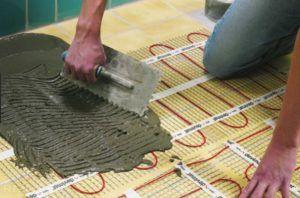 This option is used in apartments and private homes. It's even used over wood flooring or under surfaces like laminate.
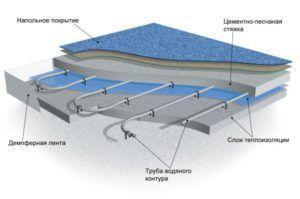
The pouring is performed on a subfloor or a wooden floor. The procedure in both situations is the same.
- They are laying out waterproofing.
- They are laying insulation.
- They lay a reinforced mesh.
- The pipeline is being laid out and secured.
- They glue the damper tape.
- The entire structure on the floor is filled with mortar.
We carry out waterproofing
It protects against moisture ingress and prevents wet mortar from coming into contact with the floor. Afterward, the work surface must be insulated. Foam plastic is the optimal choice for this task. Penoflex, a derivative of foam plastic, has also received high marks from experts.
A steel mesh is placed over the insulating material. This is necessary to evenly distribute the load across the cured screed. Without this reinforcement, the screed may crack.
Piping in such networks is carried out in two ways.
- Snail.
- Snake.
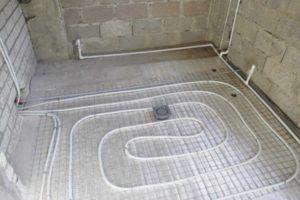
The first scheme involves laying the ductwork in a circular pattern from the walls to the center of the room. This design avoids sharp turns in the circulation direction.
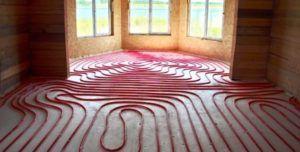
The serpentine starts from any wall and then moves toward the other one, located on the opposite side. With this design, the direction of fluid flow changes 180 degrees on all sections. The first layout is most often used in everyday life.
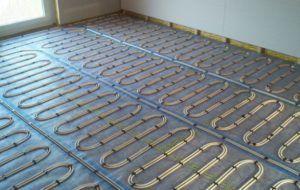
The circuit should be secured to the surface. When doing this, keep in mind that it increases the overall dimensions of the pipe. Therefore, the fasteners cannot be rigid, and the pipe must be able to slide. Plastic clips attached to the floor are effective for this purpose. Simple clamps can also be used.
It's crucial to remember to use a damper tape. This is a strip of foamed polymer material. It should be glued to the wall around the perimeter of the room. The bottom edge of the tape should be placed along the floor. This will help absorb the expansion of the fill and prevent the mortar from sticking to the walls.
Many people wonder how many centimeters the screed should cover the pipe structure. Experts say it shouldn't be less than three centimeters. The optimal thickness is 7 cm.
If it's less than the recommended thickness, the fill will simply crack. If the layer is too thick, the expected temperature won't be reached. And such underfloor heating won't provide comfort.
When laying heating pipes, it's crucial to maintain a consistent spacing between coils or zigzags. For example, for a 20 square meter room, this distance is twenty centimeters. For larger rooms, it's recommended to install multiple heating coils or serpentines.
Underfloor heating pipes can be concealed using either wet or dry fill. The former method is more common. Dry fill creates a lower density, which slows down heat transfer.
Building such a heating system yourself isn't difficult. The key is patience and some knowledge. With a little extra effort, the excellent results of your underfloor heating system will last for decades.