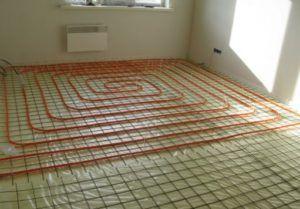
 Underfloor heating has become increasingly popular recently. However, before beginning installation, it's essential to calculate the required length of the piping materials. The question of how to determine and calculate the pipe consumption per square meter for underfloor heating (how much pipe is required per square meter) can be answered definitively, although many "experts" still struggle to figure it out.
Each private home has its own individual heating system. Therefore, installation is often done by hand. Of course, this type of heating can be installed in an apartment, but warm structures in such spaces are more difficult. it's not that easy to do.
The diameter and shape of tubular products for underfloor heating systems vary, so to understand how to calculate the consumption of rolled tubular materials, it is necessary to examine the design of this system in detail.
- Options for installing underfloor heating
- What pipes can be used for the job?
- Is there a dependence on the installation method, type of pipes and length of the circuit?
- Optimal volume of pipe assortment
- Let's calculate the required consumption of tubular products per m2
- Selecting the installation step
- Let's determine the length of the contour
- Required number of circuits
- We are installing the manifold
- Common mistakes and recommendations
Options for installing underfloor heating
There are two variants of this system.
- GrazingThis structure is covered with a deck made of some material. For example, it could be wood, polystyrene, or something else. When discussing this method, it's important to note that installation is much simpler in this situation, as the extra time spent pouring the deck is eliminated.

- ConcreteThis will require a screed, and it won't be possible to complete the job quickly.

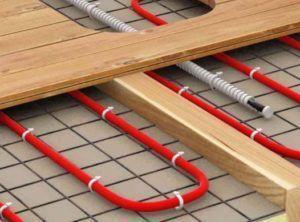
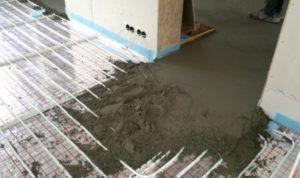
In both cases, styling becomes a challenging task. For this reason, many turn to professionals for help. If you decide to do it yourself, you should have the necessary knowledge and skills and strictly follow all instructions.
During installation work, pipes can be laid:
- snake;

- snail.

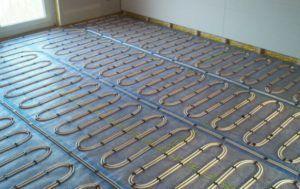
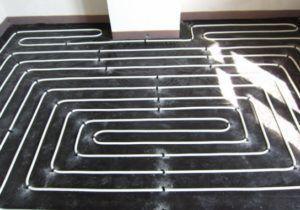
For a large room, it is better to choose a snail, and for small rooms with a complex geometric shape, a snake would be the best option.
What pipes can be used for the job?
Pipes are a key component in the installation of a hydronic underfloor heating system. The quality of the system depends on the correct selection at this stage. If the selection is incorrect and the calculations are incorrect, the heating system will not operate effectively.
Watch the video
- CopperThis material is undoubtedly one of the best. It is used in most European countries. Copper combines all the best qualities. However, the only significant drawback of these products is the high cost of purchasing this material.
- PolypropyleneThese products are used for heating networks just as rarely as the first option. However, the reason lies elsewhere. A significant drawback of these products is their large bending radius. This means that a 20 mm pipe, when extended from two sections, will not reach 320 mm. This is often insufficient.
- Cross-linked polyethylene (PEX)This rolled pipe product boasts high thermal conductivity and wear resistance. Given these characteristics, it is inexpensive. The main drawback of this product is the need for rigid fixation during installation, otherwise it will bend.
- Metal-plastic (MP)This material has gained the highest popularity among consumers. The installation of a heated floor made of metal-plastic is rightfully considered the most balanced and a high-performance option. It's all about the high efficiency and durability of the network made from this material.

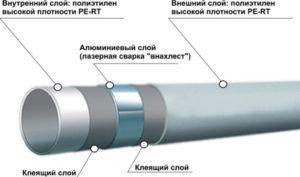
The metal-plastic pipe is equipped with an internal aluminum layer, surrounded by a polymer layer both inside and outside. These features give the metal-plastic product high resistance to damage and low thermal expansion. These significant advantages are complemented by a reasonable price.
Is there a dependence on the installation method, type of pipes and length of the circuit?
Before purchasing materials and beginning installation, prepare a drawing of the future structure. Don't throw it away after the work is completed. It will be useful during system repairs, as it shows the precise placement of the pipes.
When choosing an installation option, keep in mind that it depends on the material used for the product range. For example, the consumption for a 20mm pipe for underfloor heating would be as follows. The length of one circuit of the structure should not exceed 120 meters.
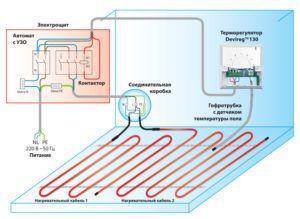 Otherwise, the pressure in the network will not reach the required level. Accordingly, when calculating 20 mm pipework, it is important to remember that a separate floor circuit will take up no more than 15 square meters.
All contours must be of uniform length. This is taken into account when choosing a 20 mm pipe installation method. The calculations are actually quite complex, as they require consideration of numerous nuances. If any difficulties arise at any stage of the work, you can always seek help from specialists.
Optimal volume of pipe assortment
In addition to the material used to manufacture the tubular products, the heat carrier pressure and the area of the building being heated should be taken into account. The most appropriate diameter for the product range is selected based on these factors.
For these systems, the optimal pipe dimensions are 16, 20, and 25 mm. If the diameter is smaller than these, the hot coolant will not circulate properly.
Let's calculate the required consumption of tubular products per m2
In general, the consumption per square meter of flooring will be equal to five linear meters of pipe. This method is considered the simplest for calculating pipe consumption per meter.2 area of the structure being constructed.
Watch the video
L = S / N * 1.1
In it, S denotes the area of the room in m2, N shows the value of the laying step, and 1.1 is the value of the consumption of the tubular product for turns.
When calculating the length of underfloor heating pipes per square meter, the required length from the floor to the manifold and back should be added. For example, when calculating the length of rolled tubing per square meter, double the distance to the manifold cabinet should be added to the formula provided.
You can easily determine the consumption of metal-plastic and any other piping product for underfloor heating using an online calculator. These programs are very convenient to use. Each of these software products is based on a "coefficient methodology."
These coefficients take into account:
- pitch and diameter of metal-plastic, polypropylene, copper and other tubular products;
- material of manufacture of the assortment;
- dimensions and type of covering of the warm structure;
- dimensions and type of screed. We offer Online calculator for calculating floor screeds.
Online calculators also take into account the presence of insulation on metal-plastic or other pipes. The software product "Valtek Complex" is deservedly popular with users; it includes a special section for calculations for underfloor heating installations.
Selecting the installation step
To ensure that the entire surface of the structure being constructed is heated and the room temperature is comfortable, it is necessary to maintain a certain length between the pipes.
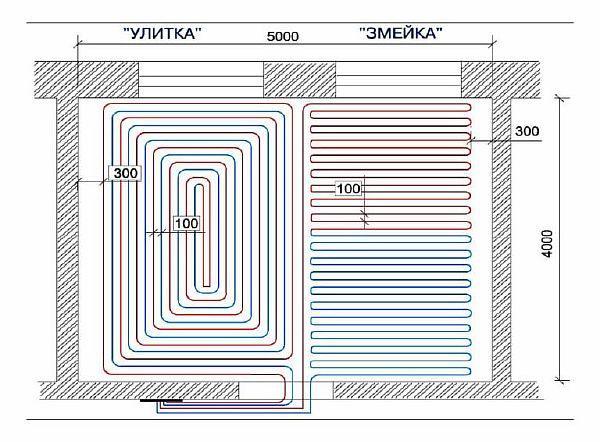
At the extreme end, this distance can be approximately ten centimeters. Further on, it can vary by five centimeters. For example: 10, 15 cm, and so on.
However, when calculating the installation pitch, the distance between the contours should not be more than 30 centimeters, as the floor surface will not heat up evenly, and therefore the heat in such a room will circulate unevenly.
Let's determine the length of the contour
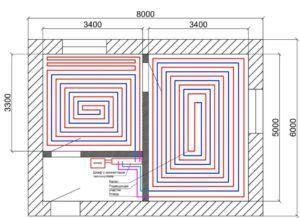 This value must be calculated based on the diameter and material of the pipes being used. For example, if the installation is using 16-inch metal-plastic pipes, the length of the water system's underfloor circuit should not exceed 100 meters. The optimal length of metal-plastic pipes in this situation is 75 to 80 meters.
If the work involves metal-plastic pipes with a diameter of 20 mm, then the length of the heated floor cannot be more than 120 m.
When calculating the pipe consumption for a warm water floor, the question often arises whether it is possible to make a circuit of different lengths. The ideal solution for a warm water floor is considered to be the same size for all loopsThis isn't difficult to do, but it's not always practical. For example, in a room with limited usable space.
Pressure losses in underfloor heating systems can be compensated for using balancing valves. Piping length variations in such installations are permitted within 40%. Adjustments to the diameter and spacing are also made, if necessary.
Required number of circuits
The question of calculating the piping requirements for underfloor heating is difficult to answer without knowing the number of circuits. This raises another problem: how to calculate the number of loops connected to the manifold? To do this, we need the following parameters:
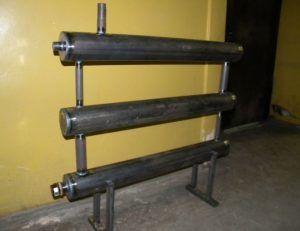
- collector volume;
- the amount of coolant passed through per unit of time;
- heat load index.
There is no need to calculate all these values, as they must be indicated in the technical data sheet of the mixing unit.
For a large space, it's necessary to "divide" it into smaller areas. It's recommended to create multiple contours.
We are installing the manifold
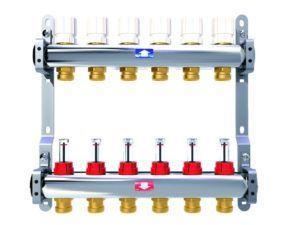 When installing a collector, you need to remember several basic rules.
- It's important to consider the height of the screed and trim that will be installed. Ignoring this will result in problems opening the cabinet door.
- It is also important to consider ease of maintenance and the ability to perform routine repairs with the main line disconnected.
- A shorter section of pipe is more rigid, and vice versa. Therefore, the manifold should be raised no higher than 25 cm above the finished floor. When working, the room's design must be taken into account. If raising the cabinet is unacceptable for a particular design, it is recommended to lower it to the floor, but with consideration given to ease of opening.
Common mistakes and recommendations
Watch the video
- An improperly constructed subfloor. For the floor, it must be level and thoroughly cleaned. Finishing the joints and subfloor is crucial for this work.
- The structure is not waterproofed. Underfloor heating requires such protection. The best material for this is vapor-impermeable polyethylene, laid in an even layer. Also, don't forget about damper tape; it reduces heat loss from the heated floor and compensates for expansion of the concrete screed.
- Incorrectly installed thermal insulation. It is recommended to install it in two layers in a staggered pattern. The primary material for this type of floor protection is expanded polystyrene, and the secondary material is polyethylene film.
- Pipe laying. Experts say this is where the greatest number of mistakes are made. Before installation, a clear diagram must be drawn up and the pipe consumption per square meter of underfloor heating must be accurately calculated. Without a detailed plan and the required amount of material per square meter, many errors will be made and material consumption will be increased. Every square meter of the structure must be measured on the diagram, clearly showing the placement of angles and lines. A detailed floor plan not only helps to accurately calculate the required material consumption but also allows you to identify problem areas during installation.
When carrying out installation work and calculating material consumption, it is important to remember that a large number of violations of established rules will lead to frequent emergency situations with the underfloor heating system.
These errors can also lead to the need to replace the entire structure. For this reason, you should approach your work with the utmost responsibility.
Watch the video