Self-regulating heating cables are becoming increasingly popular in both industry and homes. They are especially indispensable for de-icing. When cold weather sets in, there's a risk of water or sewer pipes freezing and bursting, and ice forming on steps or walkways.
In this article, we'll discuss the characteristics and types of self-regulating heating cable, its applications, and how to install it on pipes and roofs.
- What is a self-regulating heating cable?
- Operating principle
- Types – design, technical characteristics
- Resistive
- Self-regulating
- Which type to choose
- Areas of application
- Warm floors
- Water supply
- Sewerage
- Roof heating
- Heating greenhouses
- Installation of self-regulating cable
- Preparing the cable
- Mounting the cable outside the pipe
- Internal installation
- Installation of cables on roofs
What is a self-regulating heating cable?
A self-regulating cable is the same electrical conductor, but an improved version. Its design is more complex than that of a regular wire.
The heating control cable is a polymer matrix, with the help of which, under the influence of external temperatures, a change in resistance occurs, corresponding to the amount of heat it emits.
The heating element consists of two tinned copper wires coated with a graphite-based plastic compound with a semiconducting polymer added. This creates a self-regulating matrix that connects the copper wires.
The heating element is insulated with a fluoropolymer thermoplastic, which also protects it from moisture. Next comes a copper shielded braid, which protects against mechanical stress and acts as a grounding element.
The outer shell is made of various materials. Each type is designed for specific operating conditions. For standard conditions, it's made of polyolefin plastic; for aggressive environments, it's made of fluoropolymer.
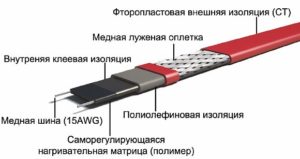
The matrix and the wire sheath are processed by radiation crosslinking.
Operating principle
The operating principle of a self-regulating conductor is based on the movement of electrical energy through the heating wires. This results in an increase in temperature and, consequently, resistance.
The higher the resistance, the lower the current and power. Conversely, the lower the temperature, the more heat is generated.
Let's consider the operating principle of the cable:
- A self-regulating matrix—a large number of resistors connected in parallel between the heating wires—heats up when voltage is applied. This causes the material to expand, disrupting the contacts between the conductive particles, thereby reducing the current flow and heat dissipation.
- When the temperature level of the heated area changes, the resistance of the matrix and the amount of heat given off by the heater change.
Types – design, technical characteristics
Heating cables are divided into the following types: resistive, self-regulating, inductive.
They differ in their operating principle, technical characteristics and design.
Resistive
Resistive cables come in linear and zonal varieties. For effective operation, they require specialized equipment that controls the conductor based on the ambient temperature.
The advantage of this type is low cost, reliability, and ease of installation.
It should be noted that such a conductor always emits the same amount of heat, regardless of the temperature of the air masses, therefore the consumption of electrical energy is low - which is economically unprofitable.
Resistive is divided into:
- Linear - a wire whose ends are connected to the electrical power supply. Based on the number of current-carrying conductors, it can be single-core or double-core.
Single-core — consists of a single heating conductor, usually steel, covered with an insulating layer of heat-resistant material that does not deform when heated. The cable may be shielded to eliminate interference generated by the cable itself and various protective devices.
The advantage of the single-core model is its ease of use. The disadvantage is the inability to cut the cable to the required length; both ends must be connected in one place.
Double-core — consists of two parallel wires that transmit electric current. Their difference and advantage over the single-wire type is that the other end does not need to be returned to the connection point, which is especially convenient when heating long pipelines.
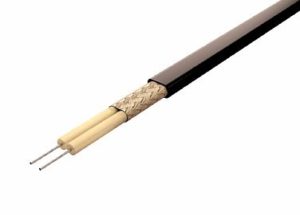
- Zonal cables have a more complex design than linear cables. They consist of two conductive copper conductors, each with its own insulation. They are also thicker than linear cables.
The distinctive feature of this type is that the internal insulation is equipped with windows every 1–2 meters. Through these windows, the conductor is connected to the heating wire, carrying the line voltage.
Thanks to this design feature, constant resistance is present not throughout the entire conductor, but only in a specific section or zone. The advantage is the ability to customize the section length to suit your needs. The disadvantage is the high price.
The resistive heating conductor has a warranty period of up to 15 years, and up to 50 years when poured into a concrete screed.
Self-regulating
A self-regulating heating cable is a modern model that differs from a resistive heating cable not only in its design features, but also in its operating principle.
Self-regulating cables are conductors encased in a polymer matrix. They don't require a regulator; they maintain the temperature they're set to, preventing overheating. This type is more expensive, but its increased efficiency makes it more economical.
Moreover, it can be cut into pieces of any size. The warranty period for this type is 10-15 years, but manufacturers include a reserve of up to 40%, which significantly extends its service life.
Self-regulating conductor can be shielded or unshielded:
- Shielded cable—the outer sheath is covered by a braid of tinned copper wire, which protects against mechanical damage and serves as grounding. This cable is designed not only for heating water pipes but also for outdoor installations, such as roofing and gutters.
The casing can be food-grade - used for heating water and sewer systems inside, or with UV protection - installed on the roof, where there is a lot of sunlight.
- Unshielded — the product does not have a protective sheath. It is used for heating domestic pipes and is not intended for outdoor installations where exposure to aggressive environments is possible.
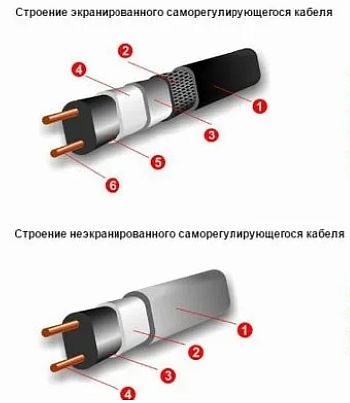
- Outer polyolefin sheath.
- Tinned copper wire braid.
- Elastomeric thermoplastic insulation.
- Polyester shell.
- Semiconducting self-regulating matrix.
- Copper veins.
- Outer polyolefin sheath.
- Inner polyester shell.
- Semiconducting self-regulating matrix.
- Copper wires
Shielded models are more expensive than those without a sheath.
Main areas of application of self-regulating heating cable:
- household pipes;
- icing systems (roofs, paths);
- industry.
To heat various communications, a heating element of the following power is required. For:
- pipes inside - 10 W/linear meter;
- pipeline outside - 15 W/m.p.;
- roofs and paths - 24-30 W/m.p.;
- anti-icing systems - up to 40.
Which type to choose
When choosing a self-regulating cable, it is necessary to consider the characteristics and parameters of the product, its operating principle, and its operating conditions—the length of the section required for heating, and the maximum low temperatures.
Points to consider when purchasing a heating wire:
- the presence of a protective braid - it provides reliability and grounding;
- type of external insulation;
- product power.
The choice of heating conductor also depends on the application. If the heating conductor is needed for sewer heating, a polyolefin product is suitable, while for water supply systems, fluoroplastic protection is recommended.
For outdoor installation, it is better to choose a model with fluoropolymer insulation, which protects against moisture and ultraviolet radiation.
If you need to heat small-diameter pipes, a low-temperature conductor with a voltage of 15 W/m is suitable. Medium-temperature conductors (up to 30 W) are intended for large-diameter pipes. High-voltage types are practically never used in everyday life.
Unshielded cables are recommended for installation in underground pipes, as they lack a grounding braid. Shielded cables are safer, but more expensive. They have the same heating matrix, so there's no point in burying a more expensive model.
When purchasing a self-regulating heating element, squeeze it with your fingers and then run your fingers along its entire length. In a low-quality product, you will be able to feel air pockets inside.
Areas of application
The self-regulating heater is used in both domestic and industrial applications. It is designed to heat domestic and industrial water pipes located both above and below ground.
In the oil and gas industry, the product is used to maintain the temperature of the technological process.
Let's take a closer look at the most common areas of application of a self-regulating heating conductor in everyday life.
Warm floors
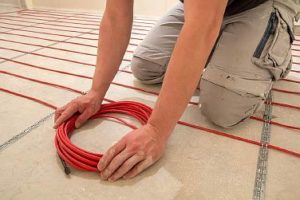
Samreg used to install electric underfloor heatingWhen installing this type of flooring throughout an entire apartment, such as a bathroom or toilet, the surface will heat up less. This is because there are usually other heat sources in other rooms, and the bathroom floor is tiled, a cold material.
If you use a resistive heating cable, you won't be able to achieve the desired balance without installing additional equipment—a thermostat and sensor.
The solution is self-regulating, eliminating the need for additional equipment. The matrix itself regulates the uniformity of floor heating.
Water supply
To prevent water from freezing in pipes in winter, a self-regulating conductor is wrapped around the water supply valve. The valve has a complex shape, so the conductor doesn't come into contact with every piece of metal.
When installing a resistive heating cable, it will also heat the air. However, if you install a self-regulating wire, the conductor will only heat where it touches the metal. After all, its operating principle is based on efficient heat transfer.
Sewerage
Sewer systems rarely freeze because the pipes are sloped, allowing fluid to flow rather than stagnate. However, if the drain assembly is faulty, the water moves slowly and can freeze along the way. Layers of ice will build up, eventually filling the entire space.
The simplest option for heating a private home's sewer system is to install a self-regulating heating cable; this will prevent the liquid in the pipes from freezing.
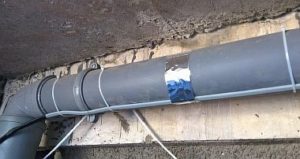
Roof heating
In winter, roofs are prone to icing, and it's difficult to determine which areas will be susceptible to icicle formation. Using a semiconductor matrix heater will allow you to heat those areas of the roof that are most prone to ice and water.
You need to choose a type that is not susceptible to ultraviolet rays and can withstand high temperatures, since the roof gets very hot in the summer.
Heating greenhouses
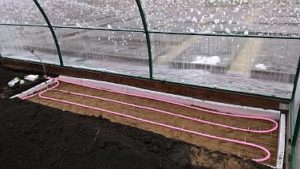
Scheme heating greenhouses with heating cable Similar to underfloor heating. It's essentially the same as heated floors, only installed under a different covering.
The self-regulating cable is secured to a protective mesh placed on a sand bed. The cable is covered with another layer of sand, then a second mesh is installed, onto which the topsoil is laid.
If the heating system cannot be mounted underground, then the self-regulating heater is placed on the walls of the greenhouse.
Installation of self-regulating cable
Before installing self-regulating heating cable to heat water pipes (outside or inside), roof or walkway, it must be prepared.
Preparing the cable
Both ends of the wire are prepared, one is closed with a sealed cap, and the other is connected to a source of electric current:
- Preparing the terminal end of the wire:
- the insulation is removed by 4 cm;
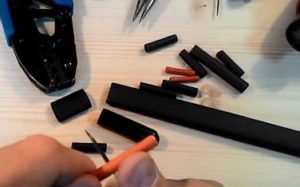
- the braid unravels and the wire is bitten off;
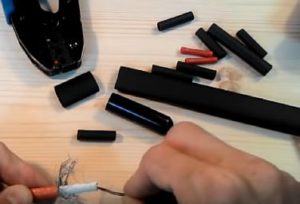
- the corner is bitten off;
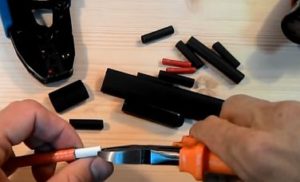
- an internal adhesive heat-shrinkable sealing sleeve is put on;
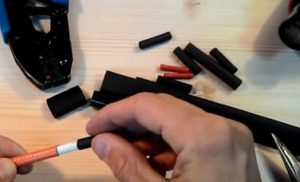
- the coupling is fitted with a hair dryer;

- the end of the coupling is clamped;
- the cap is put on after the coupling has cooled down;
- a cap is installed to ensure tightness.
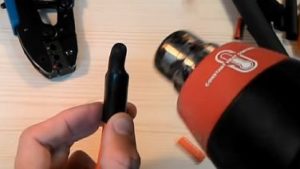
- If it is planned to place the conductor inside the pipeline, then at this stage a gland is put on the opposite end of the wire.
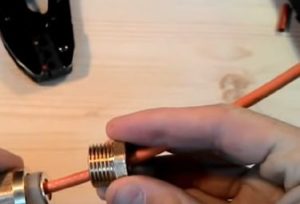
- Preparing the second end:
- insulation is removed by 6 cm;
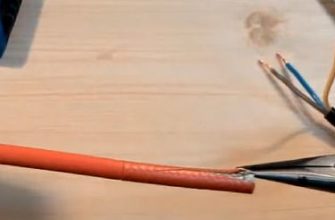
- the braid is unbraided and then twisted into one strand;
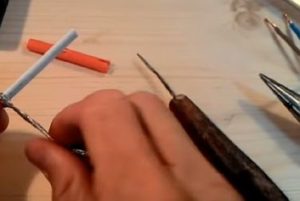
- the internal insulation is removed;
- the conductive wires are released from the matrix;
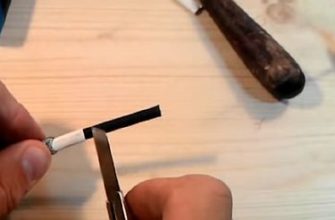
- connecting sleeves are put on and crimped;
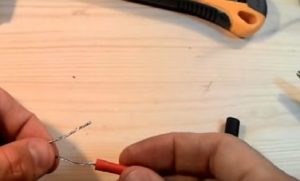
- tubes are put on and a hair dryer is placed around them;
- the coupling is put on and seated;
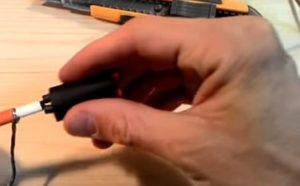
- the veins are moved apart, the core is compressed with pliers.
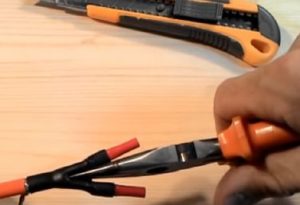
- Connecting the samreg to the power wire:
- an external coupling is placed on the electrical wire;
- small couplings are put on the wires;
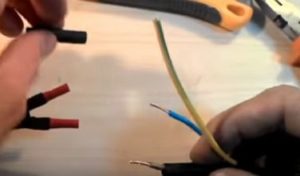
- the wire cores of the electric wire are inserted into the couplings installed on the self-regulating heater to connect with its cores and are crimped to make contact;
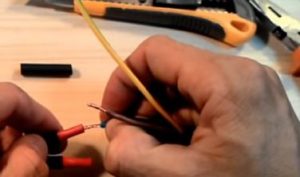
- the couplings are pushed in and seated for tightness;
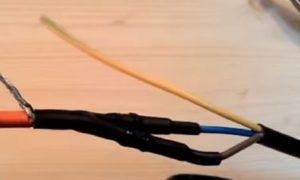
- The braiding of the electrical cable is connected to the ground using the same principle (we put on the sleeve, connect, and casing);
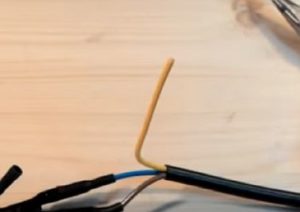
- The outer sleeve is moved onto the connection and sealed.
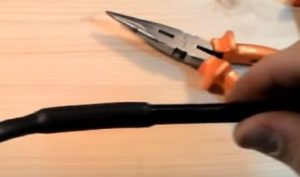
Mounting the cable outside the pipe
There are two schemes for placing the heating cable on the pipe:
- Installing a self-regulating cable linearly along a pipe is a simpler method. The cable length should be equal to the length of the pipe being heated.
The heater is secured to the product using plastic clamps, fiberglass self-adhesive tape, or aluminum tape. Metal fasteners are not allowed. Fasteners are installed every 30 cm. The cable must be placed under the pipe to protect it from mechanical damage.
If the heated pipeline is buried underground, the heating element is installed on the side. In areas where the pipeline bends, to avoid severe bends, it is recommended to position the heating element along the outer radius.
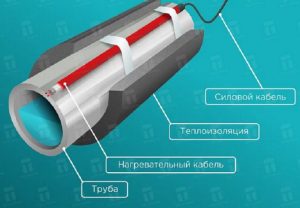
- Spiral: The wire is wound around the pipe in a spiral with an even pitch (standard 5 cm). The advantage of this method is maximum contact between the heating element and the pipe. The disadvantage is the high material consumption; it must be 1.7 times greater than the length of the pipe. This method is suitable for medium- and large-diameter pipes used in sewer and drainage systems.
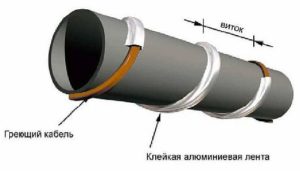
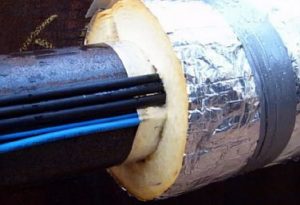
Regardless of the chosen design, a key feature of installing a heating cable on a pipe is the need to insulate the pipeline. Thermal insulation (polystyrene foam or polyethylene foam) is placed on top and must completely cover the pipe and heater, otherwise you'll end up heating the air.
Internal installation
Self-regulating heating cables cannot be installed inside all pipes; the diameter must be at least 40 mm. Anything smaller will interfere with the free flow of liquid.
If the main line is too long, it's also difficult to provide heating this way. This option is used for lines several meters long. It's easier to install the heater on vertical pipes, starting at the top and working downwards.
To install the heating conductor, you will need a tee and a sealing coupling.
The process of placing a cable inside a pipe looks like this:
- The prepared heating element, with the gland fitted, is smoothly inserted into the pipeline through the tee.
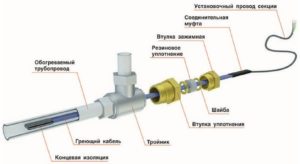
- After pushing the entire wire through, the entry point must be sealed. To do this, carefully tighten all the gland fasteners and tighten them with a clamping sleeve, first by hand and then with a wrench. This will flatten the rubber seal, ensuring a tight seal.
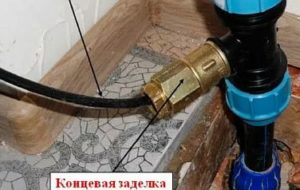
At this point the installation is complete; in order for the heating element to begin heating the pipes, the power must be turned on.
Installation of cables on roofs
To heat the roof, a self-regulating heating cable must be installed along the perimeter of the meltwater flow. The cable is typically laid in a serpentine pattern, 30-35 cm deep, with a spacing of 15-20 cm. The cable should be placed horizontally along the roof edge, along the eaves. The gutters should also be heated: if the gutter diameter is 80 mm, one heating line is required; if it is larger, two.
The way the wire is secured to the roof depends on the type of roofing. Clips installed with screws are most commonly used. Construction sealant or mastic is used to seal the resulting holes. When the integrity of the roof cannot be compromised, fastening tape is used.
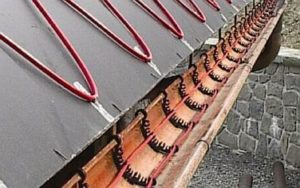
The heating system may consist of several sections, all of which must come to one point, where they are connected to an electrical cable with grounding and a control panel.
Self-regulating heating cables are a convenient heating element thanks to their characteristics and can be installed in a variety of ways. The key is to choose the right type after carefully reviewing all the details and operating conditions.