Water supply piping is a problem that must be addressed during major renovations. Sooner or later, the water supply system becomes unusable. There can be many reasons for repairing and replacing the plumbing system, but the main ones include leaks, condensation on the pipes, rusty tap water, and so on.
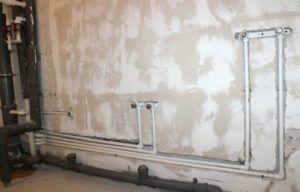 Is it possible to replace the plumbing system in an apartment or private home yourself? After all, hiring a plumber would be quite expensive. And the answer to this question is yes, it's possible.
No special permits or paperwork are required for this work. All that's required is shutting off the water supply to the riser for an hour.
All work on installing the water supply system must be carried out in strict sequence, otherwise the constructed structure will not operate without problems.
Pipe layout types affect the quality of water supply to water supply and heating systems, as well as the longevity and maintainability of utilities. Tee and manifold layouts are used.
Selection of pipe assortment
The installation of a water supply network begins with the selection of piping materials. Steel domestic mains are rarely installed these days, as this material has lost its popularity.
His place was taken cheaper and more practical Plastic and metal-plastic structures. Copper water supply systems can also be used, but their high cost makes this material unsuitable for this option.
- CopperDespite its many positive properties, this line is not without its drawbacks. First, it produces harmful cuprous oxide, which forms upon contact with water. Second, the solder used during soldering contains tin. This material eventually turns to powder, causing joint leaks.
- Metal-plasticThis material isn't considered a low-cost option, but it can be connected without the use of special tools. Installation of this type of pipeline is permitted in open areas, where the joint can be quickly re-fitted at any time.
- PlasticThese systems are considered the standard for plumbing construction. However, plastics come in different types. To make the right choice, it's important to understand the properties and characteristics of these materials. For example, polybutylene (PB) is known for its optimal thermal conductivity. Joints made from this type of plastic are absolutely reliable.
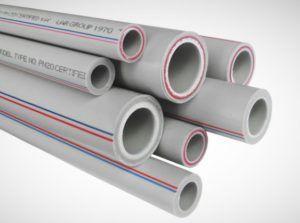 Polyethylene (PE) It's an inexpensive material, but for hot water supply (DHW), reinforced pipes must be installed. Despite its significant drawbacks, this material has the significant advantage of not bursting after freezing. Therefore, such a pipeline operates successfully in unheated rooms or outdoors. Polyvinyl chloride (PVC) is chemically resistant, but fragile and degrades when exposed to ultraviolet light.
Polypropylene piping for installing water supply systems in an apartment is inexpensive. This type of water supply system is currently used more often than others. This material is known for its strength and durability.
A soldered polypropylene joint in a distribution system can reliably withstand pressures of up to 12 atmospheres, and is virtually identical to the base material. City pipelines can withstand pressures of up to 6 atmospheres, making this range ideal for polypropylene distribution systems in apartments. Polypropylene-based piping for apartment water supply systems boasts higher hydraulic resistance than previous alternatives and improved thermal stability.
When describing the characteristics of polypropylene piping, it's important to mention its disadvantages. Polypropylene has only two. First, polypropylene cannot be glued, and welding requires the use of specialized equipment and strict adherence to all plumbing procedures. Second, polypropylene has a significant coefficient of thermal expansion, which must be taken into account during installation.
Watch the video
Choosing a water distribution method for an apartment
Water main distribution can be accomplished using a tee method (considered a classic option), or it can be done using a modern manifold method.
The first method is to sequentially install a main line from a common riser to the drawoff points. First, the main lines with different water flows are connected, and then the water is moved through the branches using a tee.
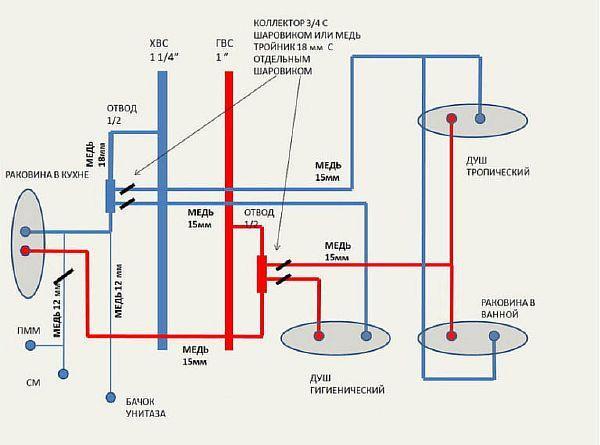
The classic scheme has the following advantages.
- Small price.
- Compact dimensions.
- Simple gasket.
And its disadvantages are the following.
- Constant pressure fluctuations.
- It is impossible to block one point of consumption.
- Tees are not always convenient to place in a bathroom or toilet.
- For a small apartment, this type of wiring is acceptable, but in a large country house it will cause a lot of inconvenience.
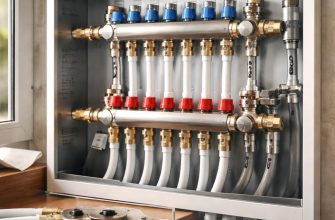
A manifold system for water supply in an apartment or private home is a method in which a separate pipe is connected to each water intake point. With a manifold system, the sink, toilet, shower, and all other plumbing fixtures in an apartment supply the required amount of water independently of one another.
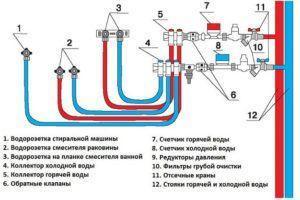
All pipes are connected to a manifold, which is located at the main line's entrance to the home. A manifold is a system with one inlet and several outlets. When connecting to it, not only the number of valves but also the number of all plumbing fixtures is taken into account.
TIP: Connecting the collector system to the home can be done after connecting the water purification filters and pressure reducers.
The collector layout of water supply pipes in an apartment has numerous advantages:
- The first is the ability to shut off water at one point without damaging other water intake points.
- The control valves for this system are located in one area and are always easily accessible.
- Constant stability line pressure (see optimal value).
- The risk of breakdowns is minimized. And if repairs are necessary, they can be completed quickly and easily.
- All water intake points have the same water temperature level.
- If necessary, a new valve or plumbing fixture can be quickly installed. This requires installing a manifold with multiple spare outlets.
Watch the video
Plumbing layout diagram
A water supply piping diagram is most essential for an apartment owner. A detailed plan helps accurately navigate the locations of various pipeline components. No special permits are required to draw up a detailed plan. City water utility workers may request this diagram only when registering a meter.
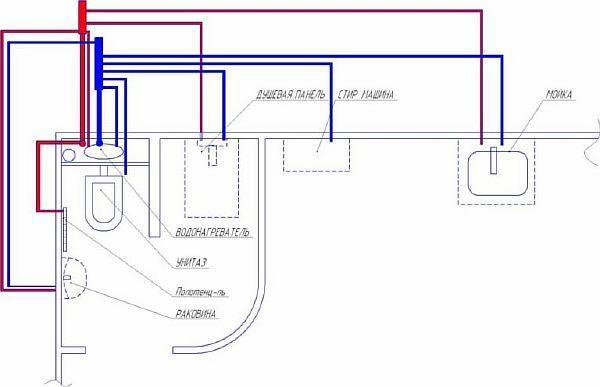
Creating a complete plan that meets all standards is a serious undertaking, even for a professional. This is because such a plan for a country house with a summer kitchen is necessary for project approval. For an apartment, a simple and clear diagram is sufficient. Such a plan should include:
- Water supply pipes.
- Accounting mechanisms.
- Drains and valves for emergency situations.
- Shut-off valves.
- Water collection points.
- Branches for resale use.
- Direction of water movement.
Collector and any other water supply piping layout must be designed according to a diagram that is understandable to everyone, not just the apartment owner. Therefore, there are specific standards and rules for drawing collector and other layouts. These include the following recommendations:
- Do not use isometric diagrams, otherwise the intersections of pipes will confuse the entire manifold or tee circuit.
- Avoid using excessive arrows and pointers to avoid confusing the plan.
- Shut-off valves and metering devices must be indicated according to the rules and clearly.
- The diameter and type of rolled pipes must be specified.
As a result, it turns out that a collector or tee circuit must be designed according to strictly defined standards and must be without any excesses.
How to calculate the diameter of a pipe assortment
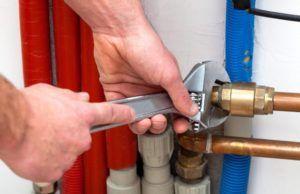 The diameter of water supply pipes must be calculated correctly. This calculation is necessary for a reason. After all, the smaller the pipe diameter, the less expensive it is. However, an excessively small pipeline diameter causes turbulence in the fluid. This reduces the flow capacity of the main line, and even with normal pressure, the water flow from the tap will be very weak.
You can calculate the correct diameter for a pipeline in an apartment yourself. The initial parameters are as follows:
- The lowest pressure is 0.3 atm.
- For 1 meter of a 16 mm pipe product, pressure losses can be 0.05 atm.
- For one fitting connection, pressure losses of 0.15 atm are possible.
- At the water intake point, losses are 0.25 atm.
- The pressure reserve for the most distant point may be no less than twice as much.
Now, we need to determine whether the apartment's sequential water supply system will have the required pressure at the farthest point. Will the current range of pipes be sufficient for the sequential design, or will larger pipes need to be purchased?
The pressure level at the bottom of the risers is determined using a pressure gauge, then 0.6 atm is subtracted for each floor. However, in multi-story buildings, this calculation is unacceptable. To avoid increasing the cost of the structure, the risers are routed separately from the building. This is done first for the lower floors, then for the upper and middle floors.
Horizontal water supply piping is characterized by a nonlinear relationship between heat loss and flow velocity, which in turn depends on the cross-section of the piping structure.
A slightly larger diameter significantly reduces heat loss. For this reason, a simple 20mm pipe system with 16mm elbows in an apartment functions smoothly.
In more complex situations, a specialist can calculate the water supply diameter. They have all the necessary formulas and nomograms for this job.
What tools and materials will you need for the job?
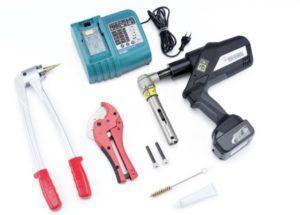 To assemble the pipeline, you'll need a standard set of tools. These include a welding machine, a tape measure, and pipe cutting and bending tools. Before purchasing materials, carefully calculate the required footage.
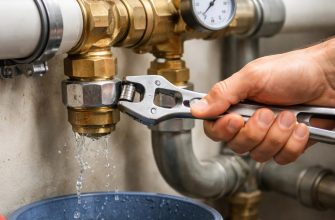
Also, before DIY installation, you'll need to remove the old pipeline. This replacement is performed using traditional methods. In an apartment, it's best to do this after disconnecting the water meter, to avoid shutting off water supply to other floors for an extended period.
Another tip that will come in handy in this situation: don't use a valve with a lever. They're made of plastic, which tends to break at the most inopportune moments. It's better to use a ball valve with a butterfly handle to shut off the water supply.
Do-it-yourself wiring installation
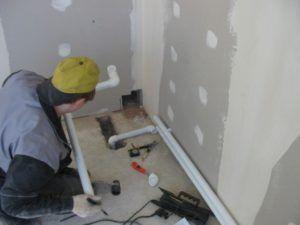 So, it's time to assemble the system. Directly The connection of polypropylene pipe materials is carried out by solderingThis is a completely straightforward process, easily mastered by even a novice craftsman. If you follow the proper techniques, you'll end up with a structure that will function reliably and for a long time.
Careful attention should also be paid to chasing and creating channels in the screed. They should be no further than 150 mm from the wall and no closer than 20 cm from furniture. All plumbing fixtures should be removed and removed from the room before work begins.
The first step is installing the arcs. These are plastic strips with corners for the faucets. They are secured to the supporting wall with screws. When installing these, consider the dimensions of the finishing material. This could be plaster, tile, or any other finishing material.
Unless the DIYer is particularly skilled, it's difficult to precisely position the outlet blanks flush. It's recommended to pre-fabricate them with an overhang equal to half the width of the faucet caps. If these caps are not adjustable, it's not recommended to "trim" them with a sanding wheel.
Watch the video
This isn't a problem with metal-plastic pipes, as such lines are constructed using detachable fittings. Soldered pipes are installed using adapters and metal-plastic inserts. A second, more reliable option is to install the network on-site. However, for this type of installation, you'll need to purchase a compact welding machine.
It is also necessary remember Separate metering units will be required for cold and hot water. It is recommended that meters and valve handles be color-coded.
Meter readings must be easily readable. For this reason, this section of the pipeline is often designed in a very unusual way. The water meter is sold already sealed.This seal must be preserved, without it the device is considered unusable.
After installing the meter, you should call an inspector from the water utility. They will record the data on the device and seal the meter and filter drain with their own seal.
Watch the video
Special attention should also be paid to bending tubular products. When working with metal-plastic products, it's important to remember that the minimum allowable bending depth is equal to five times the external volume of the tubular product.
The final stage involves installing the boiler. This work is included in a separate installation cycle. This work is performed after the pipeline is commissioned. The boiler connections are prepared in advance. Valves are installed near both connections, and at this stage they are immediately shut off and additionally capped.
Installing water supply pipes isn't a particularly difficult task, and creating such a system yourself is entirely possible. However, it's important to remember that this work won't tolerate a careless or sloppy approach.
Watch the video