Planning a bathroom designEvery homeowner must consider as many factors as possible regarding the color scheme, shape, and size of plumbing fixtures. When choosing parameters, special attention should be paid to the standard bathtub height from the floor.
When choosing bathroom equipment, its dimensions are taken into account, and how the planned equipment, such as household appliances, that can be placed in it, fits into them.
The bathtub itself is the main plumbing fixture in the bathroom. It must be safe and easy to use.
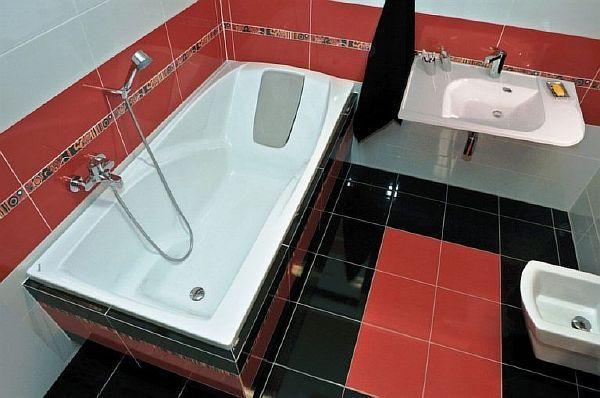
The standard height of a bathtub above the floor is 70 centimeters, but certain tolerances exist. For example, if there are young children in the home, a bathtub height of 60 centimeters is acceptable. The same rule applies to older adults.
The main criterion in relation to this parameter is ensuring safe conditions of use.
- Norms and standard sizes
- How to install, assemble, and connect - instructions
- How to soundproof and reduce heat transfer in steel products with an enameled inner surface
- Installation instructions
- Features of installation of acrylic products
- Let's talk a little about the design and operating principle of a jacuzzi.
- Features of installation of bathtubs of any design
- Tips and recommendations
Norms and standard sizes
The most important dimensioning parameter is the bathtub's installation height. This is considered regardless of its shape and other dimensions, but the clearance between the bathtub's base and the floor is essential.
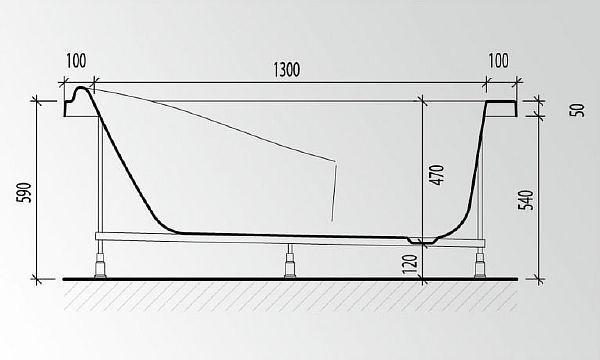 The bathtub's height above the floor should provide an optimal clearance of 12-15 centimeters to allow for installation and subsequent maintenance of the trap. If, according to the individual needs of the residents, the top edge should be at a minimum height of 60 centimeters, the issue can be resolved by purchasing a tub with a reduced depth.
Some location parameters:
- the distance from the font to the wall, if it is not located right next to it, should be at least 70 cm in width to ensure free movement of a person;
- the distance between the bottom of a standard bathtub should be about 15 centimeters to accommodate the outlet siphon;
- The font must be installed strictly horizontally in relation to the upper edge, since the slope is provided by the design of the bathtub.
It should be noted that these standard guidelines are recommendations. In some cases, deviations exist; for example, in children's and healthcare facilities, the standard bathtub height may be reduced to half a meter for safety reasons.
Recommendations for the height of the bathtub when placing it are given in SNiP 3.05.01.85.
When choosing a hot tub, various factors are taken into account. The interior dimensions are determined by the size of the people living in the house.
At the same time, in modern conditions, the size of the tub is often determined by the dimensions of the room where it will be installed. Unfortunately, modern standards do not allow for larger sizes in city apartments.
In addition to the overall dimensions, it's also important to consider the height of the feet, which determine the gap between the floor and the base. This is important because the siphon is located here.
Watch the video
Bathtub legs are always equipped with a height adjustment device, which allows you to precisely adjust the height of the bathtub to a strictly horizontal position.
In accordance with current standards, bathtub sizes can be as follows:
- Standard - 170 (1700 cm - 700 cm - 560 cm).
- Standard - 160 (1600 cm - 700 cm - 560 cm).
- Standard - 150 (1500 cm - 700 cm - 560 cm).
- Standard - 130 (1300 cm - 700 cm - 575 cm).
- Standard - 120 (1200 cm - 700 cm - 610 cm).
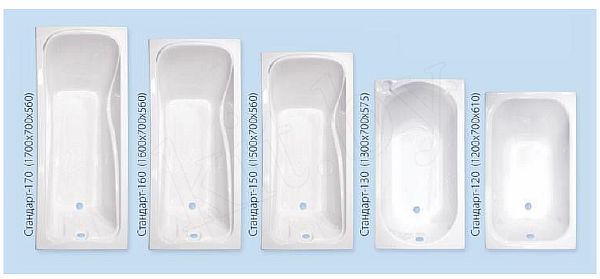
Considering that the overall standard height of a bathtub with legs from the floor should not exceed 70 centimeters, this standard is recommended to ensure safety during use.
Sometimes the size selection is so limited that a sitz bath is required. In this case, the depth of the tub can reach 70 centimeters, increasing the height to the top edge accordingly. In this case, a handle is installed on the wall for safety.
How to install, assemble, and connect - instructions
A bathroom renovation involving plumbing replacement always requires an answer to the question of what needs to be installed, where, and how. First and foremost, issues of efficient water supply and drainage must be addressed.
 Next, vertical and horizontal surfaces need to be leveled for subsequent finishing. Remember to create slopes toward the drain grate.
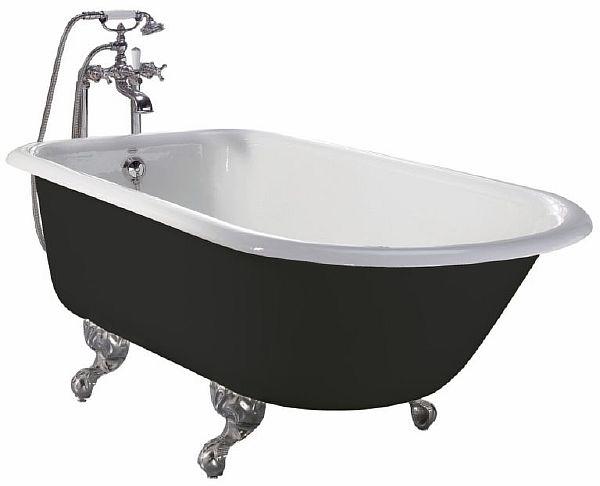
A cast iron bathtub is the easiest to install. Due to its greater weight, it is the most heat-resistant and quietest when filling with water. It should be installed strictly parallel to the floor, observing the installation height requirements described above.
Its significant weight can be considered an undoubted advantage, since thanks to it, the bathtub remains stable during use and does not require additional measures to strengthen it at the place of use.
The most popular choice for price-quality ratio are steel bathtubs with an enameled interior. They are much lighter than cast iron bathtubs and therefore easier to install.
How to soundproof and reduce heat transfer in steel products with an enameled inner surface
However, they have two significant drawbacks. The first is noise when filling with water, and the second is rapid cooling due to the material's high thermal conductivity. To avoid these problems, proceed as follows:
- The bathtub is turned upside down directly at the place where it is located.
- The surface of the bottom and sides are thoroughly cleaned of dirt and degreased with acetone.
- Mounting foam is applied to the surface of the sides and bottom and carefully leveled.
- Polymerization of the applied layer occurs within 24 hours.
Next, if necessary, protruding fragments can be leveled with a sharp knife.
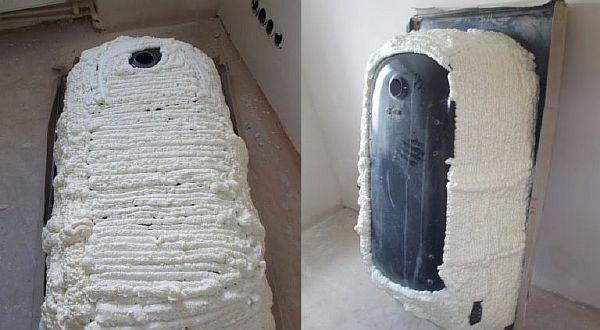
This type of external treatment of the font body significantly increases its heat resistance and reduces the noise level when filling.
The weakness of the body of such a vessel due to deformation during filling and use also merits attention and additional modification. It is common practice to install such tanks on an additional brick foundation to compensate for the load on the bottom.
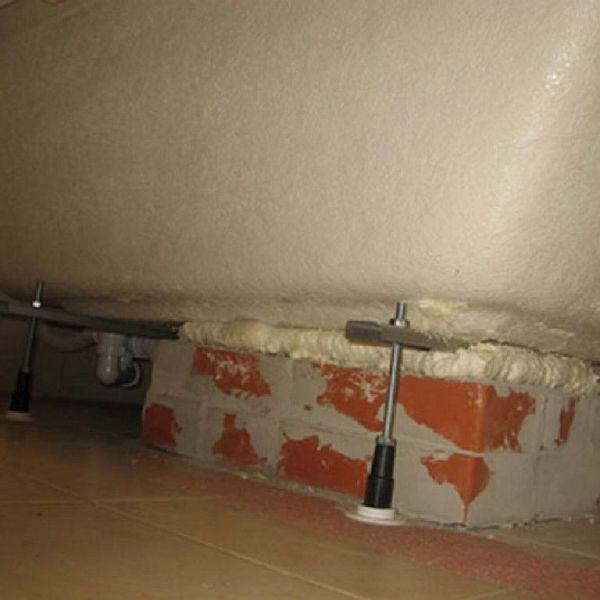
In this case, the height of a bathtub 170 x 70 from the floor is standard and is 70 centimeters.
Installation instructions
Watch the video
Installing a bathtub is a significant undertaking, best left to a professional or performed independently under their supervision. The following guidelines must be followed:
- According to SNiP requirements, the bathtub must be installed on a perfectly flat, horizontal surface. The load-bearing capacity of the flooring material must match the weight of the bathtub plus the mass of water being poured into it. In particular, porcelain stoneware tiles are best for cast iron bathtubs.
- To ensure the bathtub is preserved during installation, it is installed last, after the main finishing work has already been completed.
- Its location must be determined in advance, including the design of the supporting structure. The mounting method—whether on a foundation, a metal frame, or directly on the standard legs—must be taken into account.
- In some cases, when using a metal bathtub, the standard feet don't provide adequate performance. The enamel on the bottom where the feet rest can crack and peel over time. Therefore, thin sheet metal enclosures should be mounted on a special support plate, which increases the support surface.
- The standard height of the bathtub from the floor is certainly maintained.
Features of installation of acrylic products
Using an acrylic bathtub has its own unique challenges. The body of this material can deform significantly when filled with water and used for bathing.
Therefore, such products are installed on a specially made metal frame. The load-bearing points are positioned to support the tub not only through the bottom but also through the upper flanges.
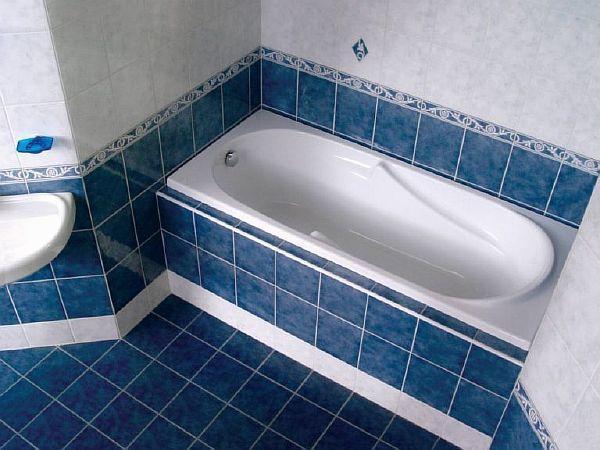
However, the most popular method of installing a bathtub is on a brick foundation. The brickwork is laid so that the height of the acrylic bathtub from the floor meets the standard and is no more than 70 centimeters. A deviation from this height is acceptable, but only downwards.
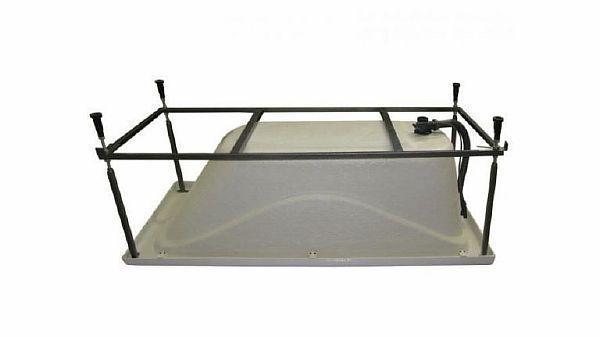
The supporting base for an acrylic bathtub is formed taking into account the decorative finishing.
Let's talk a little about the design and operating principle of a jacuzzi.
It wasn't that long ago that having a jacuzzi in a home was a sign of affluence. Today, many homes have one and it's a necessity, allowing one to relax and recharge after a hard day at work.
Watch the video
[sociallocker]
But purchasing such a device is only the first step, and not the most difficult one. The main thing is to install it correctly. Naturally, you can hire an experienced specialist, but by carefully studying the procedure, you can handle this task yourself.
The hydromassage bath consists of the following main elements:
- a bowl-shaped vessel, also called a font;
- water intake hole;
- nozzles for ejecting water jets and air;
- piping of the hydromassage system and aeration network;
- pumping station for pumping liquid through the hydromassage system;
- compressor for intake and pumping air in the aeration system;
- drain hole for transferring waste into the sewer system;
- control and adjustment unit;
- support system with position regulators during installation;
- mixing device for regulating the water temperature while filling the font;
- control panel.
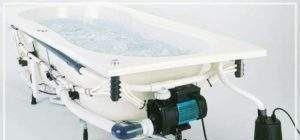 The operating principle of a hydromassage device is simple: the bathtub is filled with water at the desired temperature through a mixer, and some of the liquid enters the piping of the hydromassage system.
The pump creates pressure, and the liquid bursts out of the nozzles at high speed, exerting a massaging effect on the human body.
To further enhance this effect, you can turn on an aerator to achieve additional air flow in the form of a pure stream or mixed with water. The entire process is controlled by a pneumatic or electronic system.
Modern whirlpool systems are equipped with additional features for various purposes, including playing music, radio, television, and creating color effects. Air aromatization, ozonation, and other options are also available.
Features of installation of bathtubs of any design
Regardless of the material, shape, and size of the font, there are a number of general rules to follow during installation:
- The legs are installed on the bathtub so that the trap fits freely into the drain pipe without any distortion. Before inserting it, apply silicone sealant to the branch pipe.
- When installing, ensure the bottom is properly sloped toward the drain hole. The top edge should be parallel to the floor. This slope is ensured by the vessel's design.
- When placing a bathtub against a wall, the joints must be securely sealed. This can be achieved by filling the cracks with cement mortar and installing a border of ceramic corners. The outer seam should be painted with moisture-resistant acrylic paint.
- Large gaps are sealed with brick or covered with any suitable sheet material, followed by finishing with decorative materials.
- The bathtub must be equipped with a grounding system. This is done with a thick copper wire or a busbar. A steel strip can also be used.
- When using a whirlpool bath, additional lines from the electrical and water supply systems are required. Even when selecting such a device, it should be taken into account that its proper operation requires a water pressure of approximately 4.5-6 atmospheres. If this requirement is not met, you will need to consider purchasing and using a separate system. additional equipment in the form of a pump that increases pressure in the water supply system.
Tips and recommendations
 Even if you have some skills in construction and plumbing work, do not neglect the advice of experienced professionals.
- When installing a whirlpool bath, you will definitely need the help of a professional; you won't be able to do this job well yourself.
- When installing plumbing fixtures for a combined bathroom, it is necessary to ensure free access to each fixture.
- When choosing plumbing fixtures, consider the Ideal Standard product line. This high-quality European bathroom equipment meets any requirement. Manufactured in Europe and distributed worldwide, counterfeits are virtually nonexistent on the market.
Watch the video
The floor drain hole and the joints on the sewer pipes should be sealed with particular care.




I chose and installed my bathtub based on your article. Everything is written very clearly and understandably, and there's even a detailed video! I had a couple of questions during installation; I asked them in the appropriate field and received clear answers right away.