A stand-alone sewer system is a wastewater treatment system used as an alternative to a central sewer system. A stand-alone system treats the sewer system rather than storing wastewater. There are three types: a cesspool, a septic tank, and a wastewater treatment plant.
Sewerage is a vital utility in any home, and the comfort of residents depends heavily on it. However, connecting to a central sewer system isn't always possible in a private home, so installing a standalone system is the answer.
In this article, we'll explore the different types of stand-alone sewer systems, how they work, and which is considered the best. We'll cover each type in detail, along with their pros and cons. We'll also provide step-by-step instructions on how to install a stand-alone sewer system in your country house yourself.
- The main types of autonomous sewerage systems
- cesspool
- Device
- Operating principle and maintenance
- Advantages and disadvantages
- Septic tank
- With a filtration well
- Septic tank with a filtration field
- Septic tank with infiltrator
- Bio-treatment systems
- With biofilter
- Deep biological treatment plant with forced air supply
- Popular septic tank models and their cost
- Aeration of wastewater
- Biological treatment systems
- Aerobic biological wastewater treatment systems
- Anaerobic systems
- How to choose a stand-alone sewer system for a private home
- Do-it-yourself autonomous sewerage system
- Design and volume calculation
- Sanitary standards
- Interior equipment
- Ventilation of the sewer system
- Installation of external communications
- Installation of a treatment plant
The main types of autonomous sewerage systems
A stand-alone home sewage system is no longer a luxury. After all, comfortable living at home requires a toilet, a bathtub, and a kitchen sink.
There are several ways to set up a drainage system in a private home yourself. One of the easiest and cheapest is a cesspool, but this model is considered outdated.
Currently, there are more modern types of autonomous sewer systems that use advanced technologies - a tank with one or more sections into which the waste liquid is discharged, where it settles and is purified.
cesspool
Building a cesspool is the easiest way to create an autonomous drainage system in your home with your own hands.
Device
The design is simple: a sealed tank buried in the ground on a private property. All wastewater flows into this tank through a collector. The pipeline is laid in a layer of soil that is not susceptible to freezing; otherwise, insulation would be required.
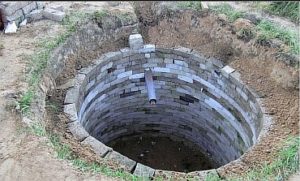
Storage facilities for household waste are equipped in accordance with the following standards:
- The distance from them to the water supply is at least 10 meters, to the well - 20 meters, to the boundaries of the site - 1 meter.
- The depth of the pit depends on the passage of groundwater, but the maximum is 3 m.
- Place at least 10 m away from buildings, otherwise there is a risk of foundation erosion.
Accumulators are most often made from:
- brick - only ceramic type is suitable, as it can withstand aggressive environments, the container is made round;
- reinforced concrete rings - their use allows for the creation of a durable structure, but installation requires construction equipment;
- plastic containers - only those with thick walls that can withstand exposure to chemicals are suitable;
- monolithic concrete structure - constructed on site from cement-concrete mixture and reinforcement.
Operating principle and maintenance
The system works as follows: all sewage flows through main pipes into a tank. The accumulated wastewater is pumped out using sewage disposal equipment. This must be done. as the tank fills, but definitely every six monthsAnd once every six months it is necessary to carry out disinfection with special compounds.
According to regulations, runoff should not reach more than 0.35 cm from the surface of the tank. If the tank overflows, liquid may leak, resulting in contamination of the soil and its aquifers.
Advantages and disadvantages
The advantages of cesspools located on plots adjacent to a private home include:
- The storage tank is sealed, which prevents soil contamination;
- Ease of installation – the ability to build the structure yourself;
- Low construction costs;
- Energy independence of the system.
Flaws:
- need for periodic cleaning;
- The model is only suitable for temporary residences and small numbers of residents, since with a wastewater volume of 1 cubic meter, even large containers will fill up quickly and will require cleaning several times a week, which is not cheap;
- the presence of foul odors during drying;
- the need for free space for access by sewage disposal trucks;
- impossibility of arrangement with nearby groundwater.
Septic tank
A septic tank is a closed, autonomous system; when wastewater enters it, it is purified by bacteria.
The main source of waste is water, and the function of autonomous sewage treatment equipment is to purify it to a safe state. A septic tank solves this problem by separating water from all impurities found in it: chemical, biological, and mechanical.
Liquid is separated from solid particles by pouring it from one tank compartment to another. This method of purification is low-level, requiring additional filtering.
With a filtration well
Septic tanks with filtration wells are sold ready-made, but they are easy to make yourself.
The structure is a container with compartments through which water is purified of solid components. It is important that the bottom of the filtration well be located above the soil aquifer. The bottom of the well has a two-layer cushion consisting of coarse sand and crushed stone, with fine or medium fractions.
The operating principle of this sewerage system:
- through pipes, the discharges enter a sealed container;
- then the solid particles settle to its bottom;
- and fats that are not subject to dissolution rise to the top.
Sometimes, such settling tanks have several compartments, through which wastewater flows alternately. The purified liquid waste then rises through a collector, usually located in the tank wall at a height of two-thirds from the base, into a filtration well. It percolates through a sand and gravel layer at the bottom, thereby filtering it.
To reduce the spread of odors coming from the storage tank, it is necessary to add at certain intervals compositions with anaerobic bacteriaUnder the influence of these microorganisms, biowaste decomposes into safe elements.
During well operation, the crushed stone and sand filter layer becomes covered with silt, so it must be replaced periodically. The rate at which a well silts up during operation depends significantly on the soil composition.
When sand is present in the soil, the wastewater absorption rate is satisfactory, but clay soil absorbs liquid slowly, resulting in rapid clogging. Standards require replacing the filter layer every five years, and waste pumping should be performed once every six months.
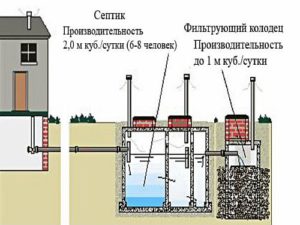
Advantages of an autonomous sewerage system with a well:
- Easy installation;
- Energy independence;
- Maintenance-free - cleaning only once every 2 years.
Flaws:
- the device is not intended for areas with close groundwater;
- does not work with high clay content in the soil;
- the need to clean the well from sludge deposits;
- low degree of filtration;
- The need to change the filter layer is a dirty and labor-intensive procedure.
This facility is recommended for private homes with 2-3 residents. It is not intended for large-scale waste disposal.
Septic tank with a filtration field
As environmental protection requirements increase, autonomous treatment units are also being improved. A septic tank with a filtration field is a complex, multi-stage structure with a settling tank, a well (distribution type), and an underground filtration field.
In addition, the device includes perforated pipes and a filter - a layer of sand and gravel.
The operating principle of this autonomous sewage treatment system is simple. Wastewater is transferred to a multi-chamber settling tank.
In the first, they settle, and insoluble elements settle. In the next section, they undergo further, more thorough purification. After the settling tank, the liquid enters a distribution well, from where it flows through a pipeline and, through holes, penetrates the soil and is absorbed by the field.
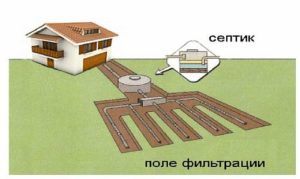
Some designs feature an additional well behind the filter field and a drainage device. Water from the drainage compartment is fed into this well, from which it is pumped out.
Installing such a sewer system requires a large area, over 30 m2. The field's productivity depends on the soil composition: sandy soils provide better purification, while clay soils provide poor filtration.
When the system is operating, filtered water accumulates in an aquifer or drainage structure. The field's lifespan, before it becomes completely contaminated with silt, is 10 years; after that, the sand and gravel layer must be replaced.
The advantage of a drain with a filtration field is a high level of performance and no need for maintenance for a long time.
The disadvantages of such a structure are: the need for large areas to install the filter, low filtration efficiency, and high costs for construction and cleaning.
This type of autonomous sewage system is suitable for cottages with a large number of residents. Lawns can be planted in these areas, but fruit crops are prohibited.
Septic tank with infiltrator
An infiltrator is a replacement for a drainage pipe. The structure takes up much less space than a filter field. It consists of a septic tank, pipes, a crushed stone bed, an infiltrator, and a fan.
The infiltrator is a pyramid-shaped box turned upside down. Its walls have an inlet and outlet, but there is no bottom. The device, with a capacity of 400 liters, is equivalent to a 35-meter filtration field pipeline.
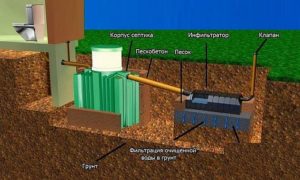
There are two types of septic tanks with an infiltrator; they differ in the presence of a well.
The operating principle of these types is as follows:
- A well-less infiltrator: the wastewater entering the septic tank passes through several settling basins with specific treatment methods. It then flows through pipes into the infiltrator and is absorbed by crushed stone.
- An infiltration tank with a well—waste from the septic tank flows into a well compartment. A pump is located there, pumping water into the infiltration tank, where it is absorbed into the gravel through the filtered bottom. This design is recommended for areas with high groundwater levels.
Advantages of the infiltrator:
- ease of installation;
- compactness;
- requires virtually no maintenance;
- withstands mass discharges.
Cons:
- Needs cleaning - but rarely;
- The level of wastewater treatment is not sufficient;
- A septic tank with a pump depends on electricity.
The use of an infiltrator with a well and pump prevents waste from moving back into the septic tank.
Bio-treatment systems
In areas where groundwater levels are high or the area does not allow the use of traditional treatment methods, and for better environmental protection, it is recommended to install biological treatment plants.
They provide almost complete wastewater treatment. There are several types.
With biofilter
The device has two compartments: a septic tank and a biofiltration tank. The filter tank is filled with a non-rotting material, such as expanded clay or polystyrene foam. During filtration, a biofilm of numerous bacteria forms on the surface of this material.
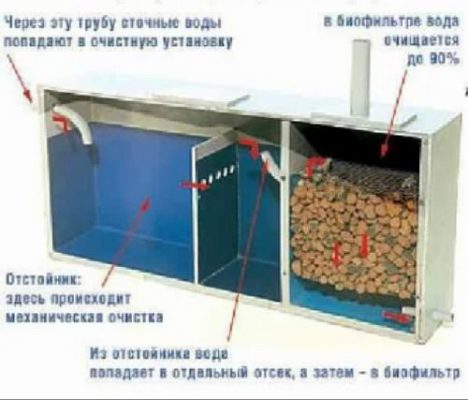
The device consists of a membrane with holes, ventilation, two rings with a plug between them, a LOU housing, a biofilter with a plug and a retainer for it, and a flat filter.
The operating principle is as follows:
- Through the inlet, the wastewater enters the settling tank, where solid particles are separated from the fat;
- then, through the membrane, they move to the next compartment, where they undergo deep cleaning;
- At the final stage, the wastewater is purified by anaerobic bacteria.
Subjected to this level of filtration, purified water accumulates in a container and can be used for technical needs.
These treatment systems achieve a purification rate of up to 95% and require no maintenance, other than pouring bacteria-containing products down the drain every month. Furthermore, they are quick and easy to install (even DIY), eliminate odors, and are energy-efficient.
When operating, it's important to avoid prolonged downtime (more than 2-3 weeks), otherwise bacteria will die. Bacteria also cannot withstand bleach or household chemicals—they die.
The price of these biosystems is high compared to conventional autonomous sewage systems.
Septic tanks with biological filtration are suitable for private homes where the owners live permanently.
Deep biological treatment plant with forced air supply
For homes with multiple residents, equipment with a higher capacity—1.5 cubic meters per day—is required to ensure deep cleaning. A forced-air system meets these requirements.
The unit is a single body with several compartments. It has two outlets on each side. It contains three settling tanks—a tertiary settling tank, a secondary settling tank, and a grease trap—as well as a first- and second-stage aeration tanks.
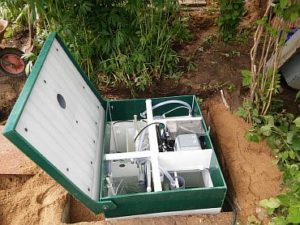
The system works like this: First, fat and solid particles are separated from the wastewater entering the settling tank and allowed to settle. Then, sludge elements, such as algae and microorganisms, are mixed into the filtered water.
To ensure the vital activity of bacteria, the chamber is aerated with air - pumping itThe last section is designed for settling sludge, which is pumped back into the aeration tank and reused.
This autonomous method of sewer cleaning has many advantages:
- provides deep cleaning - up to 99%;
- easy to install;
- has a compact size;
- does not emit unpleasant odors;
- placement is possible on any site, and it does not matter how the groundwater flows;
- no need for biopreparations.
Despite this, there are also disadvantages:
- The need for a constant supply of oxygen, and therefore dependence on a power source;
- Lack of drainage or air supply causes the death of microorganisms;
- Sludge accumulation and the need to remove it twice a year;
- The high price of the device.
Popular septic tank models and their cost
The rating of popular models of autonomous sewage systems is as follows:
- Aquatek LOS provides biological decomposition of wastewater in a five-person home, with a 98% purification rate. Prices start at 115,000 rubles.
- "Tver" is a system for a private home. It starts at 90,000 rubles, but the price is justified by the device's deep cleaning.
- "Topas" is a modern system with a high level of wastewater purification. Despite its complex design, the installation process is quick and easy. Prices start at 70,000 rubles.
- Eurolos Eco is a compact unit recommended for medium-sized homes. It processes waste biologically. Prices start at 52,000 rubles.
- The Triton is a simple, convenient, and inexpensive model. However, it's only suitable for homes with two residents, not more, as frequent pumping will be necessary, which can be costly. Prices start at 16,000 rubles.
- The "Tank" is a reliable design and includes an infiltrator. The cost without the infiltrator (which must be purchased separately) is approximately 18,000 rubles.
- "Termite" – no manufacturer's warranty, inexpensive. Suitable for summer cottages.
Aeration of wastewater
To improve the filtration of sewage, air is blown through the water. Oxygen, which acts as an oxidizing agent, has a special effect.
In addition to air, anaerobic bacteria also influence the process of decomposition of contaminants.
Biological treatment systems
Unlike multi-block treatment units that take up a lot of space, biological treatment systems are compact, require no equipment for installation, and eliminate the need for construction materials.
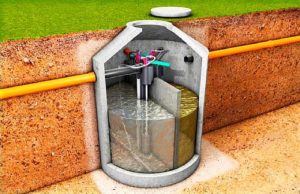
These stations perform double purification—mechanical and biological. First, solid components and petroleum products are removed. Then, biological purification takes place, using bacteria to break down contaminants.
This process produces clean water and sludge, which is the bacteria's habitat. The sludge is placed in vessels with slowly flowing water. The final purification of the water occurs in tanks, using a carbon filter or ultraviolet radiation.
Aerobic biological wastewater treatment systems
This method of water purification involves microorganisms in the presence of oxygen and heat.
Aerobic bacteria act on the biological components of wastewater, leading to its final decomposition. Chemical reagents are also used to completely purify the wastewater.
Anaerobic systems
Anaerobic treatment is performed by bacteria that do not require oxygen. By interacting with the organic matter in the wastewater, they decompose it, forming a solid sludge.
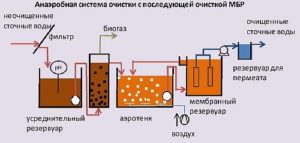
Wastewater processing is carried out in three stages:
- First, the process of dissolution and hydrolysis of organic matter occurs, which leads to the release of butyric and lactic acids;
- next, the process of acitogenesis with the production of acetic acid, during which hydrogen and carbon dioxide are released;
- Finally, methanogenesis is the production of methane gas from carbon dioxide.
How to choose a stand-alone sewer system for a private home
In private homes without a centralized sewer system, installing an independent water drainage system is a solution. Various types of septic tanks are available on the market, differing in their operating principles, price, and durability.
The selection of a septic tank should begin with determining:
- The house's purpose is either permanent or temporary residence. Some models of wastewater treatment equipment are not recommended for prolonged downtime. For summer cottages, a cesspool is a better choice.
- The size of the site, the soil composition, and the location of the watercourse. A percolation field cannot be installed on small sites. If the aquifers are close to the surface, a percolation well is not suitable.
- The number of discharges per day is calculated based on the number of people living in the house. It is specified in the device's instructions.
The equipment's capacity must be equal to three times the daily wastewater volume, as the treatment process takes three days. Standard standards stipulate 200 liters of wastewater per person. If there are three people living in a house, the storage tank capacity is:
200 l x 3 people x 3 days = 1800 l or 1.8 m³
- Vent pipe depths. Most models have vent pipes installed 800 mm below ground level. Since the installation is done at an angle, the vent pipe must be at least 700 mm deep.
- System material. Its properties and quality determine the installation, operation, and maintenance of the autonomous sewer system.
- Your financial capabilities. Purchasing high-tech models and maintaining them will be expensive. You can reduce costs by installing single- or double-chamber septic tanks.
If you're unsure about choosing the right model, consult with someone knowledgeable. The key is to remember that the equipment should last for years.
Do-it-yourself autonomous sewerage system
Before installing a stand-alone sewer system in a private home, you should read the manufacturer's installation instructions. Installing a septic tank with a biofilter should be done in stages.
Design and volume calculation
The trouble-free operation of a sewer system in a private home depends on accurate calculations and a well-designed project.
When designing, it is necessary to take into account the daily volume of runoff, the terrain, the location of groundwater, the number of drainage points, the location of objects on the territory (houses, fruit plants, water sources, etc.).
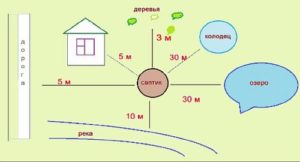
The project should include, in addition to the septic tank:
- external communications and treatment facilities;
- internal pipes and instruments;
- ventilation system.
Sanitary standards
The principle of construction and operation of septic tanks and biological treatment plants is prescribed in regulatory acts, which develop standards for the placement of treatment facilities, protection standards for surface waters and environmental safety (SNiP No. 2.04.03-85, No. 2.04.04-84, No. 2.04.01-85; SP 32.13330.2012; SanPiN 2.1.5.980-00 and 2.2.1/2.1.1.1200-03).
New standards developed in 2018 are reflected in STO NOSTROY 2.17.176-2015. Today, this is the primary regulation governing the design and construction of autonomous sewer systems.
Standard location standards from sewerage:
- houses – 5 meters;
- water intake (well, borehole) - 20 m if there is no soil with high filtering capacity between the aquifer and the filtration field, and from 50 to 80 meters if there is sandy or clayey soil;
- roads – 5 m;
- plot boundaries – 4 m;
- trees – 3 m (up to bushes 1 meter);
- other bodies of water (streams, rivers) – 10 m;
- bodies of water with standing water (lakes, ponds) – 30 m;
- underground gas pipeline – 5 m.
Interior equipment
For indoor sewerage systems, PVC or polypropylene piping is used. The choice should be made based on the water temperature and the material's resistance to household chemicals.
The size of the products should be selected based on the number of drains. For a sink, 50 mm; for a toilet, 110 mm. The slope of the pipes is affected by their size: 3 cm per meter for 50 mm pipes, 2 cm per meter for 110 mm pipes.
To prevent wastewater from flowing backwards, a check valve is installed. To prevent odor from entering the room, traps are installed.
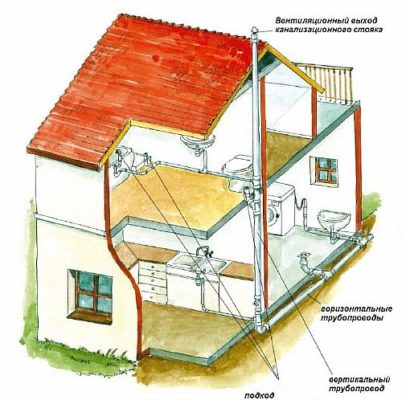
When installing the structure yourself, it is necessary to pay special attention to the junction of the internal and external main lines - the outlet from the house:
- When installing a sewer system in a finished house, the outlet can be located above the ground, but it needs to be insulated;
- through the foundation is the best option;
- through the wall, the pipe must pass in a sleeve - a pipe of a larger size.
Ventilation of the sewer system
Ventilation is an essential part of a sewer system. It helps normalize pressure in the main line, which fluctuates when wastewater is discharged, and ensures the release of accumulated gas. Furthermore, it extends the life of the equipment.
Classic ventilation - this is a waste pipe, the free end of which extends onto the roof. It rises above the chimney and ventilation pipes and is located at least 4 meters from windows. The optimal diameter of the vent pipe is considered to be 110 mm.
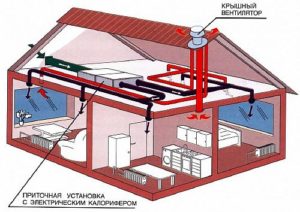
Installation of external communications
External utilities are the main pipeline from the house to the wastewater collection point. Ideally, it's a straight pipe with a 2-5 degree slope toward the tank.
Tapping into the main drainage system is permitted for drains from bathhouses, etc. However, all these locations increase the risk of blockages due to changes in flow rate, so a number of rules must be followed:
- To avoid sudden changes in the direction of the drains, it is necessary to install oblique crosses or pipes with an angle of 15, 30, 45 degrees;
- All sections of the connections must be equipped with additional inspection wells.
For external utility lines, plastic or cast iron pipes are recommended. They are laid in trenches at a depth not subject to freezing; otherwise, they must be insulated.
Trenches are dug 40 cm wide, which is enough even for laying insulation. The depth depends on the length of the pipeline and its exit point from the house. Each meter of the trench should have a slope of 2 cm.
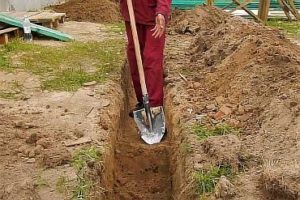
Installation of a treatment plant
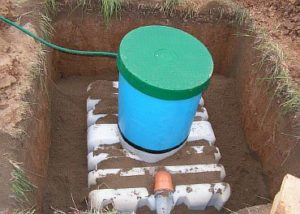
The process of installing a septic tank yourself:
- A pit is dug at the designated location. Its size should be 30 cm larger on each side than the sump itself.
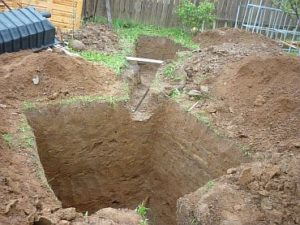
- The bottom of the pit is compacted and filled with concrete.
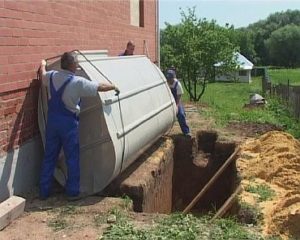
- The tank is installed on a hardened concrete pad. It is secured with a cable. The technology allows for the septic tank and biofilter to be placed in the same excavation pit.
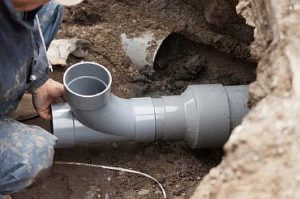
- The sewer system is being assembled - pipes are being connected according to the developed diagram.
- Biofilter blocks are filled with expanded clay and bioactive absorbents.
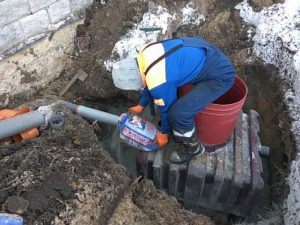
- The container is filled with earth and soil. As you fill, compact each layer periodically.
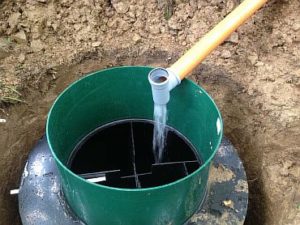
- Water is poured into the septic tank, the level is slightly higher than the level of the filled material.
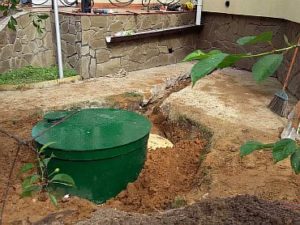
- The device is buried, first sand is poured in, and then soil.
When servicing a stand-alone sewer system in a private home, it's important not only to ensure the system's smooth operation but also to prevent blockages in the storage tank. A key part of maintenance is cleaning the pipes, which significantly improves the system's throughput capacity.
Autonomous wastewater treatment plants are mandatory when building a private home. They protect the environment from untreated wastewater and residents from potential poisoning.
But it is important, when doing the installation yourself, to do it correctly, otherwise the desired effect will not be achieved.