Radiators are heating devices that are essential for the vast majority of people to live comfortably.
They are used not only in homes but also in offices and garages. By making the right choice at the purchasing stage, the device will perform well.
- Features of choosing heating devices
- Characteristics of aluminum radiators
- Characteristics of bimetallic batteries
- Characteristics of cast iron batteries
- Characteristics of steel radiators
- What criteria should be used to select radiators?
- Heating system type
- Heat transfer of different types
- Reliability and durability
- Appearance and finishing
- Price category
- Calculation of thermal power using basic formulas to simplify the selection procedure
- By area
- By volume
- Helpful tips for choosing
Features of choosing heating devices
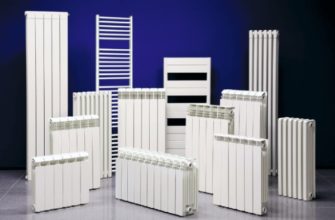
Radiators may vary in color, size, and material. All devices have a streamlined shape, without sharp corners. However, technical specifications vary.
Before purchasing a heating appliance, it is recommended that you familiarize yourself with the characteristics and features of radiators, which are presented in a wide range of assortments on the market.
We suggest you find out what types there are types of heating radiators, their pros and cons, selection features.
Characteristics of aluminum radiators
Aluminum batteries are the most popular devices. This is because aluminum alloy is a lightweight and malleable metal, so devices made from it are lightweight yet highly durable. high heat transfer.
Aluminum radiators are made up of sections, each consisting of multiple interconnected plates.
Its popularity is due to a number of advantages:
- fast heating;
- high heat capacity;
- affordable price;
- large selection of models.
Aluminum radiators cool down within seconds. This isn't the only drawback of the device; there are other disadvantages:
- actively react to various types of chemical influences;
- strength at a reduced level;
- The quality of the threaded connection in the upper valve for releasing air from the system is not very good.
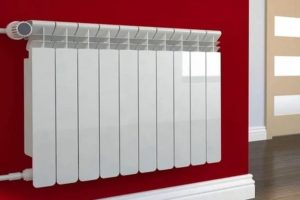
These devices are divided into three types, based on manufacturing techniques:
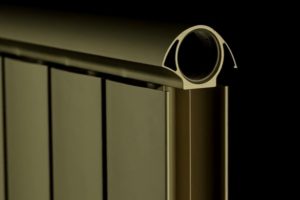
- Anodized type. Radiators whose metal undergoes several stages of purification, and the surface is coated with an oxide film. The downside is the high cost.
Advantages:- good heat transfer;
- the metal is not subject to rust.
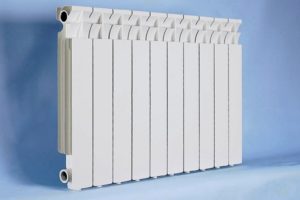
- Die cast. The device is made of silicon and aluminum alloy. Cons: short lifespan, limited model selection. Pros:
- affordable price;
- performs its functions.
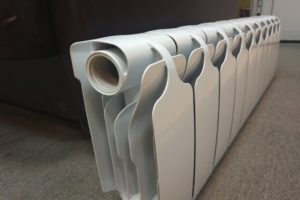
- Extrusion. The heating element is manufactured using a special technology: first, the unit is extruded, then connected to the manifolds using a press. Cons: visible seams on the radiator sidewall, high risk of leaks, often mistaken for injection molding. Pros:
- accessibility;
- fast heating.
Characteristics of bimetallic batteries
Bimetallic radiators are manufactured using an aluminum-steel alloy, though copper is less commonly used. The core is made of steel, while the body is made of aluminum. These radiators are the most efficient, as their operating pressure ranges around 50 atmospheres.
Besides this, there are other advantages of the device:
- light weight;
- compactness;
- any coolant can be used in the system;
- long service life;
- ease of installation;
- can be placed in any room;
- has resistance to water hammer.
The only downside to a bimetallic radiator is its high price. But the cost is justified, as a good radiator can't be cheap. From a cost-saving standpoint, installing one heating device in private houses it is not advisable.
Another disadvantage is that it requires a large amount of water for circulation.
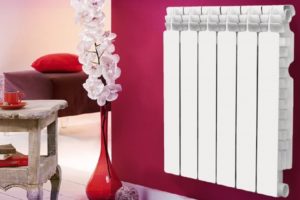
There are 2 types of bimetallic batteries:
- Monolithic – the internal comb is a single piece. The downside is that if the radiator produces little heat, it's impossible to add additional sections.
Pros:- long service life;
- working pressure level – up to 100 bar.
- Sectional – The device has several separate sections. Disadvantages: service life limited to 25 years, operating pressure less than 35 bar.
Advantages:- easy to operate;
- affordable price;
- You can add sections.
The heat transfer level is the same for both types.
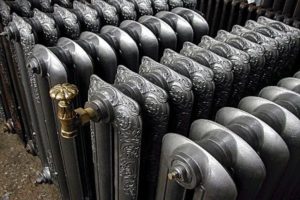
Characteristics of cast iron batteries
These heating radiators are familiar to everyone. These are the ones installed in typical apartments. Older models look unpresentable, while newer equipment can be integrated into the interior.
These batteries are ideal for operation in central heating systems.
Cast iron products are very heavy, making them difficult to transport and install. Another significant drawback is the time it takes to heat up and warm the room.
Advantages:
- reliability, long service life;
- cools slowly, releasing heat;
- cast iron is resistant to corrosion;
- high heat capacity;
- the radiator can be used even with low-quality heat carriers containing impurities;
- low cost.
Characteristics of steel radiators
Steel heating radiators are made from low-carbon steel. The top layer of the device is coated with a special enamel. This device has found its customers due to a number of advantages:
- strength;
- reliability;
- rust resistance;
- long service life;
- not susceptible to the effects of aggressive substances.
Disadvantages that confuse buyers:
- high cost;
- Some models consume a lot of electricity and are heavy.
There are 2 types of steel batteries:
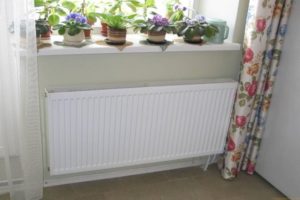
- Panel. They consist of one, two, or three steel plates with a ribbed surface. The radiator can be additionally equipped with a convection grille. Three-plate radiators are equipped with two or three such grilles.
The coolant circulates within them. If the device lacks such a device, the heat output of the heating device will be several times lower. The plates are connected by spot welding.
Flaws: consumes a lot of electricity, the device is not able to withstand water hammer, some models are large and heavy.
Advantages:- fast heating;
- good heat dissipation;
- additional protection from external influences;
- You can choose the device based on its size and the presence of a grill;
- withstands high coolant temperatures.
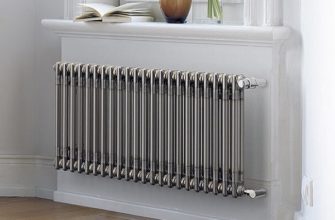
- Tubular. These are sections that are presented in the form of pipes. In appearance, the radiator resembles a cast iron unit. Additional sections cannot be added in this case. The number of pipes ranges from 2 to 6. The height of the unit is up to 1 meter. Disadvantages: sections cannot be added, the operating pressure is low, and the cost is high.
These batteries are produced in several formats: columnar - all elements are the same size, segments - sections have the same diameter, radius designs (similar to a semicircle) and diagonal (all tubes are different sizes, smoothly decreasing, the length is diagonal in any direction).
Pros:- low probability of leaks;
- resistance to rust and external influences;
- large range of models.
What criteria should be used to select radiators?
Once you've familiarized yourself with the characteristics and features of heating appliances, you can begin choosing a specific model. To ensure the appliance fully meets your needs, pay attention to the following details.
Heating system type
This is the main factor when choosing a radiator. In our country, there are two types of heating systems:
- Centralized. This system is present in apartment buildings. Water pressure is high and variable. All radiators are connected to a single pipe and are turned on sequentially, one after the other. When the central system pump starts, it turns on abruptly, causing water hammer.
The coolant is very hard water, which can damage metal. In the summer, when the heating system is turned off for long periods, rust appears on the appliance. The best heating appliances in this group are cast iron and bimetallic ones.
For such a heating system, you should choose a radiator:- which operates under pressure up to 16 atmospheres;
- resistant to water hammer;
- not susceptible to negative chemical influences.
- Autonomous. Private homes are connected to this system. It consists of two pipes through which the coolant circulates in a circular motion. The operating pressure is –2 bar. The water has moderate hardness and acidity. Therefore, the following radiators are suitable for autonomous heating:
- aluminum;
- steel;
- cast iron.
You can choose any type. Bimetallic devices are available, but due to their high cost, they will perform no better than other devices, and in some cases, even worse.
Heat transfer of different types
The second point worth considering before purchasing is that appliance store salespeople are required to know and explain the thermal conductivity of each heating appliance model. Buyers only need to know the following:
- Heat output of one section:
- cast iron appliance – 100-150 W;
- aluminum radiator – 20-210 W;
- bimetallic – 150-180 W.
- Heat output of radiators that do not have sections:
- steel – 1200-1500 W;
- convectors – 150-10,000 W.
When choosing a device based on this parameter, it is best to give preference to aluminum or steel.
Reliability and durability
The service life of radiators varies depending on the material from which the device is made:
- cast iron installation lasts up to 50 years;
- aluminum devices – 15-20 years;
- made of steel – 15-25 years;
- bimetallic models – 20-25 years.
If you're hoping for a long-lasting heating appliance, a cast-iron radiator is a good choice, but its appearance isn't for everyone. In this case, a bimetallic radiator is an alternative.
Products made of aluminum and steel (copper) can last the stated 25 years, as they are resistant to water hammer and respond best to pressure changes.
Appearance and finishing
Those who value the appearance of a heating device are advised to familiarize themselves with the following features:
- Cast iron utensils. The latest models look more attractive than their predecessors. They've become flatter and smaller in size. However, the cast iron radiators are coated with an anti-corrosion primer and a special paint.
- Aluminum. In this case, you can choose a model that suits the room's parameters. Manufacturers offer these devices in a variety of colors.
- Steel. The simple design makes the unit easy to integrate into any interior. Tubular radiators have unique shapes and look attractive in any apartment without taking up much space.
- Bimetallic. They also come in interesting designs and original shapes. Models with rounded edges and smooth corners are more common on the market.
Price category
Heating radiator pricing varies. Prices are quoted per section:
- cast iron utensils – 300 rubles (except for “retro” models, their price starts from 2000 rubles);
- aluminum – from 300 rubles;
- steel – from 1,500 to 10,000 rubles for the entire radiator (sectional types are practically not sold);
- bimetallic – 600 rub.
The cheapest options are Russian-made panel and cast-iron heating units. More expensive models include retro and tubular steel ones.
Calculation of thermal power using basic formulas to simplify the selection procedure
An important factor when choosing a radiator is its thermal output. Calculations are based on the room's area or volume.
By area
There are building codes for heating requirements in a room:
- at moderate climatic temperatures, 50-100 W is required per 1 sq. m;
- in cold conditions – up to 200 W.
To calculate the required amount of heat, multiply the room's area by the required value given above. To avoid the risk of error, it's best to choose the upper limit of the standard.
It is permissible to make a calculation with a slight reserve.
By volume
To determine how many sections a radiator should contain, you need to calculate the volume of the room. The ceiling height determines how much heat is needed to heat the entire apartment.
The calculation formula remains the same: calculate the volume of the room by multiplying its area by the ceiling height to determine the amount of heat required:
- to heat an apartment in a panel house, 40 W is needed per 1 square meter of air, the number of sections is 9.75;
- in a brick house – 35 W, number of sections – 8.5.
Helpful tips for choosing
When choosing a heating device, read the recommendations from experts:
- First, contact your building's management company to find out about the following characteristics:
- working and test pressure;
- the composition of the coolant and what alkaline environment it has;
- maximum temperature of water in the central heating system.
- A high-quality, properly functioning, and efficient radiator must be resistant to water hammer, which cannot be ruled out in a central heating system.
- Find out if your radiator can rust. This determines its service life.
- Accurately calculate the number of sections required. This is especially important when purchasing a device for a monolithic house.
- The power of the device must correspond to the maximum temperature of the coolant – up to 130 degrees.
- Optimal service life is 25 years.
- Choose a radiator with thick walls, as the coolant often contains many impurities and harmful substances.
- Before paying, please carefully read the technical specifications of the device.
- Buy radiators only in specialized and trusted hardware stores.
All types of radiators are acceptable for use in private homes. Choosing a radiator for an apartment has its own set of considerations:
- In new buildings where water levels are normal, it is better to purchase aluminum radiators;
- Houses that have been in use for more than 20 years have a high pH of the water, so the choice should fall on bimetallic or panel steel devices.
Heating radiators are an essential device in any home. They are often installed in offices, garages, hospitals, and other places. There are several types of radiators, each with its own unique characteristics. These characteristics should be considered when choosing a heating system.

When I ordered radiators from Global, I used the information on the official website. Everything was clearly explained there, explaining what and how. Everything heats perfectly; it's even hot in the house. I'm happy with my choice.