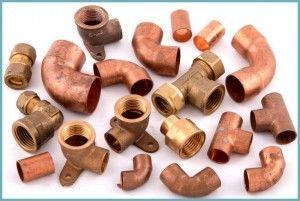
 As a rule, Heating networks are equipped with the following pipes: made of plastic, steel, copper, or galvanized. Copper products stand out from the rest.
This is facilitated by the impressive array of advantages these products offer and their lack of drawbacks. The only downside to these materials is their high cost.
That's why solderable copper pipe fittings are considered an elite option for heating systems.
Copper products are used in various pipelines inside buildings:
- For cold and hot water supply;
- For heating;
- Air conditioning;
- For connecting the solar system and heat pump to the water supply network and heating main.
What are fittings?
A distinctive feature of copper pipes is their poor compatibility with other materials used in heating networks.
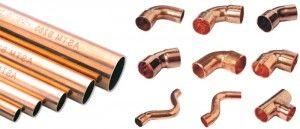
Therefore, copper fittings are recommended for these products. These are the same components used in heating system installations. They withstand high temperatures and are not damaged by sunlight.
Fittings are the most commonly used pipeline component. These components are used to create turns, branches, and combinations of pipe products of the same or different diameters.
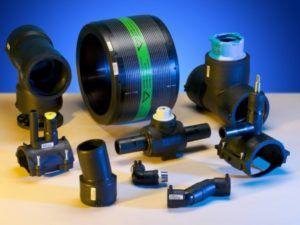
Manufacturers offer them in a wide variety of sizes and shapes:
- Angle-shaped elbow (single-socket or double-socket);
- Arc-shaped bend;
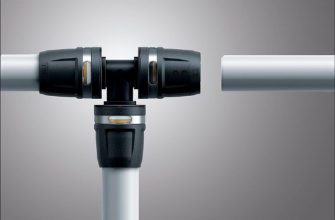
- Tee;
- Coupling;
- Plug.
Among a wide variety, buyers can select the components needed for future communications.
Depending on the fastening method, they are divided into:
- Copper. It is used only for soldering metal parts. The connection is made as follows: the pipe is inserted into the fitting sleeve, and solder and soldering flux are placed in the space left behind. For a secure connection, the filler is melted with a torch. After the workpiece has cooled, it must be cleaned.
IMPORTANT! These fittings guarantee a very tight and durable seal. Leaks in such cases only occur if installation and operation instructions are not followed.
- Copper compression fittings. These materials are in high demand among customers. They are installed using a special compression ring, which is tightened with a nut from the outside. Compression fittings have a clear advantage because they can be installed in places where other fittings are inaccessible or pose a high risk of fire.
- Copper press fittings. They are used to weld copper and plastic pipes together. They are very widely used today.
- Self-locking. These are excellent new materials. They are placed on the pipe and snapped into place using a special key. This also activates the spring-loaded clamping mechanism. It is equipped with an elastic seal, creating an excellent seal.
How to solder copper pipes
Video 1.
Fittings are available in diameters from 6 to 108 mm. They are designed for installing copper components when working with soft or hard solder. They are used in heating systems, for gas and water supply.
IMPORTANT! Copper fittings change temperature and pressure ratings when changing the type of solder used.
Copper soldering is used in water supply and heating systems. The technical characteristics of this product allow copper pipes 1 mm thick to withstand pressures of 100 bar, and copper fittings can withstand very high temperatures.
This connection has excellent corrosion resistance, is not difficult and does not take much time.
If you want Learn in detail how to solder copper pipesThe video on our website will help you solve this problem. It explains the process in detail and clearly.
Brazing is a modern method for installing pipelines. A wide variety of fittings, fluxes, solders, and soldering pastes are available commercially.
Flux This is a special mixture designed to remove oxides from the soldering area. It also helps reduce surface tension and promote solder flow.
Solder (can be hard or soft) consists of an alloy of metals that melt easily when heated. It almost always contains tin and lead. This alloy can be used for soldering cookware, as it is environmentally friendly.
Solder paste Contains solder (hard or soft), flux, and a bonding agent. The paste appears as a viscous, dense mixture.
What is the best way to solder – hard and soft methods
Soldering is called hard or soft. This depends on the type of solder used. It can be a spool of wire, easily bent by hand, or a solid rod.
This video explains how to use a gas torch to solder copper pipes with hard solder.
A gas torch is used for soldering. It is used to solder components using flux and solder.
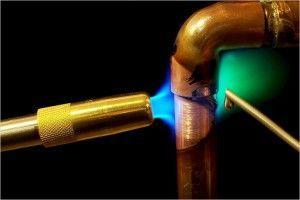 When choosing a gas torch, you need to consider the size of the parts to be soldered and the amount of time required for the process.
For fast soldering, use a gas torch with a large nozzle. For slower heating, use a small flame. The gas mixture used depends on the soldering method. This can be:
- Acetylene-air;
- Acetylene-oxygen;
- Propane-air;
- Propane-butane air;
- Propane-oxygen.
If it is not possible to use an open flame, then electric induction heaters are used instead of a gas burner.
Low temperature or soft method
This work is done with soft solder. The melting temperature for this process ranges from 200 to 250 degrees Celsius. This soldering method is necessary for joining soft pipes to formed thin-walled copper fittings.
Video 2.
When soldering in this way, the distance between the pipe and the fitting should not exceed 0.05 to 0.20 mm.
The optimal mode of the low-temperature method is achieved when working with propane-air and propane-butane-air gas mixtures.
Electric heaters are constantly being improved and are becoming more and more popular. They come to the rescue in situations where an open flame is not an option.
The result is just as good as a gas torch for brazing. The pipe heats up just as well, and the joint is securely joined.
Soldering process
Soldering is the simplest method.
Video 3.
- Before work, the fittings are inspected for proper dimensions, and if necessary, the pipes are calibrated. However, calibrating the socket of the fitting is not recommended;
- The components to be soldered are removed from the polymer shell to the required length. Burrs are removed from the outer and inner edges of the workpiece;
- The pipe and socket are cleaned of dirt. The inside of the socket and the outside of the pipes are cleaned with wire brushes until shiny, then flux is applied. High-quality flux and other welding materials are essential for the final result. Flux is applied to the outside of the pipe with a brush;
IMPORTANT! Applying flux to the inside of the socket or to the soldered diameter of the fitting is strictly prohibited. Excess flux on the inside of the socket will cause corrosion.
- Next, the socket and the spigot are assembled. The resulting joint is heated with a gas torch. The flame is set to be uniformly soft and wide;
- The heating temperature during the process can be monitored visually. If smoke rises from the flux, causing the indicator substance to evaporate, the temperature has reached 200 degrees Celsius. If the piece turns red from the heat, the temperature has risen to 600 degrees Celsius (the torch flame changes from blue to green).
- Care must be taken to ensure that the fittings do not touch any other objects, otherwise the heat will be dissipated in the wrong direction. If a large-diameter workpiece needs to be heated, the flame of the gas torch is moved around the joint. This is done to improve heating;
- The solder is injected into the capillaries in one spot. The amount of solder is equal to the diameter of the components being soldered. If soldering a tee joint, proceed as follows: First, heat the straight sections from below, then the parts from above. This is done to prevent the heat from subsequent heatings from melting the previously made joint;
- The resulting seam is thoroughly cleaned to prevent corrosion.
High-temperature method
This work is carried out at temperatures exceeding 450 degrees Celsius using hard solders. The components are heated to 750 degrees Celsius.
Video 4.
When working with this metal, care must be taken to avoid overheating the elements, otherwise the metal will soften. The heat is reduced after a dark cherry color is achieved.
When high-temperature soldering elements that have a large diameter, the hard solder is applied to two oppositely located places.
Another difference of this method is that when soldering copper elements, flux is not used, but when working with copper and brass or bronze, fluxes containing phosphorus must be used.
Video 5.
Fittings and pipes welded using high-temperature welding are the strongest. This method is used for connections subject to fatigue loads and high temperatures.
Soldering is reliable and durable. It's easy to do, and no special knowledge or skills are required. Any ordinary person can do it. easily select fittings for copper pipes solder and make the connections correctly. Your home will have reliable and environmentally friendly plumbing.