A hydronic underfloor heating system is a multilayer structure whose core is the pipes. The pipes carry the hot coolant, which heats the room.
In this article, we'll learn what determines whether pipes can be connected, under what conditions, and how to connect them yourself.
- Which pipes are best to use?
- PEX pipes made of cross-linked polyethylene
- Polyethylene PE-RT
- Metal-plastic
- Metal
- Is it possible to connect underfloor heating pipes or not?
- Connecting cross-linked polyethylene and metal-plastic pipes
- Cross-linking of copper pipes
- How to connect underfloor heating pipes (press fitting)
- Connecting underfloor heating pipes in a screed
- How to solder a heated floor pipe
- How to connect a heated floor pipe to a metal-plastic pipe
- What to do if a heated floor pipe is punctured?
- Is it possible to extend the pipes if they are not long enough?
- Video tutorial
Which pipes are best to use?
Only those circuits are suitable for floor mains, which can withstand high temperatures.
Today, the market offers a wide variety of products made from the following materials: copper, metal-plastic, and cross-linked polyethylene. We'll discuss galvanized rolled pipe materials separately.
Each type has its own characteristics and is intended for use in specific conditions.
PEX pipes made of cross-linked polyethylene
Cross-linked polyethylene pipes have excellent performance characteristics. This gives them an undeniable advantage over other materials, making them popular both for cold water supply and for installation in underfloor heating systems.
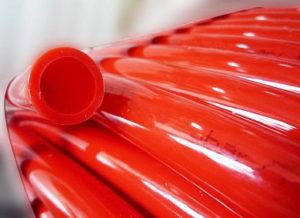
They are made from polyethylene of a specific density. The products are stitched together using several methods.
Depending on the production process, pipelines come in different classes:
- PEX-a is made using high-density polyethylene. The production method, a peroxide process, involves melting the polyethylene under high temperature. The resulting amorphous mixture is then extruded through a special forming orifice; this method is called extrusion.
PEX-a is a multilayer construction with an aluminum insert between the layers, which helps maintain the product's shape. A special adhesive is used to bond the layers; its properties are not affected by temperature.
Please note! This product is capable of permeating oxygen to the coolant. To prevent this, manufacturers began equipping it with a protective EVOH coating on the outside—a layer of thin plastic (polyvinylethylene).
- PEX-b is made from medium-density polyethylene, which is softened to a solid consistency. With this method, cross-linking occurs after extrusion.
- PEX-c—the raw material in this case—is also medium-density polyethylene. Cross-linking occurs at ambient temperatures, leaving the material in a solid state.
Cross-linked polyethylene hoses are widely used in the installation of heated floors, but PEX-a is used more often, as it has good elasticity and allows for the installation of a line with a bend of up to 5 diameters.
PEX-b is harder and therefore breaks easily. PEX-c, on the other hand, does not handle high temperatures well, so it is more often used for cold water. Furthermore, products made from this material are durable and lightweight, which is an advantage for DIY installation.
PEX-a pipes have memory—if deformed, they can fully regain their shape; this requires heating. PEX-b pipes do not have this property, and PEX-c pipes have a reduced memory.
Polyethylene PE-RT
PE-RT pipes are modified; they differ from PEX in that they are seam-free. A system made from these pipes is virtually silent and can withstand sub-zero temperatures. While they can tolerate high temperatures above zero, they do so only for a limited period.
Furthermore, this material is susceptible to aggressive substances and lacks structural memory. Despite this, heat-resistant polyethylene is widely used in underfloor heating systems due to its affordable price.
Metal-plastic
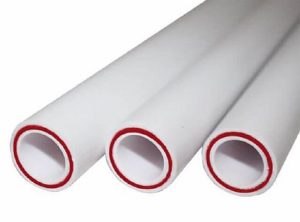
Metal-plastic pipes for underfloor heating are an excellent option. They are flexible and moldable, and can be bent even without heating. Furthermore, the material is durable, tolerates temperature fluctuations well, and is environmentally friendly.
Metal-plastic pipes consist of several layers: cross-linked polyethylene on the inside, followed by metallized foil, and a polymer coating on the outside, which protects against mechanical damage. This design prevents corrosion and scale deposits. With proper installation, the pipes will last for over 50 years.
When comparing metal-plastic or cross-linked polyethylene for underfloor heating, plastic has superior thermal conductivity. However, there's a high risk of coil kinking, and since this type of product lacks the ability to restore its shape, this section will have to be removed.
Metal
Metal pipes for underfloor heating are available in the following types:
- Copper pipes are expensive, so they're not very popular for hydrofloor installations. Furthermore, installing such pipes is difficult, requiring specialized equipment, making it difficult to do the installation yourself.
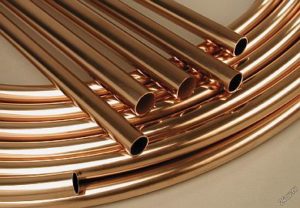
However, it is worth noting that copper pipe is an ideal option for underfloor heating, as it has excellent characteristics:
- high thermal conductivity;
- durability;
- resistance to corrosion;
- plasticity and strength.
- Corrugated stainless steel is a relatively new type that's well-suited for underfloor heating, but is not widely used due to its high cost. It features a protective polymer coating, and the stainless steel is corrosion-resistant and highly resistant to mechanical, chemical, and thermal stress.
In addition, this model has increased flexibility and can be laid in the most complex patterns without the risk of kinking.
To sum it up, we can say, that the most popular models that are used for heated floors are metal-plastic pipe or cross-linked polyethylene circuit.
They have good performance characteristics and are affordable. However, if finances allow, it's better to use metal (copper) piping, which has high thermal conductivity and is more durable.
Is it possible to connect underfloor heating pipes or not?
When laying underfloor heating pipes, the length of the loop is often insufficient to form a continuous loop. This raises the question: is it possible to connect the pipes together, and how? There are several methods for connecting loops, depending on the type of material.
Important! When choosing a method for joining floor pipes, consider the operating pressure, as each connection is designed to withstand a specific load.
Let's take a closer look at the methods for connecting underfloor heating pipes.
Connecting cross-linked polyethylene and metal-plastic pipes
Polyethylene or metal-plastic circuits can be joined using fittings (brass, bronze, and plastic), which can withstand high temperatures. Fittings come in the following varieties:
- Electric welders are effective, but they require specialized equipment for installation, so they are rarely used. The process is as follows:
- an electric welding fitting is placed on the pipe cut;
- welding equipment is connected to the terminals; it will apply voltage to the element, which will lead to heating and fusion of the joints;
- the device is switched off, the resulting connection is capable of withstanding pressure up to 12 Amp.
- Pressed joints have the main advantage that when pressed, the entire space is filled with polymer, thereby creating a highly durable connection.
Sequence of actions:
- a nut is placed on the end of the crimping tube, with the thread facing the connection;
- the split ring is put on with an indent of 1 cm from the cut and fixed;
- the hose is pulled with a fitting device;
- The compression nut is tightened tightly using two wrenches.
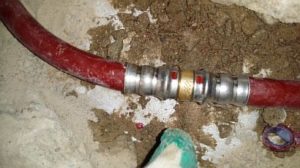
- Compression fittings are the easiest to install at home:
- a clamping sleeve is placed on the polymer hose;
- the end of the contour is stretched in diameter using an expander;
- the stretched edge of the tube is pulled until it stops on the fitting nipple;
- The connection point is fixed in this position for several minutes, this is enough for a tight joint of the fitting.
Cross-linking of copper pipes
Just like when installing a plastic circuit, copper can be joined using press or push fittings. This method is recommended for exposed areas, so that the part can be easily replaced in the event of a leak.
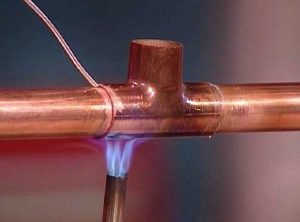
But the most reliable and practical is - soldering copper pipesThis is a more labor-intensive process, but the resulting connection is durable and reliable. Here's the sequence of steps:
- the contour cuts are cleaned from the outside and inside;
- the edges of the parts are lubricated with a special connector for soldering copper underfloor heating pipes - only on top;
- the products are joined together and excess mixture is removed;
- The connection point is heated with a gas burner and the solder fills the gaps.
How to connect underfloor heating pipes (press fitting)
As mentioned above, pipelines can be joined using press fittings. This component consists of:
- housings - come in different shapes (angle, tee, coupling);
- sleeves are the basis of the fitting, the raw material for its production is stainless steel;
- Clips are an elastic ring (gasket) that connects the body and the sleeve.
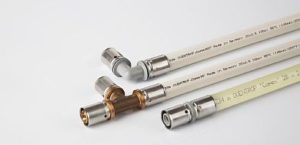
Please note! The fitting body is equipped with a "window" to ensure the tubular component is inserted correctly. Only when the tubing is visible in this opening can pressing begin.
Pressing is performed using special pressing tongs. The procedure involves squeezing the tool's handles. The process is quick and easy, and no special skills are required.
The advantage of using such a connection is its strength, long service life, and the design does not require maintenance.
Connecting underfloor heating pipes in a screed
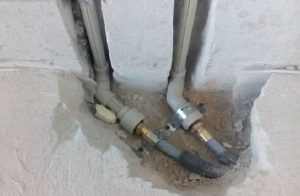
Although experts advise installing water-heated floors under a screed without joints, it is not prohibited to do so.
It's worth noting, however, that connecting floor circuits using threaded connections, such as union nuts or PRX fittings, is not recommended. It's better to connect pipes using press fittings or couplings.
Important! When pouring concrete in these areas, insulate fittings or couplings from the concrete. This can be accomplished by wrapping them in plastic film.
How to solder a heated floor pipe
Soldering is a common method of joining plastic pipes. Underfloor heating. The technology is simple and doesn't require a large financial investment. There are two soldering methods:
- Coupling – this method uses a shaped part (a coupling or a contour with a larger diameter). This method is suitable for 63 mm tubing. The welding process involves melting the outer edge of the part and the inner part of the coupling. The parts are then joined, creating a tight joint.
- Direct welding involves melting small sections of two plastic pipes together, then joining them end-to-end. This relatively simple method reliably joins two parts into a single unit.
Please note! Along with hot soldering techniques, cold soldering is also used. This method uses a special solvent that softens the plastic.
How to connect a heated floor pipe to a metal-plastic pipe
Although experts recommend using a single-material piping system when installing underfloor heating, sometimes it becomes necessary to connect a metal-plastic circuit to products made from a different material.
For example, when connecting this circuit to steel (copper) plumbing or heating components, a compression fitting and a calibrator are required. When joining components made of different materials, the threads should be selected based on the size of the steel pipe, and the cuffs and washers should be selected based on the size of the metal-plastic pipe.
Tow is wound onto the copper pipe, and then the fitting is screwed on. The end of the fitting is pushed onto the cone, and the nut is tightened.
If connecting a metal-plastic circuit to polyethylene products is necessary, special threaded fittings can be used as a connector for underfloor heating pipes. This type of connection is most often made when connecting underfloor heating to a boiler.
What to do if a heated floor pipe is punctured?
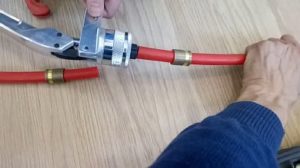
If you have underfloor heating in your home or apartment, there are times when a puncture can occur in the floor pipe. First, if the floor is functioning, you should disconnect it from the water supply. However, more often, such damage occurs during installation or repair of the system, when the final coating hasn't been laid or the screed poured—this is a huge advantage.
If there's a concrete screed, to locate the damaged area, you'll need a hammer drill, chisel, and hammer to break up the concrete. This should be done carefully to avoid damaging the entire structure.
When punching a pipe made of metal-plastic or polyethylene, they are repaired using press couplings, using a special press.
Please note: If the heating element will be filled with screed after repair, threaded fittings cannot be used.
Once the puncture location is located, the damaged section should be removed and the entire circuit installed in its place. The connection is made using press couplings, which should be wrapped in polyethylene film to protect them from the cement mortar.
Is it possible to extend the pipes if they are not long enough?
As is well known, it's better to make a continuous underfloor heating loop, as this ensures the system's reliability, and to make connections at the manifold attachment points. For large heated spaces, it's recommended to divide the area into several branches.
To avoid making a mistake in the loop size, it's important to calculate it correctly. You can use an online calculator for this.
However, it is still possible to extend the underfloor heating circuit if necessary by connecting the missing section of pipe to it, which, incidentally, is permitted by GOST. Underfloor heating loops can be extended using various methods, including butt joints—usually press fittings.
Please note! In such cases, it is recommended to use pipes and fittings from the same manufacturer.
In summary, connecting underfloor heating pipes is possible, and there are various methods. However, it's more practical and reliable to install a continuous loop, especially under the screed, so that in the event of a leak, the concrete layer doesn't have to be damaged.
Additionally, it's important to choose high-quality piping and fittings from reputable manufacturers. This will ensure your heated floor will last a long time and create a comfortable atmosphere in your home.