Heated floors are a common feature in our apartments and are not considered a luxury. They come in varying power ratings, depending on their design. They can serve as both primary and supplemental heating.
In this article, we'll discuss the best underfloor heating power and why, determine the optimal temperature for different types of rooms and flooring, and explain how to calculate the optimal heating system power.
- Recommended underfloor heating temperature
- Factors determining the power of underfloor heating
- Main heating or not
- Type of room and its size
- Floor covering
- Thermal insulation of the room and heat loss of the building
- Installation type
- Thermostat type
- How to calculate the power of a hydronic underfloor heating system
- Making a plan
- Determination of area
- Calculation of heat loss
- Coolant flow rate
- Laying step and contour length
- Floor power
- Boiler performance
- Circulation pump
- Let's calculate the power of an electric underfloor heating system
- Which underfloor heating system should I choose?
- Let's determine the temperature regime in the room
- How to reduce consumption costs
Recommended underfloor heating temperature
It's no secret that temperatures vary in rooms with different purposes. For example:
- in the bedroom, kitchen or living room - the standard is considered to be 29 degrees;
- in a bathroom or toilet, where the humidity level is high - 31;
- In rooms with increased heat loss, such as a loggia or a large room with many windows, the 35-kW (or 35-kW) ratio is used.
If we consider the system temperature based on the floor covering, then when using rolled carpet, linoleum, parquet or laminate, the normal temperature will be 27 degrees.
Factors determining the power of underfloor heating
There are many factors that influence the choice of device power that must be taken into account to ensure the heating system operates efficiently.
Climate conditions also play a significant role. If the house is located in a cold climate, the heating system's capacity should be selected with a reserve.
Main heating or not
One of the factors influencing power output is the heating type—that is, whether the system will be the primary or secondary heat source. If it is the primary heating system, a higher-output unit is required, with a specific power level of 200 W per m².
Each type of heated floor has its own standard heating power per square meter:
- cable - 220 - 230 W;
- cable mats - 100 - 160 W;
- infrared film - 130 - 230 W;
- rod - 130 - 160 W;
- water - 40 - 150.
Type of room and its size
Each room in an apartment has its own function, which determines the temperature. Furthermore, the room's size and the number of windows affect the temperature.
For example, the power of the heating system installed on the loggia should be higher than that intended for the kitchen.
In most cases, electric floor manufacturers provide recommendations for these parameters:
- bathroom - 150 to 180 Watts/m2;
- glazed balcony - 150 to 180;
- kitchen, bedroom, corridor - 110 to 150.
When determining the power of underfloor heating based on the size of the room to be heated, do not take into account areas where heavy furniture will be located, as installing underfloor heating is not recommended. Naturally, the smaller the room, the lower the power rating of the heater required.
In addition, thermal conductivity is affected by the material the house is made of – wood, brick, concrete.
Floor covering
Heating power indicator in a lot depends on the finishing coatingAfter all, the material has different degrees of thermal conductivity.
When using underfloor heating under laminateHeating costs will increase because this material is a poor conductor of heat. Using carpet or linoleum will heat up faster, resulting in energy savings.
Thermal insulation of the room and heat loss of the building
A home's thermal insulation, which largely determines heat loss, is one of the most important factors when determining the power of underfloor heating per square meter. If the insulation (windows, doors, and ceilings) are poor, the system will operate longer and consume more heat, leading to increased costs.
In old panel houses, the wall thickness is only 10-15 cm. In such buildings, heat loss reaches 50%.
| Temperature in degrees | Good insulation (W/m2) | Average | Bad |
| 18 | 40 | 70 | 110 |
| 20 | 47 | 77 | 117 |
| 24 | 90 | 120 | 160 |
Rough estimate You can insulate a room yourself using an online calculatorAccording to modern building codes and regulations, the level of thermal protection should be within 100-130 W/m2.
It is recommended to provide additional insulation to the ceilings on which the heating system will be installed to prevent heat from escaping outside.
Installation type
The installation method of underfloor heating also influences its power selection, as the heat output depends on the thickness of the underfloor heating system.
Installation methods:
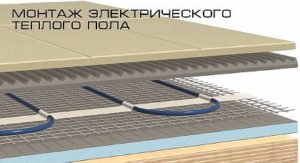
- A cement screed is one installation option. Concrete mortar is poured to a minimum thickness of 30 mm. To strengthen the structure, polypropylene fiber or mounting mesh is laid on top of the thermal insulation, to which the heating element is attached. A concrete screed is then poured on top. The thicker the concrete layer, the longer the heating time, but the heat accumulates, which increases the cooling period.
- Underfloor heating under tiles is often installed on an existing subfloor. First, cables are laid at a specific spacing—the closer the spacing, the better. The heating element is then filled with tile adhesive, and after it hardens, the tiles are installed. This method ensures good heat transfer.
- Dry installation under laminate flooring: If pouring a concrete screed is not possible due to the weight of the structure, installation is performed using grooves. To ensure uniform temperature distribution across the entire surface, the grooves should be 10 mm deep, into which the heating element is placed. If the cable is high-power (180-200 W), then it is recommended to make the grooves 15-20 mm deep.
Thermostat type
A thermostat is a device that records signals from a temperature sensor.It is responsible for supplying electricity to the device and, when necessary, turning the heating on and off, which leads to resource savings.
How to calculate the power of a hydronic underfloor heating system
The heat output of water floors directly depends on the length of the main line.
To calculate the system power you will need to know:
- area and configuration of the premises;
- coolant flow rate;
- heat loss;
- laying step.
Making a plan
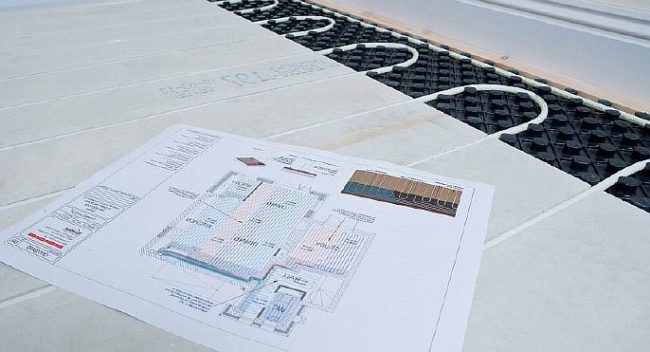
Any calculation should begin with drawing a floor plan. It's easiest to do this on graph paper, but squared notebook paper will also work. The plan should show all the windows and doors in the room, with their dimensions indicated.
The room's height is measured immediately, and the usable volume is recorded. The areas where furniture will be placed are marked on the plan. Then, a diagram of the pipe layout is drawn.
Determination of area
When calculating the power of a water-heated floor, it is important to remember that the area under stationary furniture and equipment is not taken into account.
The area of the room is calculated using a standard formula (the area of a square, rectangle, etc.), and the areas where the furniture will be located are subtracted from the result.
Calculation of heat loss
Heat loss is the amount of heat lost by a room per unit of time. To reduce heat loss, heating devices and good thermal insulation are used.
When calculating heat losses the following is taken into account:
- room area;
- size of windows and doors;
- ceiling height;
- number of external walls;
- temperature outside;
- thermal insulation of walls;
- the type of room that is located above.
To calculate heat loss, you can use an online calculator.
Coolant flow rate
To calculate water consumption We'll need to know how much coolant passes through the pipeline in 1 hour. This is necessary to properly adjust the flowmeters and select the correct pump capacity.
Water consumption is calculated using the formula:
G = 0.86 x Q / Δt
Where:
- G – water consumption in kg/h;
- Q – thermal power in W;
- Δt is the temperature difference between the coolant in the supply and return circuits; for underfloor heating it is equal to 10 °C;
- 0.86 is the heat capacity coefficient of water.
Laying step and contour length
For underfloor heating in private homes, metal-plastic or polyethylene profiles with a diameter of 16 mm are most often installed. There are several methods for laying the pipes, including a serpentine or a snail-like pattern, but the installation pitch should not be too small.
It is recommended to limit the length of each circuit to 80 meters. The pump power selection depends on its size.
The length of the contour can be calculated using the formula:
L = F/b
Where:
- F — area of the room;
- b — laying step.
If the pipeline length is more than 100 m, it must be divided into several loops.
Floor power
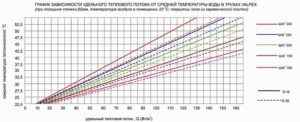
The power of a hydronic underfloor heating system per square meter is low, only 40–150 watts. For the system to be effective, heat distribution across the surface must be uniform, without the formation of cold spots. To increase heat transfer, it is recommended to reduce the pipe spacing.
The heat flux density is calculated using the formula:
Q=q/F
Where:
- q — heat loss index;
- F is the area.
Boiler performance
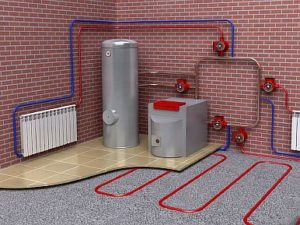
To calculate the boiler output for underfloor heating, consider the entire house's underfloor heating output. Add up all the calculated values for each room.
Add 15% to the resulting figure—this will be the required boiler output. If you buy a boiler without a reserve, the unit's capacity will be depleted as quickly as possible at 100% load.
Modern boilers produce 24 kilowatts of heat, enough to heat an average room up to 240 square meters. Electric boilers are also available, including those with a built-in pump, which is very convenient.
Circulation pump
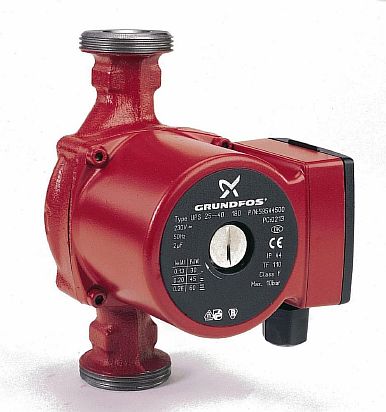
Without a pump, hydronic floors will not function effectively. How do you calculate the pump capacity for underfloor heating? It depends on the hydraulic resistance in the line; the longer the pipeline, the more powerful the pump required.
To determine the pump performance, you can use the formula:
Q = 0.86*Pн/(tпр.т — tобр.т)
Where:
- Pн — heating device power in kW;
- tобр.т — temperature indicator of the coolant in the return line;
- tpr.t — temperature level in the supply.
It's recommended to choose floor heating systems that allow for wide power adjustments. When turned on, the power should be at maximum, as this will allow the floors to warm up faster.
Once the set parameters are reached, the heating temperature should be automatically reduced in the system.
Let's calculate the power of an electric underfloor heating system
Before calculating the power of an electric underfloor heating system (heating cable, mat, or infrared system), you need to determine whether the network can handle the additional load and design a project. You should also decide whether it will be:
- main - 150 - 220 W/m2;
- additional - 110 - 150.
It is recommended to install underfloor heating when heat loss is no more than 100 W per m². If the figure is higher, an additional heating system is required.
All electric floors, except for self-regulating heating cables, should not be installed under heavy furniture, as these systems are susceptible to overheating.
Therefore, as with hydronic heating, to calculate the unit's power, you must first draw up a furniture layout plan. In other words, you need to calculate the area to be heated.
Let's take a room with an area of 20 m2. From this value, subtract the area occupied by the furniture—8 m2—to get a heated area of 12 m2.
In general, it is correct to calculate the system's power not by area, but by volume, since heating a larger amount of air requires more energy.
Heat loss also influences the choice of heat output for electric floors. These calculations are quite complex, so you can use tables available in specialized literature or online. Of course, the values listed there are average values.
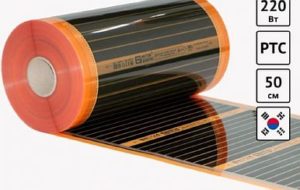
Manufacturers indicate the power output of electric underfloor heating per square meter on the label. It looks like this: 220V/50-60Hz/50cm/55W, meaning the floor operates at 220W and emits 55W of heat per square meter. If a resistive heating cable is used, its output is low, and it can be increased to 200W per square meter by reducing the coil width.
Let's calculate the maximum power of an infrared heated floor using the example of calculating the maximum power. We'll assume the size of the heated area we determined above—12 m²—and a standard film with a voltage of 220 W per m².
P = 12 m2 x 220 W = 2,640 W.
As a result, we find that our room will require a film-based underfloor heating system with a total power of 2640 W.
Which underfloor heating system should I choose?
Water or electric underfloor heating—each has its advantages and can create a comfortable atmosphere in the home.
Hydronic heating is more commonly installed in private homes, as it's less expensive than electric heating. However, installing it in apartments requires connection to the central heating system, which is prohibited without permission.
In apartment buildings, preference should be given to electric heaters. Models with lower power consumption are acceptable, as apartments already have primary radiator heating.
If the house's design allows it and you plan to install underfloor heating in the screed, then cable heating is the best option. Mats are the easiest to install; they simply need to be laid out on the floor.
If ceiling height is a concern, infrared strip floors are a suitable option. They are only 3 mm thick. Heating is achieved by emitting infrared waves, which increases efficiency by 95%, resulting in lower energy consumption. This system can be installed under any type of flooring.
Let's determine the temperature regime in the room
There are two ways to determine the temperature level in a room: using standard standards or based on your own preferences.
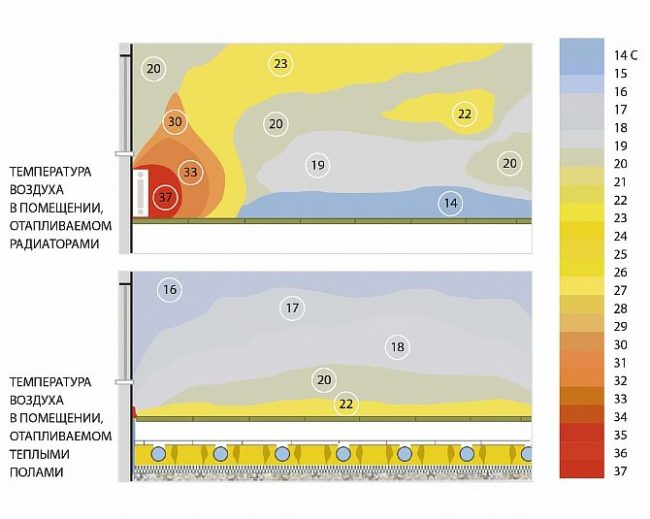
Temperature is measured in three locations: on the floor, at a height of 50 cm, and at a height of 150 cm. At a height of 150 cm, the temperature should be no less than 18 degrees Celsius, with the maximum being determined individually. The floor surface temperature should not exceed 40 degrees Celsius. The permissible temperature difference between rooms is 10 degrees Celsius.
How to reduce consumption costs
There are several ways to reduce energy consumption:
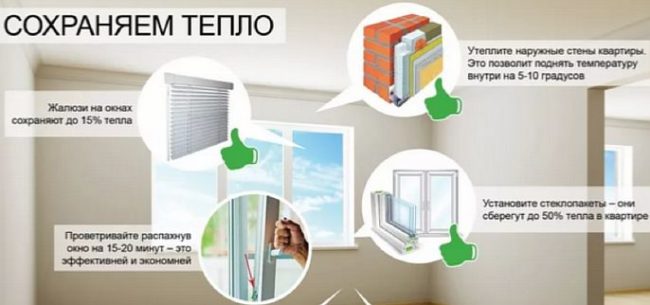
- use of high-quality thermal insulation material;
- carrying out work on insulating windows and doors;
- use of a finishing coating with good thermal conductivity;
- installation of a thermostat.
Furthermore, using a multi-tariff energy payment system also leads to savings. Operating heated floors at night will cost half as much. And if you lower the heating temperature by 1 degree, energy consumption will decrease by 5%.
When considering installing underfloor heating in your home or apartment, it's important to carefully consider its power rating. A mistake can negatively impact the indoor environment and increase heating costs.



Hello, I really wish this article had been helpful last year when we installed electric flooring in the bathroom. We didn't leave enough space between the walls, so the walls got too hot, and the consumption increased. A programmable thermostat could also help.