Installing underfloor heating under laminate flooring on a wooden subfloor is gradually gaining popularity. There are three main types of underfloor heating, each with its own distinct advantages in efficiency, reliability, and cost. The choice depends on the type of room.
For example, a water-based floor with a heavy concrete screed is more suitable for private homes, while electric underfloor heating is more suitable for apartments. Installation can be done independently; the main thing is to follow all the manufacturer's recommendations and instructions.
Find out how to produce Installation of various types of electric underfloor heating under laminate flooring: infrared, carbon, cable, in the form of heating mats, amorphous metal.
- We determine the optimal combination of underfloor heating and wooden base
- Water
- Infrared
- Electric
- Laying infrared film flooring under laminate on a wooden base
- Electric underfloor heating installation technology
- Installing a water-heated floor on a wooden floor under laminate
- Laying laminate flooring
- Basic mistakes
- Video materials
We determine the optimal combination of underfloor heating and wooden base
Installing heated wooden floors under laminate flooring is somewhat challenging. This is due to the underlying material: wood readily absorbs moisture, which can cause significant deformation. Rapid evaporation of moisture can cause cracks and imperfections.
When laying laminate flooring over heated floors, the difference in height should not exceed 1 mm. However, if moisture is absorbed, this difference may increase, leading to structural failure. The solution to this problem is to use moisture-resistant materials. additional waterproofing is achieved.
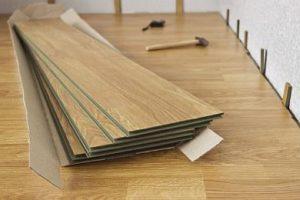
It's important to note that wood is considered a good thermal insulator, so in most cases, laminate, parquet, linoleum, and other flooring materials are used rather than wood planks. They are also not used as an underlayment for flooring.
The following structure can be erected as a heated floor on a wooden base:
- electric;
- infrared;
- water.
Water
This type is considered the most cost-effective and safe. It works by laying pipes made of polypropylene or metal-plastic on a prepared base. Hot water is circulated through the pipes, simultaneously heating the underlying underlayment and laminate.
A significant drawback of this design is the large pipe diameter, which increases the height of the heated floor. This can be a serious problem in low ceilings.
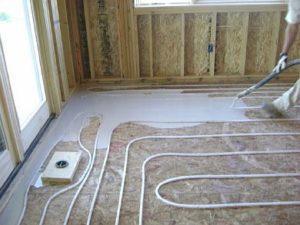
If you plan to install a water system under laminate flooring on a wooden floor, you should consider the following:
- room temperature – no higher than 28 degrees;
- ensure there are no sudden changes in temperature;
- The heating element should not heat up above 50 degrees.
Before installation, it's important to remember that installing a heated wooden floor under laminate flooring is quite difficult and will likely require professional assistance. Despite the effectiveness of underfloor heating, it's rarely installed in summer cottages and small private homes.
Operation costs are low, but installation and initial start-up can require significant financial investment. When performing DIY installation, it's important to ensure the quality of the work and the absence of physical damage to the structural components, as this could lead to leaks and subsequent failure of the entire system.
Infrared
In terms of its type, infrared floors are considered a type of electric system, but the difference lies in the nature of the heat emitted. The heat source is a film sheet with a polymer coating and a conductive layer, placed on the subfloor.
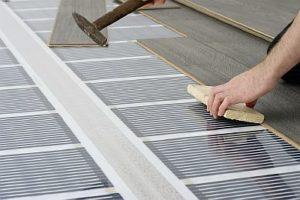
Each component of the heating system is enclosed in a layer of polyethylene film, which is designed to ensure reliability and safety, but does not increase the thickness of the heated floor.
The main advantages of an infrared system for a wooden floor under laminate:
- It is easy to install by yourself; even a complete novice in repair work can carry out the procedure independently;
- no load on the wooden base (as in the case of a water floor);
- small thickness;
- rapid heating of the structure;
- ease of temperature control.
The main disadvantage is considered to be the high price!
Electric
Like infrared underfloor heating under laminate flooring, the electric system is connected to the power grid via a cable. When power is applied, a magnetic field is generated, heating all the system components. If all system components are installed correctly and the installation process is followed, the heat will radiate upward into the room.
This type offers all the advantages of infrared floors, but is more affordable. These factors make electric systems popular today as underfloor heating for wood floors under laminate flooring.
The only drawback is the risk of short circuits. However, this can be resolved by coating the base and ceiling with a special solution, as well as ensuring safety when working with electrical equipment.
Also on You can lay heating mats on a wooden floor - This is a more advanced type of electric floor.
Laying infrared film flooring under laminate on a wooden base
Watch the video
Installation steps for installing infrared underfloor heating on wood under laminate:
- Prepare the subfloor: remove any large debris from the surface. Apply a coating that reflects infrared rays and heat to the prepared surface. Penofol or a similar material is most commonly used. The coating is installed with the foil side facing up to prevent heating of the apartments below (in a multi-story building) and the concrete floor or basement (in a private home). The elements are installed end-to-end, and the connecting seams should be sealed with construction tape.
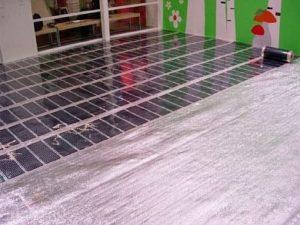
- The film, which serves as the main heating element of the underfloor heating system, is being laid. During installation, it will likely be necessary to cut the material, but this should be done very carefully and only at specially marked locations. When laying the film, maintain a 5 cm gap from the wall and a 25 cm gap from heating appliances and devices. Also, do not allow one sheet to overlap another. Seams are secured with regular adhesive tape.
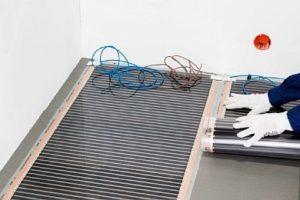
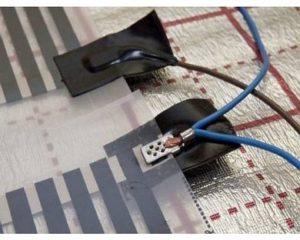
- Terminals (sold in a kit with the IR film) are connected to the copper elements, from which the wires will then extend. It is recommended to maintain parallelism when connecting the terminals to maintain the independent connection.
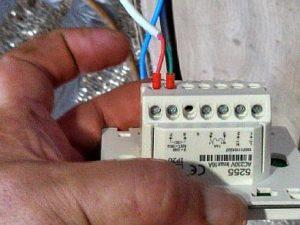
- A 220V wall-mounted thermostat is installed (50-100 cm above the floor), to which wires are routed from the terminals. Wires also run from the thermostat to the temperature sensor, which should be positioned precisely between the carbon strips under the film (the sensor can be secured with adhesive tape).
- Insulation is placed and laminate is laid.
During installation, do not use nails or similar fasteners that could damage the integrity of the IR film, as this could cause a short circuit or failure of the underfloor heating system on a wooden floor.
Electric underfloor heating installation technology
Installing electric underfloor heating under laminate on a wooden floor involves several steps:
- Remove the old flooring and prepare the subfloor (remove debris and damage). The floor must be as level as possible; this is checked using a spirit level.
- Waterproofing the surface to prevent condensation from forming under the laminate flooring is achieved by creating a plank deck, the components of which are treated with a liquid-repellent agent. Wooden joists, spaced 60 cm apart, serve as a foundation.
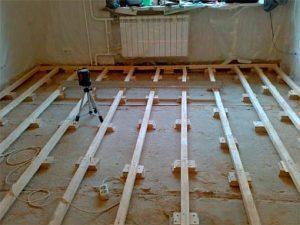
- Creating a thermal insulation underlay. Chipboard or plywood boards are placed under the joists installed in the previous step to create insulating niches. Insulating material is then laid into these niches. A heat-reflective film is then placed on top. This is necessary to direct the heat upward and prevent it from warming the floor or floors below. Metal insulation is additionally applied to the joists at the cable turning points.
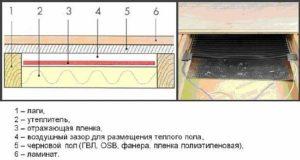
- Heating cables are laid according to a diagram (the diagrams are the same as for installing infrared film). The simplest way to install a serpentine is as a single electrical circuit. The distance between the circuit parts should be equal to ensure uniform heating of the laminate on the wooden floor. The installed electrical cable is secured with specialized cable ties.
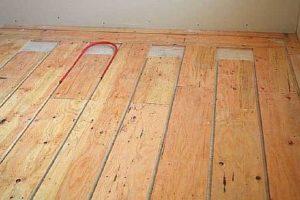
- The temperature sensor is placed in a corrugated tube, which is sandwiched between the cables. All cables (electric underfloor heating and sensor) are routed to the thermostat, which is installed at least 50 cm above the floor.
- A base is placed on top, onto which the technician will lay the laminate.
It should be noted that if heating is required for a high-density space, it is recommended to create multiple independent circuits, each connected to a separate thermostat. Failure to do so may result in electrical overload.
Installing a water-heated floor on a wooden floor under laminate
Video
The base will be created using expanded polystyrene boards with a foil surface. We'll assume the subfloor beneath the laminate is made of OSB panels. Installing hydronic underfloor heating on a wooden base consists of the following steps:
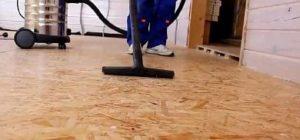
- Removal of small and large construction and general debris. Sweep and vacuum debris.
- Now it's time to create a technological gap using a damper tape. Typically, when using a heated wooden floor, the rising and falling temperatures cause the boards to change shape. To prevent damage, a similar gap is created using tape or laminate underlay (but the thickness should be greater – about 8 mm). The tape is placed around the entire perimeter of the room.
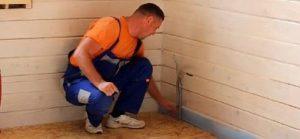
- The next step is to apply a layer of foam adhesive, which will be used to bond the slabs to the subfloor. If you're doing the renovation yourself, it's important to carefully apply the foam around the entire perimeter and a small amount in the center.
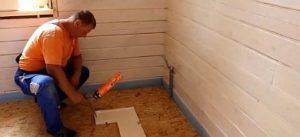
- If the slab is being installed in a corner, it's necessary to cut an L-shaped piece to fit. When marking the slab yourself, make the cut approximately halfway down the slab to ensure the grooves at the corners align precisely.
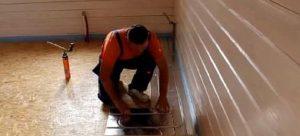
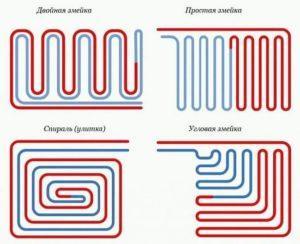
- The entire surface is laid in a similar manner. Underfloor heating pipes can be laid using various layouts. The options shown below vary in heat output, operational efficiency, and DIY complexity.
- The water pipes must be brought into the room and carefully inserted into the ducts. The pipes must be firmly secured. The shape of the ducts increases the contact area and the tightness of the connection.
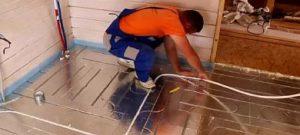
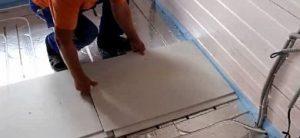
- A base is created for laminate flooring on a wooden floor. It's important to remember that even with the high density of polystyrene foam sheets, an additional base layer is advisable. Neglecting this and laying linoleum directly on the polystyrene foam underlayment significantly increases the risk of pipe failure. The additional layer can be created using gypsum fiber panels (for example, Superfloor from Knauf). These often feature special slots that allow all components to be integrated into a single unit using polyurethane foam. A thin underlayment is then laid on the water-based flooring, and the laminate flooring can be installed.
When choosing the type of layout for a warm wooden floor under a laminate, you should refer to the diagram.
The most common option is the "snake" design. It offers increased heat transfer efficiency, but the end of the pipe will still contain cold liquid.
If you install the heating system yourself and have the relevant experience, you can implement a more complex design (for example, a double snake).
Laying laminate flooring
Before laying laminate flooring after installing an electric or hydronic system, ensure the underfloor heating system is functioning properly. It is recommended to periodically run the system for three days, raising the temperature by 5 degrees Celsius each day.
If you've installed a water-based flooring system yourself, you should immediately apply full pressure and ensure the pipes are undamaged and there are no leaks. After checking, wait until the flooring cools to 15 degrees Celsius (59 degrees Fahrenheit) before laying the laminate flooring over the wood underfloor heating.
Once the installation is complete, the technician begins laying the laminate:
- A polyethylene backing is created, it is placed end to end, and the seams are covered with construction tape.
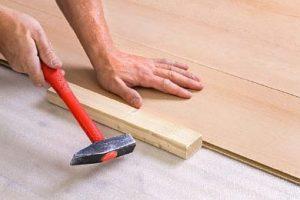
- Laminate sheets are placed on the underfloor heating subfloor. Typically, the sheets are not laid flush against the wall; a 5 mm gap is maintained. Otherwise, follow the manufacturer's recommendations.
We invite you to find out - Do you need a backing or not, which one to choose for laminate, what types are there and how to install it
Basic mistakes
When installing a heated wooden floor with your own hands, novice craftsmen often make the following mistakes:
- Incorrect element placement. Heating components should only be positioned in areas free of furniture or other objects above. Otherwise, the surface will not be heated, and poor heat dissipation may lead to system failure.
- Incorrectly cut cable or IR film. This should only be done in the designated areas indicated by the manufacturer. If the cable is longer, it should be re-routed, but with the turns closer together.
- The turns of electrical cables or elements of IR film should not overlap each other, otherwise the system may overheat.
- Failure to remove debris from the subfloor, or the presence of an uneven, imperfect floor. It's important not only to remove all debris (even small ones), but also to check the surface with a spirit level to ensure it's level.
- No pre-laminate floor heating system testing is required. If a defect is discovered afterward, repairing the system will be much more difficult, as it will require removing the flooring and reinstalling the system.
- If you plan to install heated wooden floors under laminate flooring in several rooms, then each room should have its own individual temperature controller.
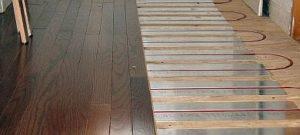
When using the floor, it's important to prevent it from overheating; ideally, maintain the temperature between 20-30 degrees Celsius. If you plan to be away for an extended period, keep the heating on low during the cold season. To prevent damage, do not damage the floor (even to hammer nails).
Thus, the complexity of installing underfloor heating on a wooden base depends on the type of structure and room.
Electric underfloor heating is considered the most optimal in terms of efficiency and cost; it can be installed in any type of premises.
You can do the installation yourself, the main thing is to carefully follow the manufacturer's instructions.