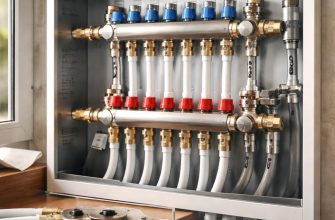
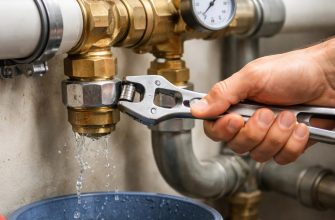
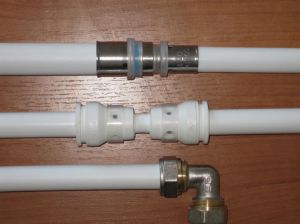
 Nowadays, there are many materials available that can be used to install plumbing in your home yourself. Iron pipes are the most commonly used. as well as polypropylene and metal-plastic pipes.
They have their advantages and disadvantages, but to assemble a water supply system from metal or polypropylene pipes, special equipment is required.
Installing metal-plastic plumbing products yourself is the optimal solution, allowing you to save time and money.
This article will cover the intricacies of installing metal-plastic pipes yourself, and also present a video that clearly demonstrates the process.
Metal-plastic plumbing pipes appeared on the market about ten years ago. They are made from the familiar plastic material. Metal-plastic pipes offer significant protection against wear and tear.
This is facilitated by a design that resembles a pie made of several different layers. The inner layer is food-grade plastic, safe for contact with water.
The outer layer consists of multilayer polyethylene, protecting it from damage. The pipe is reinforced with an aluminum jacket sandwiched between the plastic layers, reinforced with an adhesive layer.
Technical specifications
Rolled tubular products are manufactured with diameters ranging from 16 to 53 millimeters. The most commonly used diameters for domestic applications are 16 and 20 millimeters.
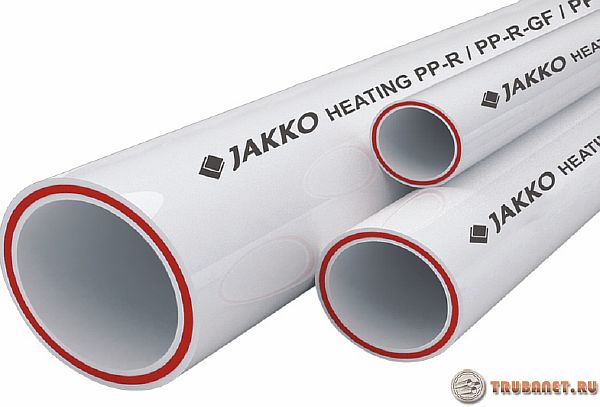
Depending on the size, the wall thickness ranges from two to three and a half millimeters. They are typically produced in rolls of 50 or 100 meters.
Advantages
- Flexibility is the most important advantage metal-plastic pipes, using a special tool A radius of five centimeters can be achieved, completely repeating the corner shape without breaking the pipe or using fittings. Complex shapes with a radius of fifteen centimeters or more can be easily bent by hand. This makes system installation extremely easy.
- Lightweight. A hundred-meter roll can easily be lifted by one person.
- Its strength exceeds the strength at the joints.
- There is virtually no risk of leaks in continuous sections.
- The multi-layer construction ensures significant wear resistance. The service life of the water supply system is over 50 years.
- They are not affected by rust, and the smooth inner surface prevents the formation of sedimentary deposits.
- If such deposits have appeared during long-term use of the water supply system, they can be removed quite easily.
- The appearance is much more attractive than that of metal ones.
Flaws
- Metal-plastic products cannot be used outdoors, nor should they be exposed to sunlight for long periods of time, as they are sensitive to ultraviolet radiation.
- Strength and heat resistance are certainly lower than those of metal ones.
- They cannot serve as a grounding device, but they accumulate static electricity, which cannot be discharged because the metal parts are insulated at the connection points.
- Compression fittings require regular maintenance (tightening).
Preparing for installation
Before installing a plumbing system, it's important to carefully consider its layout and location. First, mark all water-use points (faucets, showers, washing machines, and dishwashers) on the plan, relative to their locations in the house.
It's important to purchase at least 10 meters of extra pipe, as any DIY installation inevitably involves losses during assembly. If any excess pipe does remain, it can always be used for repairs or installation of new equipment.
After this, it is necessary to mark on the diagram all the connection points, as well as the places where the locking devices will be installed.
Safety valves must be installed at the entrance to the house before the meter, as well as before each consuming device.
By doing this, you'll know the number of assembly components required to assemble the plumbing system and their specifications. A sample calculation process is shown in the video.
Tools for installation of the structure
Although the process of installing metal-plastic pipes yourself is very simple, some tools will still be needed.
You will need special scissors for cutting., springs for bending them, a calibrator for aligning and flaring the cut area, sandpaper for precise burr removal at the joint, wrenches or pipe wrenches, as well as pliers to facilitate the process of installing fittings.
The practical application of these tools is shown in the video posted in the section “Installation of threaded fittings”.
Each element in the short list above is important for high-quality work; however, when carrying out urgent, small-scale work (if you are careful), it is quite possible to replace the scissors with a hacksaw or jigsaw, and the calibrator with any tool that can gently flare and clean the cut edges.
Installation rules for the structure
Installation of metal-plastic water pipes begins at the entrance to the house/apartment. They are installed sequentially, one after another, along the main line. Fittings and shutoff valves are installed immediately during installation.
After the main line is assembled, branches are installed to individual water-consuming devices. When bending a continuous pipe, it's best to use a special spring (see video).
This will allow you to obtain a more uniform bending line and also prevent deformation of its inner side.
Metal-plastic pipe products must be secured to the surface along which they are pulled.
Although they bend less under heat than similar PVC products, at least two fasteners per linear metre horizontally and one vertically are required.
It is not recommended to install plumbing yourself at temperatures below ten degrees Celsius.
Installation of connections using threaded fittings
Compression threaded fittings are quite expensive. They account for the majority of the overall costs when installing a metal-plastic plumbing system.
There are specialized fittings available for sale, suitable for use in any type of connection (tees, crosses, elbows, adapters).
If an error does occur, you can always install a special plug over the extra hole. This way, it can be used later when installing new equipment.
A threaded fitting consists of a nipple and two or more nuts with an O-ring and gaskets. To assemble the fitting, you'll need two wrenches of the appropriate size and a sealant (FUM tape or silicone).
Assembly is accomplished by inserting the end of the pipe into the sealing ring and tightening the nut onto the fitting. It's crucial that the cut end of the pipe touches the fitting evenly.
As you can see in the video, after inserting the fitting into the pipe, tighten the nut by hand until it stops, then place one wrench on the fitting and the other on the nut and, using the wrench on the fitting as a support, screw the nut until the required tightness of the connection is achieved.
When tightening threaded connections, avoid overtightening them. A characteristic creaking sound will be heard when all parts are securely connected.
Installation of connections using compression (press) fittings
If you don't want to tighten all the threaded connections of your water supply every few years, you can use press fittings.
This method is completely permanent and eliminates the need for system maintenance. Fittings of this type can be filled with concrete.
The only drawback of this method of assembling a water supply system from metal-plastic pipes is the need to use industrial equipment to press the connections.
It's quite expensive, and purchasing it for one-time use is pointless. However, in large cities these days, you can find companies that offer both specialist services for the job and industrial equipment rentals.
If you can obtain the necessary equipment, it's best to confidently choose press fittings for DIY plumbing installation. Press fitting connections are superior to threaded ones in every respect.
We invite you to watch a video demonstrating high-quality installation of metal-plastic pipes using press fittings.
Use the tips provided in this article and video, and you'll be able to install metal-plastic water pipes yourself without any hassle.