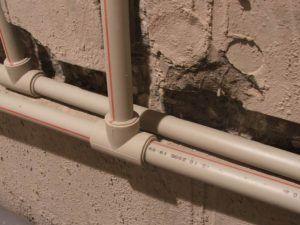
 Polypropylene pipes are becoming increasingly popular nowadays. In order to evaluate the advantages and disadvantages of using these products, it is necessary to consider their properties in order to determine the need for their use.
Polypropylene pipes for hot water have the following set of technical characteristics.
- Melting ability.
- State of aggregation of liquid at 175 degrees ambient temperature.
- Melts at + 140 degrees.
- High wear resistance of polypropylene products.
- Relative hardness.
Many manufacturers claim that the maximum hot water temperature in such pipes can only reach 95 degrees. This is due to two reasons.
On the economic side of the issue
 The first reasonBuyers have the right to file a lawsuit if a polypropylene pipe deteriorates even at 98 degrees Celsius, even though the packaging and documentation state that the product can withstand 100 degrees Celsius.
This rule applies in the US and Europe. Manufacturers must prove that there were technical violations during installation, otherwise they lose the lawsuit.
Compensation from the manufacturer includes:
- Moral damage.
- The cost of a defective product.
- Damage due to water leakage.
The last two of the three points are minor by the standards of serious production. However, moral damage can be costly even for large companies. That's why manufacturers often specify lower temperatures.
Manufacturing errors
The second reason — the production technology itself. Variations in physical and mechanical properties are always present in large batches of polypropylene pipes. Sometimes the material has a different composition, or the wall thickness of the product is slightly thinner than stated.
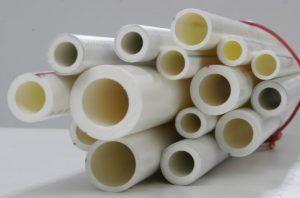
Specifying a lower limit temperature is the optimal solution compared to the need to make control more stringent, rejecting an additional 20-30% of products.
In this situation, the specified technical characteristics include almost all products for hot water supply.
What is the temperature of the water inside the pipeline?
According to regulatory documentation + 95 degrees Celsius This limit The temperature of water in residential pipes is regulated. It doesn't matter whether it's a heating system or a hot water supply. The maximum temperature is reduced to 37 degrees Celsius for kindergartens and other institutions.
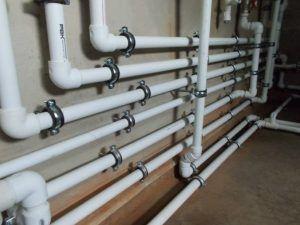
In theory, polypropylene pipes shouldn't cause any problems. However, there are some nuances that need to be taken into account.
Temperature change and the impact of climatic conditions
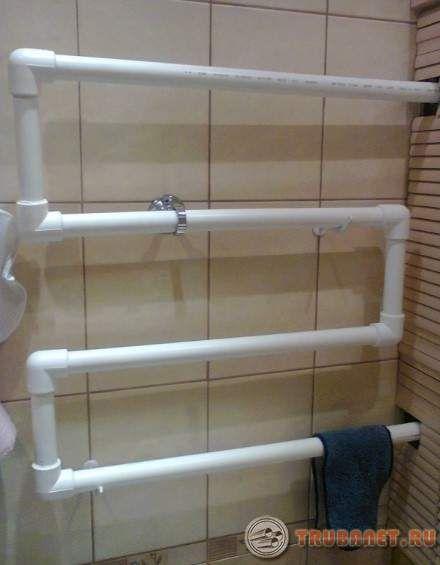 Appliances inside the home begin to consume more energy when the outside temperature drops significantly. Therefore, in such situations, electrical appliances must produce significantly more heat.
To do this, you can use two solutions:
- Expansion of heat transfer area.
- Increasing the temperature of the heating device
Designers themselves determine the number of heating radiators in the rooms and their sizes.
After the house has been commissioned, change these characteristics it is not possible.
Owners of premises can only replace radiator batteries with other, more efficient ones or add individual sections.
Moreover, there is a requirement that the temperature in residential premises must be maintained under all conditions and within a specified range. Ultimately, there remains only one solution: increasing the temperature in the main line.
How to deal with the human factor?
If the system operates as usual, the set amount of heat is supplied to the heating main. However, before operation, a cold stream is added to the working fluid. In summer, the hot water supply is fed directly through the supply.
Video
The hot water supply switches back to the other operating mode if the water temperature in the supply pipe exceeds 90 degrees. This must be done manually in each home.
Due to human error (sluggishness or, more simply, laziness on the part of the company's employees), water temperatures may exceed the specified limit. This should be anticipated and appropriate materials with the necessary safety margins should be used.
Polypropylene pipes and reinforcement
Polypropylene has a fairly high linear (thermal) expansion. This does not pose a problem under normal operating conditions.
Furthermore, polypropylene is a highly flexible material. This means that deformations in different sections compensate for each other. However, in some situations, when heated, the pipes may expand excessively.
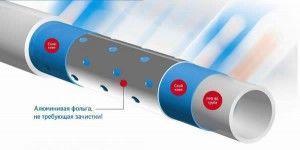
Pipes reinforced with fiberglass or aluminum, is recommended for use in cases where it is necessary to minimize the coefficient of expansion. The thickness of the reinforcing layer does not exceed 12 mm.
Reinforced products are less susceptible to the influence of high temperatures and have higher thermal resistance.
Reinforced pipes resist deformation, even if the water temperature inside them approaches the point where polypropylene would melt. Fiberglass or aluminum reinforcement helps solve the same problem.
Video
The best option is – polypropylene pipe with a fiberglass interlayerThese products are more expensive, but they are more reliable.
These are the advantages of fiberglass reinforcement for water supply.
- The formation of electrochemical processes, due to which the aluminum layer is gradually destroyed, even if the difference between the potentials in the middle is small, is completely excluded.
- The layers are glued together, not welded. Therefore, the pipe itself will not delaminate under any circumstances.
- Polypropylene pipes eliminate the need for thorough cleaning during installation, which saves money when installing hot water.
About some installation features
Polypropylene pipes cannot be connected using threads, as they will not adhere securely to the plastic surface.
The likelihood of creating a strong connection between elements is reduced. Alternatively, the risk of damaging fittings and pipes due to mechanical impact increases.
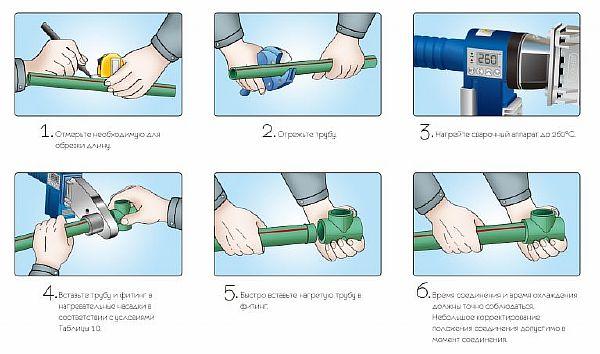 With the classic connection method, the joint between polypropylene pipes is formed by welding. This method is much more reliable than conventional threading.
Manufacturers produce a wide range of hot water fittings to suit any system. Threads are located on one side of the fitting, while welding is on the other.
Video
Some water supply pipes are threaded at the factory. However, these products are not designed for high pressure and are not used for hot water supply or heating systems.
It is not recommended to use manual threading when organizing hot water supply.
When choosing polypropylene pipes for hot water, specific conditions must be taken into account., in which they will be used. The material is suitable for any type of plumbing system, virtually regardless of the liquids flowing inside.
Operating temperatures are also almost irrelevant. The exception and main limitation for polypropylene is the Far North.
Video
The main advantage of polypropylene for hot water is that it is protected from corrosion and the formation of contaminants on the surface.
This ensures that polypropylene pipes last as long as possible. Therefore, it's worth choosing polypropylene pipes for hot water.