Before building a private home, it's a good idea to design the sewer system. Building a septic tank yourself from concrete rings is an excellent solution.
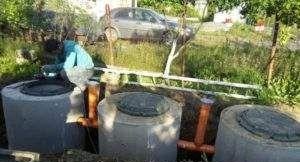
Similar installation is not a complicated procedureIn this article, you'll learn how to properly install it, as well as why concrete rings are the best choice for a sewer system. See also Make a septic tank yourself from plastic Eurocubes
- Septic tank made of reinforced concrete rings – advantages and disadvantages
- The operating principle of a reinforced concrete septic tank
- Scheme, design structure
- Calculating the volume of a septic tank
- Selecting a location for installation
- What materials and tools will be needed?
- Preparing the excavation pit
- Installation of rings, connection of overflow pipes
- Sealing of joints and backfilling
- Creating a filtration well
- Wastewater disposal
Septic tank made of reinforced concrete rings – advantages and disadvantages
The use of reinforced concrete rings as a base for a septic tank has the following advantages:
- possibility of long-term operation (50-100 years);
- increased resistance to negative environmental impacts;
- High strength, comparable to natural stone. The structure can withstand heavy pressure and function even under heavy water discharges;
- When installing additional waterproofing, a septic tank made of reinforced concrete rings becomes completely sealed, and groundwater will not be able to damage the structure;
- Low cost, allowing you to save significantly on DIY sewer system construction. Installing a septic tank made from concrete rings will be much cheaper than installing a similar one made from polypropylene.
However, there are certain disadvantages to this system that it's advisable to be aware of before beginning construction. These include:
- the need to use special mechanisms or equipment for installation, since concrete is a fairly heavy material, which affects the weight of the structure;
- There is a risk of runoff liquids leaking into the soil beneath the system. This occurs due to cracks in the concrete, leaks in the joints after long-term use of the sewer system, or poor sealing.
It is recommended to carefully evaluate the significance of the shortcomings and, based on this, make a decision on the choice of material for constructing a septic tank with your own hands.
The operating principle of a reinforced concrete septic tank
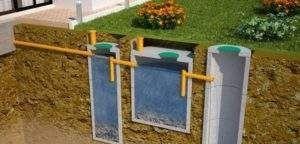
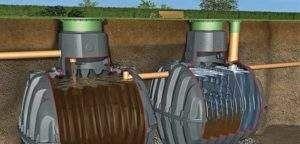
For smaller areas, a chamber-type design with a drainage or closed bottom is most often used. The latter option results in a simple wastewater tank, while the former creates a cesspool system with drainage.
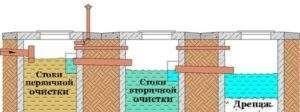
The operating principle of a 3-compartment drainage septic tank:
- The waste liquids enter the initial compartment, where they are clarified, i.e., the sediment of heavy elements is removed.
- The clarified wastewater then flows into the next chamber, where fermentation occurs.
- After this, the wastewater flows into the last compartment, where it is drained into the soil.
The treatment efficiency of such a structure reaches 90%. The remaining 10% is sludge residue, which will need to be removed several times a year using a sewage disposal system. A septic tank like this, built with concrete rings, can handle large volumes of liquid. Typically, for a building with up to five residents (a two-story private home), such a system is sufficient.
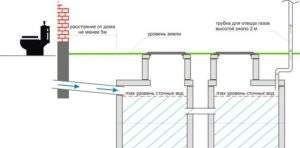
Installing an additional septic tank compressor with a timer in the second chamber will significantly accelerate the decomposition of biowaste. This compressor ensures a regular supply of air. A ventilation pipe should also be installed in the second compartment; it should extend 70 cm above ground level.
Scheme, design structure
The most effective design is one with three separate chambers. Externally, the system resembles a wastewater treatment plant, which has separate compartments for collecting wastewater and subsequently filtering it. Before beginning installation, it's important to understand how a septic tank made of concrete rings is constructed.
It is recommended to install a storage septic tank in cases where the construction of a drainage system is impossible due to waterlogging or high clay content of the soil.
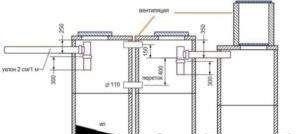
A sealed-bottom sewer system without drainage fills up fairly quickly, requiring frequent calls from a sludge truck for waste removal. A septic tank made of concrete rings with a drainage base eliminates this drawback.
Watch the video
Most of the incoming liquids are automatically filtered into the ground. Therefore, on average, sewage disposal services are needed only twice a year to remove residual sludge.
Calculating the volume of a septic tank
When installing a septic tank, it is important to first calculate the required volumeProper calculation will eliminate the need for frequent calls to a sewage truck and tank cleaning.
The minimum capacity of a sewer manhole is the volume of wastewater discharged from the house in three days. Typically, calculations assume approximately 200 liters per day (0.2 cubic meters) per resident.
To obtain an approximate capacity, multiply the building's occupancy by 2 and 0.2. When using a multi-chamber structure made of concrete rings, remember that the resulting value will equal the required capacity of the first two tanks in the system. The final drainage chamber should not be included in the calculation.
It is advisable to do the following before building a septic tank with your own hands from rings: a soil assessment needs to be carried outThis is done to test the ability of the soil to absorb liquid under a bed of gravel and sand.
Watch the video
Based on the geological assessment results, the appropriate volume of the third chamber, where wastewater enters the soil, is calculated. However, this step is often overlooked due to a reluctance to spend money on the assessment, so in most cases the volume of the third tank is equal to the first.
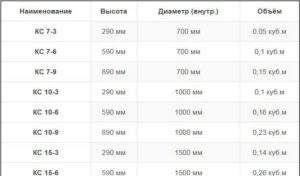
After calculating the required volume, you need to select the appropriate concrete ring sizes and begin installing the septic tank yourself. Typically, the internal diameter ranges from 70 to 250 cm, and the length ranges from 0.5 to 1 m.
To calculate the capacity of a reinforced concrete ring, you'll need to use the formula for calculating cylindrical volume. Then, to determine the quantity, simply divide the total capacity by the volume of one ring.
The most common product sizes for septic tank installation are shown in the image below.
Selecting a location for installation
To determine a suitable installation location, it is necessary to study the regulations and legal framework. Installing a concrete septic tank or laying sewer lines in close proximity to residential buildings is prohibited.
Watch the video: A septic tank made of concrete rings from A to Z
[sociallocker]
Before starting to design a septic tank, it is advisable to remember the following rules:
- availability of access road for a sewage disposal vehicle;
- A septic tank should be located at least 50 meters from a water source (e.g., a well). This is necessary to reduce the risk of sewage contamination of drinking water.
- The sewer system should be located 5 meters from buildings. However, the distance should not exceed 20 meters, as this will require additional costs for laying sewer pipes;
- The layout of the pipes must be accompanied by a low groundwater level.
When designing a sewer system, it is also advisable to ensure ventilation of the septic tank.
What materials and tools will be needed?
When selecting concrete septic tank rings, it's advisable to consider options with locking devices. These rings significantly simplify installation and prevent movement during freezing and soil expansion. When purchasing, it's a good idea to check that the mounting surfaces are level and that the locking devices are intact.
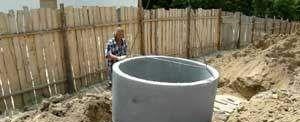 To carry out installation, the following tools and materials are required:
- pipes for sewerage construction;
- standard construction tool kit;
- sand (preferably river);
- building level;
- cement;
- DIY materials for waterproofing a septic tank made of concrete rings;
- mounting foam;
- hammer drill;
- ladder;
- large container for mixing the solution;
- large brush.
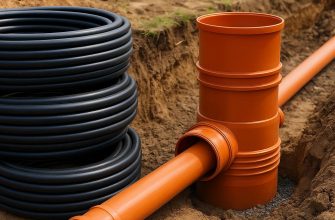
Overflows between tanks are constructed from special sewer pipes made of polypropylene or asbestos. When purchasing these, it's advisable to ensure they are suitable for external sewerage systems.
It is also recommended to learn about the advantages and disadvantages of different pipe materials. For example, Polypropylene products are characterized by strength, reliability and elasticityThe diameter of the constructed pipeline is approximately 110-120 mm.
Preparing the excavation pit
Construction work should take place during periods when groundwater levels are at their lowest. These are typically the warmest or coldest months of the year. The pit can be dug manually or with an excavator.
In most cases, the two options are roughly equivalent in terms of financial costs, as specialized equipment costs are the same as hiring a crew to dig the pit. Using an excavator is preferable, as it saves significant time.
When carrying out excavation work in winter, it is recommended to first set a fire at the site of the future pit.
Watch the video
To simplify installation and allow for external waterproofing to improve joint sealing, it is recommended to dig a pit 50-80 cm larger in diameter than the concrete rings. The required depth is calculated as the sum of three heights: the ring elements, the filtration pad (approximately 30 cm), and the slab (approximately 15 cm).
The soil removed during excavation can be immediately removed using the vehicle that delivered the concrete rings for the septic tank. The pit should be two-tiered, with the second pit 60 cm deeper. If this is not a single-chamber septic tank made of concrete rings, it is recommended to dig separate pits for each pit.
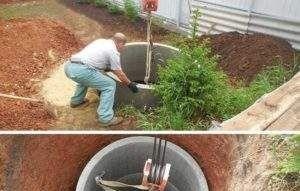
Trenches are also dug for the sewer pipe; it must be located below the frozen soil layer. The trench dimensions depend on the size of the reinforced concrete rings. In most cases, they are approximately 1.5 m deep and 50 cm wide.
To ensure gravity flow of wastewater, the bottom should have a slope of 2-3 cm per linear meter. It is advisable to first calculate the distance between the end points by multiplying the distance by the slope coefficient (defined by regulations).
After excavation, the bottom should be well compacted and filled with 10 cm of sand. Then, a 30 cm layer of concrete is poured using a 3:1 cement mortar. A concrete bottom is not necessary if a bottom ring is to be installed. In this case, a 20 cm layer of crushed stone will suffice.
Installation of rings, connection of overflow pipes
First, install the bottom ring so that its walls are perpendicular to the bottom. A level installation will improve the strength, reliability, and stability of the structure. When using a reinforced concrete ring without a bottom, a concrete screed is created. Its dimensions should exceed the ring diameter by 20 cm. It may take up to 14 days for the screed to fully form.
Next, the first ring is installed. This work cannot be done alone, so several people will be needed to assist. After installation, the next ring is installed. To improve the fixing properties, special metal brackets are used on the outside. The entry points are covered with concrete and insulation for security.
Watch the video
[sociallocker]
A construction crane lowers the concrete septic tank rings into the pit. The outer voids are then filled with soil and sand. Don't rush this; it's important to compact the soil evenly and alternately with pouring water. This backfill provides shock-absorbing properties and can drain stormwater and groundwater.
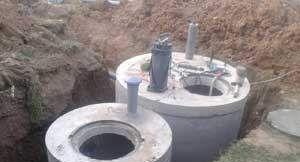 The layer above the soil freezing level should be additionally insulated. Failure to do so will result in ice buildup, which will significantly reduce the effectiveness of the cleaning process. Polystyrene foam or specialized thermal insulation materials can be used for insulation.
To connect the sewer pipe to the ring, drill a hole using a hammer drill. Foam is used to secure the hole and also to retain excess moisture. The hole must then be sealed.
Tees are installed on the overflow pipes, as well as those coming from the house. They direct wastewater downwards and speed up its treatment. Tees are also necessary to ensure constant access for clearing any blockages. It is advisable to insulate the overflow pipes.
Sealing of joints and backfilling
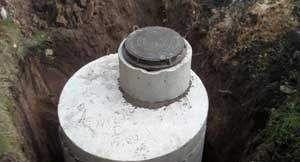 To prevent the damaging effects of groundwater on the septic tank and protect it from leaks, all joints are sealed. The joints between the base and the bottom ring are sealed with a moisture-resistant cement mixture.
Tips and recommendations for installing a septic tank with a high groundwater level.
For DIY septic tank waterproofing, a special deep-penetrating impregnation or bitumen mastic is often used. Cement-based impregnations are used for the rings. Liquid glass is sometimes added to this mixture, which makes the joints resistant to high humidity.
Do not use strong chemicals for sealing. They can destroy the beneficial microorganisms that help decompose biological waste.
Creating a filtration well
A percolation well is typically installed only on soil that absorbs liquid well. About 1 meter beneath this structure is filled with a soil filter. The bottom is first filled with sand (about 30 cm), then with gravel to the same thickness. The final layer is crushed stone to a depth of 20-30 cm.
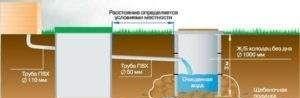
However, treated wastewater can drain not only through the bottom but also through the side walls. If this design is planned, the reinforced concrete ring at the base must be perforated. The installation procedure for such a ring is no different from conventional technology. The "pocket" between the outer walls and the ground is filled with crushed stone.
Perforated pipes are used to create a filtration field. They are placed on a layer of gravel and sand, which allows clean water to penetrate the ground. The pipes are then covered with a geological fabric and backfilled with soil.
Wastewater disposal
A percolation well is used to dispose of wastewater. If it is installed in areas where pebbles, sand, or crushed stone are present beneath the structure, the infiltration process will proceed without problems.
When building a septic tank yourself, it's best to install a three-chamber version. Then the final chamber will handle pre-treated wastewater.
Thus, the construction of an autonomous sewer system with your own hands can be carried out quite quickly.
However, it's unlikely you'll be able to complete the construction yourself, as you'll need to call in workers to dig a trench or specialists with specialized equipment, as well as helpers to lay the rings. The large dimensions of the structures make it difficult to install them yourself.
Watch the video
Installing a filtration well and laying overflow pipes is a simple process and doesn't require professional equipment. Therefore, you can do it yourself.