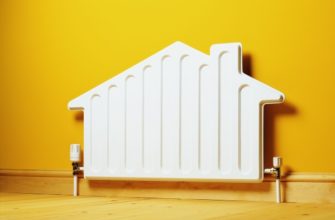
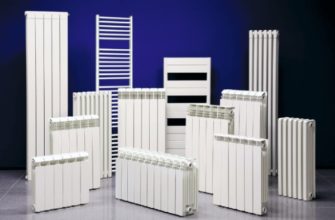
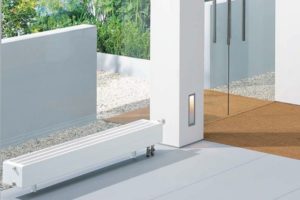
A floor-standing radiator is a type of heating device that, unlike wall-mounted types, has special legs that allow the radiator to be attached to the floor.
These devices are reliable and durable heat sources that are installed in rooms where it is impossible to install wall-mounted radiators.
If the room size does not allow the use of floor convectors, you can install radiators built into the floor.
- Key features of floor-standing radiators
- Operating principle
- Advantages and disadvantages
- Types of floor heating devices
- Aluminum
- Bimetallic
- Made of aluminum and copper
- Made of aluminum and steel
- Cast iron
- Steel
- Selection criteria
- Material of manufacture
- Equipment
- Dimensions
- Technical specifications
- Installation method
- Manufacturer
- Appearance and design
- Connection method
- Price
- Installation and connection
- Alternative options
- Built-in radiators
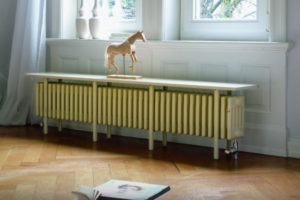
- Skirting convectors
Key features of floor-standing radiators
Floor-standing radiators are installed where conventional wall-mounted radiators cannot be installed. For example, on partitions made of glass blocks or plasterboard. Floor-standing radiators are also often used in rooms with large glass areas.
Features of floor-standing water heating radiators:
- Like their wall-mounted counterparts, they evenly heat rooms and prevent cold air from entering. They also prevent ice from forming on window panes.
- The height of these products, including the legs, does not exceed 15-20 cm. Low-profile floor-standing radiators are compact and take up minimal space.
- They are connected from the sides or from below – it depends on the model.
Floor-standing radiators are nothing new; they've been around for a long time. However, they're not widely used. They're typically only found in rooms with large windows.
Operating principle
Floor-standing radiators are part of a hydronic heating system. How do radiators work within the system?
- The coolant is heated by the boiler to the set temperature.
- Water is supplied through pipes and fills the batteries.
- The radiator housings get hot.
- Thermal energy is supplied to the room by convection or radiation.
The radiation principle is used only in panel and selective radiators. This accounts for approximately 80% of the total power output. Heat waves are directed sideways—at an angle—or perpendicular to the floor surface.
Finned radiators deliver heat to the room primarily by convection. The warm air moves upward, displacing cold air.
Advantages and disadvantages
Floor-mounted hydronic heating radiators are installed primarily because wall-mounted radiators are unsuitable, but they do offer a number of advantages. Before choosing a floor-mounted design, it's helpful to consider all its pros and cons.
Advantages of floor radiators:
- compactness, small height and dimensions;
- do not close the windows;
- take up minimal space;
- do not obstruct the view;
- a wide range of models with different power levels;
- ease of installation;
- stylish look and modern design;
- heating temperature regulation;
- affordable price.
Floor-standing radiators, despite their compact size, offer high thermal output and minimal heat loss. This is due to their design—floor-standing radiators are low but wide.
Flaws:
- uneven heating of the room - the air at the top warms up faster, while the air at the bottom remains cool longer;
- do not always fit harmoniously into the interior;
- They cannot be hidden by furniture or partitions.
Types of floor heating devices
Floor-standing radiators for hydronic heating systems are made from metals and their alloys. Each option has its own characteristics, advantages, and disadvantages.
Let's take a closer look at each model.
Aluminum
Aluminum radiators are manufactured using casting (casting a single unit) or extrusion, which involves joining individual components together. Both the inside and outside of the radiator are coated to protect the metal from external influences.
Advantages:
- increased heat transfer;
- high strength;
- not afraid of coolant chemicals;
- fast heating.
Aluminum radiators are an ideal choice for home heating systems. Their operating pressure ranges from 5 to 16 atmospheres, and the heating power of a single section ranges from 80 to 212 watts. The maximum coolant temperature is 110°C.
Flaws:
- effective at pH 7-8;
- sensitivity to mechanical impacts and pressure surges.
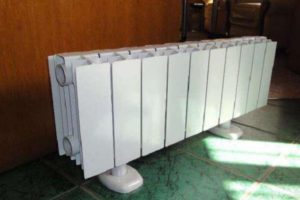
Bimetallic
These devices are made of two metals and are resistant to water hardness. They are used for heating offices and apartments. Both the interior and exterior surfaces are coated with an anti-corrosion coating to prevent rust and wear.
Bimetallic radiators can withstand hydraulic shock and pressures of up to 50 atmospheres. The heating power of each section is 125-180 watts. Two popular types of bimetallic radiators are copper-aluminum and aluminum-steel.
All bimetallic models are lightweight and attractive—these are their main advantages, common to all types. All bimetallic radiators share one common drawback: their high cost. The maximum coolant temperature is 110-130°C.
Made of aluminum and copper
The fins are made of aluminum, and the heating element is copper. This option boasts the highest efficiency of all types. This is due to copper's high thermal conductivity—400 W/μA. This is almost an order of magnitude higher than that of steel (47 W/μA).
Advantages:
- high strength of the heat exchanger;
- minimal risk of leaks, compared to sectional type analogues;
- Only copper, which is extremely resistant to corrosion, comes into contact with water;
- light weight;
- easy installation.
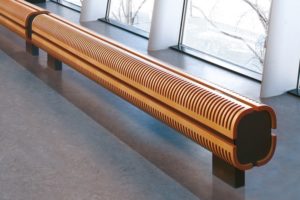
Made of aluminum and steel
Compared to copper-aluminum models, these radiators are somewhat cheaper and lighter in weight, and heat up faster. However, they are inferior in strength. The radiator consists of two elements: an aluminum body and steel tubes located inside.
Advantages:
- high heat transfer;
- small mass;
- high heating rate;
- reliability;
- durability.
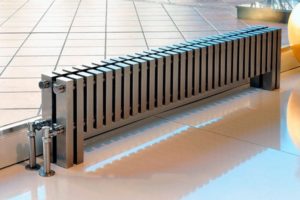
Cast iron
Cast iron radiators are cast sections that are sealed together. Cast iron radiators are typically installed in apartments and are selected based on the total area. The number of windows, the number of floors, and the layout of the rooms are also taken into account.
Cast iron radiators can withstand pressures up to 18 atmospheres, and each section has a power rating of 100-150 watts. The main advantage of cast iron is its high wear resistance, which is completely unaffected by water quality. The maximum coolant temperature is 150°C.
Advantages:
- high heat transfer;
- long service life;
- insensitivity to chemical influences;
- the ability to accumulate and retain heat for a long time.
Flaws:
- there is a risk of leaks;
- large mass;
- Difficulty in maintaining surfaces – it is inconvenient to wash and remove dust between the ribs of cast iron sections.
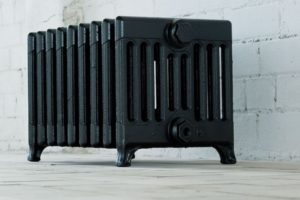
Steel
There are several variations of steel heating units. These are among the most affordable options for heating rooms with large windows. They provide consistent, high-quality heating. They are available as radiators. convectors, registers.
Heat output: 1200-1800 W. Power depends on the steel thickness and the size of the product. The thicker the metal, the better the room heating. Maximum coolant temperature: 130°C. Service life: 20-25 years.
Advantages:
- compactness;
- high heat transfer;
- pressure resistance;
- simple design;
- long-term operation;
- attractive appearance – does not spoil the interior;
- price.
Flaws:
- inferior to aluminum-copper analogues in heat transfer;
- unstable to corrosion if the protective coating is damaged.
Selection criteria
Before purchasing a floor-standing radiator, consider the operating conditions, the material the product is made of, its components, the area to be heated, and other factors.
Material of manufacture
When choosing radiator materials, consider the operating conditions. Any radiator can be used in a private home, as it is not dependent on a centralized heating system, its interruptions, or sudden outages.
Here, everyone independently controls the system pressure, heating temperature, and coolant quality. In centralized pipelines, the pressure is higher than in autonomous systems. Consequently, a centralized heating system poses a high risk of water hammer.
Steel panel radiators are not suitable for apartments. Install bimetallic radiators that can withstand pressures of 20-50 bar or more.
Equipment
When choosing floor-standing radiators, be sure to check whether they come with installation and connection components or whether you need to purchase them separately.
Before purchasing any devices, determine (look in the technical documentation) the diameter of the pipes.
Dimensions
Select radiators based on window dimensions. The length of the radiators should be 50-75% of the window width. Narrow radiators cannot create a sufficiently dense heat flow.
Find out how to determine optimal radiator size, what dimensions influence and how to determine the optimal parameters.
Choose low-profile radiators for rooms with low windowsills when installing taller radiators is not possible. The lower the radiators, the more even the heat distribution and the greater the flow.
Technical specifications
They affect the quality of heating, the size of the heated area, cost, etc. The main technical characteristics of floor-standing radiators include:
- Resistance to water hammer. The service life and operating efficiency depend on this indicator. The higher the indicator, the better.
- Working pressure. This is specified in the product datasheet. It should not be more than 1.5 times higher than the pressure in the heating system. In older five-story buildings, the pressure is typically less than 8 atmospheres, while in modern buildings, it's around 15 atmospheres.
- Number of sections. Radiators can be expanded if their size proves insufficient during operation.
- Power. The key factor on which the warmth in a room depends, especially in frosts down to -40°C.
- Maximum coolant temperature. It may be too low in imported models. It is recommended to choose radiators that can withstand coolant temperatures up to +130°C.
Installation method
Keep this in mind if you plan to install radiators yourself. Lightweight panel-type radiators can be installed by any homeowner, but heavy cast-iron structures require outside assistance.
In apartments with centralized heating, there's usually no choice—radiators are connected as the riser layout allows. However, in private homes, you can design the layout of radiators and risers as you see fit.
Manufacturer
Choose radiators from reputable manufacturers. Products from both domestic and European manufacturers are available on the market. German and Italian radiators are in high demand, followed by products from Spanish, Austrian, and Polish manufacturers.
Trusted and reliable brands:
- Cast iron radiators – VIADRUS (Czech Republic), ROCA (Spain), FERROLI (Italy), MZOO (Belarus), DEMIR DÖKÜM (Turkey), CHAZ (Cheboksary, Russia).
- Steel – ZEHNDER, ARBONIA, BEMM, KERMI (Germany), TET-A-TERM (Italy), KZTO (Kimry, Russia).
- Aluminum. They are primarily made by Italian companies such as GLOBAL, DECORAL, ROVALL, and others. There are also aluminum radiators from a domestic manufacturer, the Stupino SMK plant.
These are just a few of the manufacturers producing floor-standing radiators. The Russian market boasts dozens of companies offering floor-standing radiators of various designs.
Appearance and design
The simplest and most common option is rectangular panel radiators. These are most often installed in apartments, offices, and private homes. Sectional radiators are also a popular choice for apartments.
Tubular radiators are also available, adding a unique touch to interiors. Bimetallic radiators offer many models with sophisticated designs. Curved radiators, models with smooth corners, and rounded shapes are also available.
Connection method
Radiators come with left- or right-hand connections. Single-panel models are typically connected on the right, while double-panel models are more versatile and come with left- or right-hand connections.
Sometimes flat radiators are connected using a saddle method - the lower branch pipe is connected to the supply pipe, and the return pipe is connected to the lower branch pipe on the opposite side.
Price
The cheapest radiators are cast iron and aluminum, with prices starting at 3,000 rubles per section. Steel radiators are much more expensive, costing 7,000-30,000 rubles. Bimetallic models start at 5,000 rubles per section.
Domestically produced products are cheaper. Moreover, unlike many imported counterparts, they are designed for local conditions.
Installation and connection
Floor-standing radiators are connected from the side or from below. Depending on the design and weight of the radiators, this work is performed by amateurs or professionals.
Regardless of the design, connect floor-standing radiators like standard modifications with a bottom connection type:
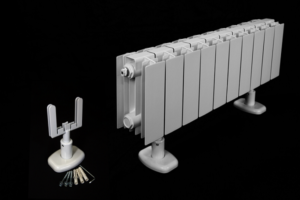
- Adjust the height of the brackets using a building level.
- Screw the auxiliary brackets to the floor.
- Fix the radiator, place the temperature regulator and handle on the side.
- The final stage is checking the quality of the connections and completing the binding.
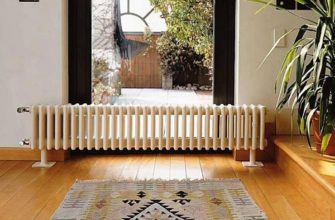
The heat exchanger stands on legs/supports. They do not require masking.
Alternative options
In addition to radiators with legs, manufacturers offer several floor-mounted options.
They allow you to abandon the traditional forms of batteries that take up free space in the room.
Built-in radiators
These are radiators installed in recesses in the floor. They are concealed and save space, but are difficult to clean. Heat is released through grates—metal or wood—mounted at floor level.
These models can even be installed in doorways, without obstructing passageways. They are especially suitable for rooms with French windows. Underfloor radiators are connected to the central heating system via pipes.
Pros:
- simplicity of design;
- light weight;
- compactness;
- corrosion resistance;
- hidden location;
- uniform heating of the room;
- prevent windows from fogging up.
Cons:
- it is necessary to make niches;
- minimal heat transfer.
Watch a video about installing floor radiators:
Skirting convectors
These radiators are typically installed in bathrooms, where radiators aren't always available. They are 20-25 cm high and 10 cm deep.
Pros:
- economical – reduce costs by 50%;
- have protection against overheating (there is a built-in thermostat);
- convenient and easy installation;
- evenly distribute heat flows.
Cons:
- installation is carried out only by specialists;
- If the installation technology is violated, the wall finish may be damaged;
- price.
Floor-standing heating radiators are not only a worthy alternative to wall-mounted ones, but sometimes the only possible solution.
Thanks to a wide range of floor-standing versions, differing in appearance, design, materials, and other features, you can choose the optimal option for any interior and operating conditions.