Nowadays, swimming pools aren't just found in large sports complexes; they're often installed in cottages and summer houses. Owners are faced with the question of how to heat the space and the water. Previously, heating was primarily provided by radiator systems. Today, pools are heated with underfloor heating.
To produce heating water in the poolYou can use an electric water heater. When purchasing one, pay attention to the device's power—3 kW is sufficient for a small pool—and it should have a thermostat to regulate the water temperature.
From this article you will learn About the benefits of heated floors in a swimming pool, which is best for which rooms, and how to install underfloor heating yourself.
- Benefits of heated floors in a swimming pool
- What type of heated floors should I choose?
- Features of heated floors in a swimming pool
- Heating of bypass tracks
- Warm floor under the bowl
- Installation of heated floors in a swimming pool
- Installing underfloor heating under the bowl
- Installation of underfloor heating on paths
- Ventilation of the room
- Operation and maintenance
- How to Reduce Heat Costs with Pool Covers
Benefits of heated floors in a swimming pool
Underfloor heating provides uniform heating of a room. There are no hot or cold zones when installed. These systems are energy-efficient because their operating temperature is lower than that of radiators, and they don't disrupt the interior design because they are concealed beneath the flooring.
The floor of the pool is mostly finished with ceramic tiles - a cold material, so walking on such a surface is not comfortable.
Installing underfloor heating will solve this problem.
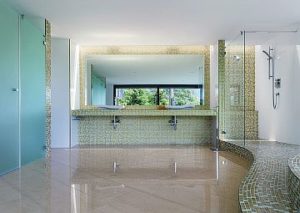
Another problem with pool floors is that they are periodically exposed to water, which leads to increased humidity. Furthermore, there's a risk of injury due to slipping on wet tiles. Heated floors can also solve this problem, as water evaporates more quickly from a warm surface.
In addition, the advantage of heated floors in the pool bowl is that the water is heated.
What type of heated floors should I choose?
There are two types of heated floors: hydronic and electric (cable and infrared). They differ in the heat source. For piped systems, it's the hot coolant. For electric systems, it's the electrical grid.
For the pool, water heating is recommended, since the room has high humidity, which is why electric heating is considered more dangerous. But if install into a screedIf a protective layer protects the heating cable from moisture, then cable flooring can be installed. Film systems can be installed for heating paths, but they require high-quality waterproofing.
Features of heated floors in a swimming pool
Underfloor heating is used in the pool area as primary or additional heating.
To ensure more comfortable conditions, it is recommended to zone the area. This will allow each zone—the bowl and the paths—to receive the required heating fluid temperature.
It is absolutely necessary install a manifold group, it will supply water separately to each branch. If you install automatic thermostat, then it is easy to maintain the temperature of water and air.
Also, when planning, it should be taken into account that, according to standards, the air temperature should be several degrees higher than the water temperature.
Heating of bypass tracks
As we've already mentioned, pool floors, including walkways, are typically tiled, which feels cool and isn't very pleasant to walk on with bare feet. Therefore, installing under-lane heating will make walking on them more comfortable.
The heating element should be positioned so that all lanes are heated and there is no significant difference between the water and air temperatures. The standard temperature range for pool water is 26 degrees Celsius, air temperature is 27 degrees Celsius, and the lane surface temperature is 31 degrees Celsius.
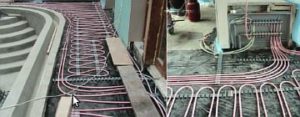
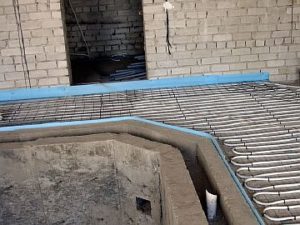
Warm floor under the bowl
The heated floor in the pool bowl allows you to heat the water, providing a comfortable temperature.
Like any underfloor heating system, a basin heating system consists of a layer of insulation on which the piping is laid in a spiral or serpentine pattern. All pipes are connected into a common circuit and covered with screed.
Installation of heated floors in a swimming pool
You can install electric or hydronic underfloor heating in your pool. The heating model should be selected when planning the structure to ensure all the details of the heating system are taken into account.
Installing underfloor heating under the bowl
The water type is better suited for a bowl, and it is also safer for containers filled with water.
Installation begins with setting up beacons for pouring the first layer of concrete.

A level is installed in the center, using this as a guide for laying out concrete blanks, and mounting a metal profile on them.
A concrete screed is erected using the installed beacons.
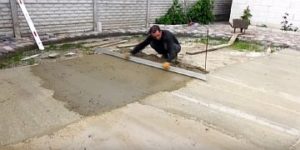
After the concrete has dried, the pool base is insulated and covered with polystyrene foam, which is secured with a special adhesive.
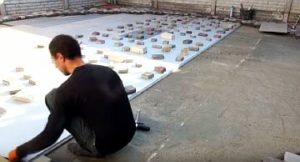
The pipeline is installed and secured to the expanded polystyrene foam with fasteners. It is recommended to use cross-linked polyethylene pipes with an anti-diffusion layer.
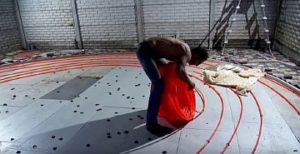
The second layer of concrete screed is poured along the beacons that were installed previously.
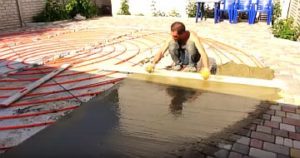
Once the concrete has dried, it should be leveled. You can use a leveling machine.
The final stage is laying ceramic tiles, which will serve as the bottom of the pool.
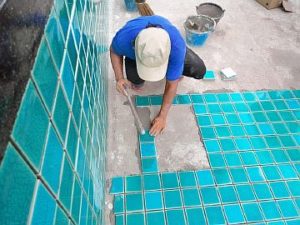
For the floor to function, it must be connected to a water heater or the home's heating system. The boiler's capacity should be selected based on the required temperature. Water passes through the heating element, is heated, and then supplied to the pool.
When using a common house boiler, or if the source is central heating, a manifold must be installed, since the temperature in them exceeds that required for the floor.
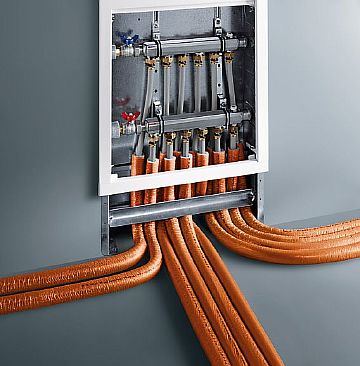
Installation of underfloor heating on paths
The process of installing a water-heated floor on the bypass paths in a swimming pool is the same as installing it in other rooms:
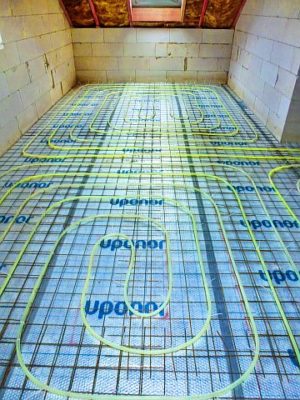
- The floor base must be level, and a hydro- and thermal-insulating material with a reflective surface facing upwards is laid on it.
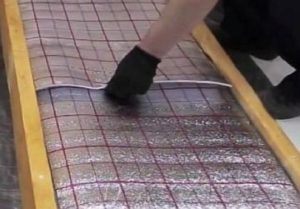
- A mounting mesh is placed on the insulation; it will improve the adhesion of the screed, and the pipeline will be attached to it.
- The pipes are installed according to the planned layout and secured to the mesh with clamps.
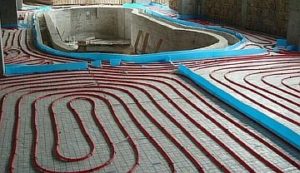
- The pipeline is connected to a power source. This could be a standalone heating element set to the floor temperature. Alternatively, it could be fed from the main house boiler via a pump-distribution unit, which would ensure the coolant reaches the floor at the desired temperature.
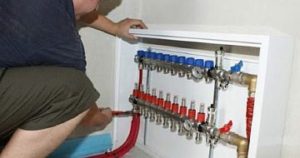
- The concrete screed is poured, This is done only after checking the system for leaks.
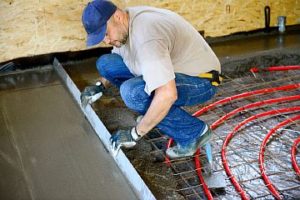
- When the concrete has dried, ceramic tiles are laid.
There's a simplified option for installing cable flooring on an existing screed. To do this, cut grooves in the screed for the cable and temperature sensor, according to the planned layout.
A silicone-sheathed cable is placed in the grooves and secured with tape. The wire is connected to the installed thermostat. A sensor is extended from the thermostat and also placed in the groove. The surface is then filled with putty or tile adhesive. The tiles are then installed.

Ventilation of the room
Condensation accumulates in the pool area, causing mold and rust on metal parts. To prevent condensation and keep the pool area comfortable, humidity should be kept at 50-60%.
To reduce humidity levels, high-quality ventilation is required. If a recuperator is used in the ventilation system together with a heat pump, then heat won't be wasted. Heat is stored in the recuperator and transferred to the incoming air via a heat exchanger. This means the incoming air is already heated, reducing heating costs.
Operation and maintenance
When using heated floors, it is necessary to follow a number of rules:
- the room temperature should be within the range of +26 - +30;
- water temperature 23 - 27 degrees;
- You need to turn on the heating in advance, since underfloor heating heats the water slowly.
Installing automatic thermostats will simplify maintaining the desired temperature. A room thermostat reacts to a 1-degree temperature change, but the heater's response is slow. Using a chromothermostat will improve the system's efficiency.
How to Reduce Heat Costs with Pool Covers
Heat loss in open-frame pools, especially those located outdoors, is greater than in indoor pools. Evaporation is considered the main cause of energy loss. Heat loss can be reduced by covering the pool when not in use. This can reduce water heating costs by up to 70%.
There are various types of covers, both manual and automatic. Roller shutters with solar slats are recommended; they are safe and energy efficient. By accumulating solar heat, they provide an additional several degrees of heating to the water. The roller shutter instructions state that due to energy savings, the protective system pays for itself in 3-5 years.
In addition to saving electricity, the presence of roller shutters allows you to save on the maintenance of utility networks (ventilation, air supply), and on anti-corrosion protection and anti-fungal treatment.
You can reduce heating costs by lowering the pool's water temperature when not in use. Another option is solar panels, which heat the water using solar energy. When planning a pool in your home, it's important to choose and install underfloor heating wisely, as well as to carefully calculate and design the necessary components.
It's best to entrust the design work to professionals; this way, you can avoid a number of installation errors and operational problems.

Heated floors in a pool are definitely cool. After reading the article, I didn't expect there would be so many installation details. Thanks for shedding light on them and explaining everything in detail. Now all that's left is to actually do it.
Thanks for the insightful article! We have a heated pool at our public pool on the outskirts of town, and it's been in great condition for about twenty years. It's still working perfectly, and we haven't had to replace anything in all that time. I think it's important to build a high-quality and reliable floor so it lasts for decades. Even if it costs more.