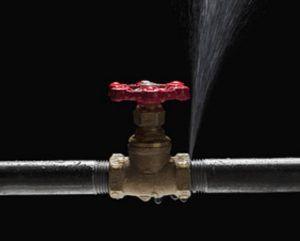
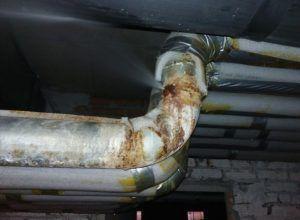
 The term "pipe hole" refers to a deformation-induced hole in a pipeline. Pitting corrosion is considered the main cause of this phenomenon in pipe rolling plants.
This is a clear signal that the pipeline needs urgent replacement. It's not always possible to perform a full range of pipe repairs, including replacement, so they are only carried out partially.
It's important to remember that such measures are temporary, and replacing damaged areas is inevitable. You can enlist the help of professional contractors, or you can do the repairs yourself.
How to fix the "accident"
To seal, you need to prepare the following tools:
- Drill.
- Bolts (set).
- Brush for cleaning rolled metal.
- Adhesive agent BV-2, and epoxy adhesive type.
- Acetone and gasoline.
- Ketn.
- Spatula.
Before sealing the leak in the pipe, drain the water from the system. To do this, close the shutoff valve and open each faucet. The system should be free of any remaining water.
Next, the size of the corrosion formation is determined. To do this, carefully remove the paint layer and rust formation with sandpaper. A small area should form in the damaged area. smooth surface.
After this, the cleaned area must be degreased with acetone. Gasoline can also be used for this purpose. This step is crucial when repairing the area.
When applying a bandage to a workpiece with an uneven surface, it is impossible to achieve a perfectly sealed joint, and all sealing procedures will have to be repeated again.
On a thoroughly cleaned surface, the extent of the deformation can be accurately determined. Based on this information, a method for further correction can be determined. Fistulas are classified by their formation type as follows: point And elongatedEach of them is eliminated differently.
In what ways is the work carried out?
 Repair of fistulas in pipes is carried out using the following methods:
- Using a boltThis method is used when a small hole needs to be patched. The hole is enlarged with a drill, and a thread is cut in the prepared hole. A prepared screw or self-tapping screw is screwed into the thread. This method is not recommended for older pipelines. The age of the used metal can lead to a larger hole appearing in the "problem" area.
- Bandage with rubber liningThis method is universal because it's suitable for all types of pipe systems and any type of water leak. The bandage is selected depending on the size of the leak. It's recommended to use a rubber gasket, and cut a strip 0.5 cm larger than the bandage and a centimeter smaller than the circumference of the pipe. This strip is placed underneath the pipe and placed over the leak area. If the leak is not very large, the water supply can be maintained during repairs.
- Repair with adhesive bandageFirst, you need to prepare a strip of fiberglass or regular bandage. The tape should be large enough to wrap around the pipe six times. This tape is soaked in epoxy adhesive and wrapped so that the leak is centered. Finally, the bandage should be secured with a clamp. This pipe network will not be operational for 24 hours after the repair.
- Cold welding sealingThis option is temporary. It's intended for small holes. Afterward, it's best to patch the problem area with a more reliable method. The short-term nature of this method is due to the fact that exposure to water and high temperatures weakens the liquid weld. To repair with cold welding, simply apply it to the leaking area.
Troubleshooting plastic products
There are two ways to seal a fistula in a plastic pipe: threaded And soldering.
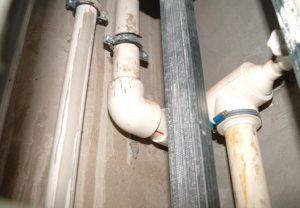
The threaded method can only be used for items that can be threaded. The damaged section of pipe containing the leak is cut off with special scissors.
An insert is prepared from blanks of the required volume. Threads are cut on plastic materials using a die. Then, fittings and couplings are used to secure the other structure to the pipe network.
Welding on plastic pipes begins with cutting off the leaking section. After that, a fitting and a blank of the appropriate size are prepared.
A heated soldering iron for welding plastic pipes is used to heat the outer edges of the plastic and the inner edges of the fittings. At the final stage of the repair, the fittings are attached to the prepared pipe.
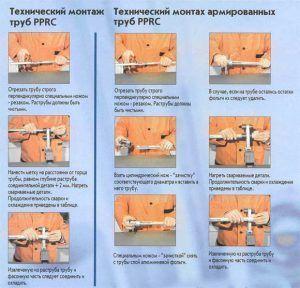
This should be done without delay, since plastic tends to harden instantly, and it is impossible to redo an incorrectly fastened structure.
Repair of copper products
Copper pipe leaks are not uncommon. Copper pipes have been used in construction for a long time. Not only are they suitable for all types of pipelines, but they are also highly ductile and resistant to corrosion.

Copper systems are repaired by welding, which will require the assistance of a specialist. To avoid a major leak, the network should be inspected regularly. If any damage is noticed, it should be repaired immediately.
Problems with the heating main
Communications do not last forever, and even when using high-quality materials, a fistula may form on the heating pipe.
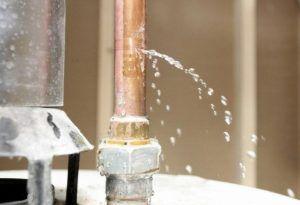
The following reasons are the underlying causes of heating leaks:
- Wear and tear. This is associated with long-term use of the heating system. Steel components are most often affected by leaks.
- Violation of the operating conditions of the heating system. This includes temperature fluctuations and pressure, hydraulic shocks.
- Use of goods of dubious quality.
- Poor sealing of joints.
If a leak appears in the heating pipes, you must proceed as follows.
For example, if there is a problem with the threaded joint of steel pipes, the joint will need to be disassembled and a new layer of backing applied.
If the damage occurs on the heating pipe itself, the problem area will have to be welded using gas or electric welding.
If a copper pipe is leaking, it also needs to be welded. However, welding copper is quite complex, so it's best left to professionals.
If metal-plastic heating system pipes are leaking, the entire affected section will need to be replaced. In this type of pipe, leaks most often form at the compressor joints.
The solution to this problem with plastic heating pipes is to replace the entire section. It's recommended that the polypropylene joint be welded in accordance with all relevant standards. Any imperfections can cause the joint to fail within a very short time.
When working with plastic products, it is prohibited to make changes to the wiring diagram.
Features of metal pipelines
If we are talking about how to weld a fistula in a pipe that is large in size, then there is only one recommended solution - a complete replacement.
If the leak is small, here are some options. However, these recommendations only apply to metal pipe leaks.
Option 2. Rubber pieces for the repair. Cut a strip of rubber slightly longer than the circumference of the hose. Cover the problem area tightly with this strip and then secure it in place. For security, cover it with a bandage and cement, as described in the previous method.
Option 3A bandage and table salt. This is how small "gaps" between joints are sealed. To do this, wrap the leaking area with a bandage mixed with salt. When dissolved, the salt seals the micro-leak. However, this method should not be used for larger lesions; a different approach is required.
Defects in water supply networks
People often ask how to fix a leak in a water pipe. Unfortunately, leaks in plumbing systems are a very common occurrence.
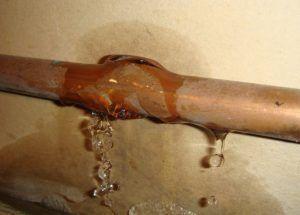 In this case, you can seal the water leak using devices such as a clamp, cold welding, or any other traditional methods.
The condition of the plumbing system should be regularly checked. If the fittings have been in use for a long time and cannot be replaced quickly, it's important to keep a few spare clamps on hand for repairs, as a leak in such fittings can occur at any time.
Before removing such paint, it is recommended to prepare all repair tools, because no one knows what size hole may be under this layer.
IMPORTANT! A leak in a cold water pipe under a layer of paint is not as dangerous as a leak in a hot water pipe. If water from under the removed paint gushes out of the pipe during repairs, it can cause serious burns.
Leak in sewer pipes
When considering the question of how to eliminate a fistula in a sewer pipe, it should be noted that it is impossible to cope with this task a little more complicated, than to repair water leaks in joints.
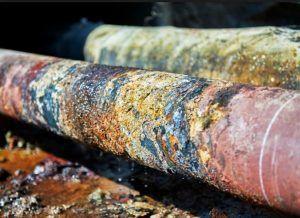
Before repairing, an assessment of the defect and the strength of the workpiece will be necessary. Minor leaks can be fixed with plugs for this type of rolled tube. Another repair method that can be tried is wrapping the leak with gauze soaked in epoxy resin.
A rubber gasket secured with a clamp can be used to temporarily seal a water leak. This and a clamp can be purchased at any hardware store. The gasket can also be secured with wire.
Longitudinal cracks and chips in the pipe are easily repaired with sealant. To do this, the hole is slightly enlarged, degreased, and dried.
After this, a sealant is applied to the area. Metal materials in the sewer system are sealed against water leaks using cold welding.
Fixing a leak yourself
Water leaks happen at any time, so sealing pipe leaks yourself is a very important skill.
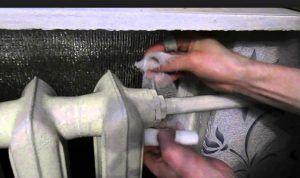
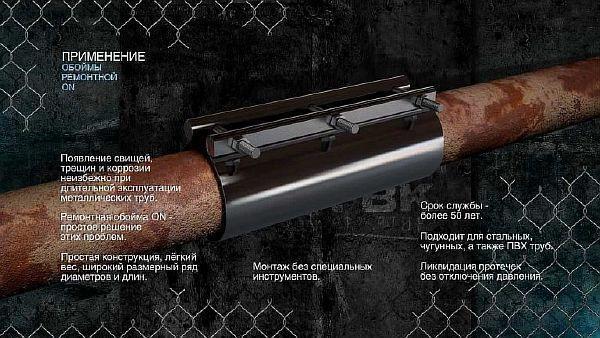
For very urgent fistula repairs, a clamp is recommended. It's a metal tie. Apply the clamp as follows:
- The water supply system is shut off.
- The bolts on the clamp are unscrewed and it is wrapped around the water leak area.
- The nuts on the clamp are tightened with an adjustable wrench, while the pipe itself is held in place with a pipe wrench. Without support When sealing with a clamp, the pipe can be damaged, which will entail additional water leaks and repair costs.
Sealing methods using a lock nut and rubber bands also prove effective. Overall, sealing and repairing a pipe leak is not difficult.
If you're unsure of your abilities, it's worth calling in professional plumbers. And if the leak was sealed using a temporary method, you should consider how to perform a full-scale pipe repair in the near future.

Tell me, which sandpaper is better for removing rust - coarse or fine?
Hello. If the scratches are deep, and this applies to rust, sandpaper grades P120-P180 are best, and even P80 can be used. For primer, use P320, for clearcoat, P1200, and for polishing or to give plastic a glossy finish, use P2000.
I still think that the best option for any damaged pipe is to replace it with a new one. However, if that's a budgetary concern or you need to at least temporarily fix the defect, the options described in the article are certainly applicable. I wonder, though, if this method can be used to repair damaged heating radiators.