 Polypropylene-based pipes have appeared on the market not so long ago.
But they have already become quite widespread, both among owners of private buildings and among those who deal with industrial facilities.
This is explained by the low price of not only the products themselves, but also all the components for them.
- Inside and outside diameters. Compliance
- Wall thickness and its influence on other parameters
- About the calculation of passability
- What else does the calculation of passability depend on?
- Why strengthen polypropylene pipelines?
- What else should be taken into account?
- Let's determine the length of the water supply system
- Additional tips
Inside and outside diameters. Compliance
The material is becoming the basis for pipelines that stand out from their competitors due to their ease of installation and corrosion resistance. Polypropylene does not conduct electricity. It rarely leaks and has an attractive appearance.
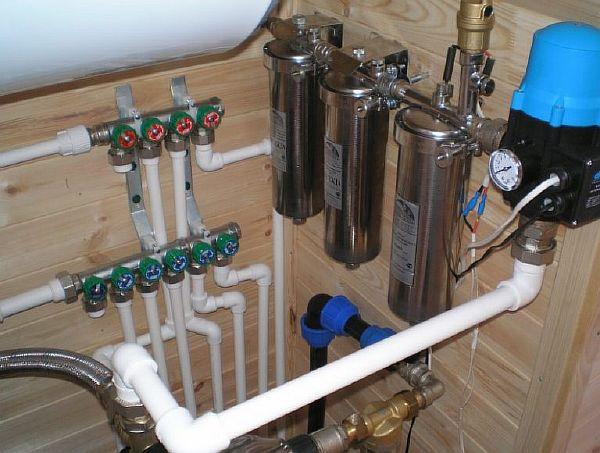 Polypropylene water supply piping systems are used not only in domestic buildings, but also in agriculture, industry, external water supply pipelines, sewerage, and water supply.
The following classification exists for polypropylene pipes:
- PPsA special type in which the internal environment moves while maintaining a temperature of 95 degrees.
- PPRThe most common variety. The base is a random copolymer. Conducts both cold and hot water. Suitable for underfloor heating and conventional radiators.
- PPBA block copolymer product. Suitable for systems carrying cold water, air, and heated floors. Polypropylene pipes have their own internal diameter.
- PPH. The base is homopolypropylene. Its strength characteristics are improved and it is used in ventilation shafts, cold water supply systems, and various industrial applications.
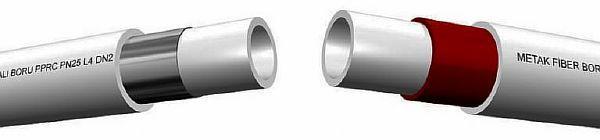
Polypropylene products can be reinforced or unreinforced. Fiberglass and aluminum foil are most often used as reinforcement. The foil is placed in the middle of the wall or near the outer surface.
Wall thickness and its influence on other parameters
Before designing a system, it's important to determine the required diameter (abbreviated Ø). There are complex hydraulic calculations that only true professionals can handle.
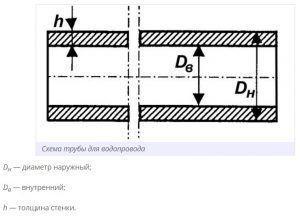
These calculations are necessary to select the correct dimensions for all sections of the water supply system and save on potential costs. The system's location and internal pressure—these parameters require special attention.
Larger sections are not unnecessary, but they are more expensive than other options.
What diameters are polypropylene pipes for water supply produced in? It ranges from 16 to 1200 mm. Each size has its own purpose.
- 16-32 millimeters are the optimal parameters for heating systems in domestic conditions.
- 40-50 millimeters – for sewer systems with internal installation. In this case, 110 mm pipes are also allowed.
The number of points responsible for water supply and the length of the pipeline determine the choice of size for those involved in the design of the internal system through which cold water flows.
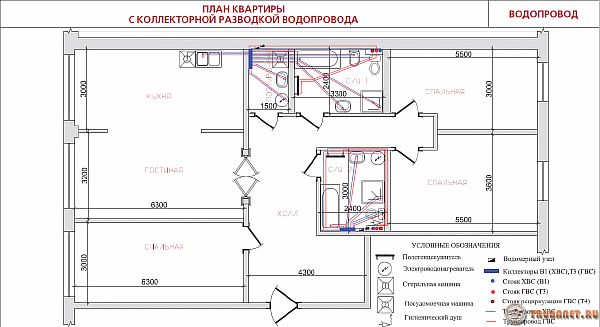
32 millimeters – the minimum size for a water supply polypropylene pipe. The diameter should be between 16 and 20 millimeters, if we are talking about conducting indoor wiringThis concerns the external indicator.
About the calculation of passability
You can use a simple formula to determine the required internal Ø.
 The total peak water flow is designated as Q total. number P – 3.14. V – to designate the speed, with which water moves through polypropylene pipes. The parameter value is selected based on the following conditions:
- For thin ones – 0.7-1.2 m/s
- For fat people – 1.5-2 meters per second.
There's a reason for this difference. The smaller the diameter of the structure, the smaller the surface-to-clearance ratio. If a water supply pipe is too thin, the volume of water passing through it is slowed by the walls.
The lower velocity value is used when selecting pipes with a polypropylene core with a diameter of 10 to 25 millimeters. The higher value is required for pipes with a diameter of 32 millimeters or more.
For each group, experts recommend using the higher value, especially when designing water supply systems for apartment buildings. Peak hours will leave upper floors without water if larger diameter pipes other than polypropylene are used.
Video: REHAU pipes, copper, metal-plastic or polypropylene for water supply and heating
[sociallocker]
What else does the calculation of passability depend on?
Outside diameters are not particularly important. Flow rate is determined by:
- By how many turns and places there are where one size transitions into another.
- Deposits and age indicators.
- Product properties. On a flat surface, the speed of movement will be greater.
- The length of the pipeline. The resistance that slows the water's movement increases with increasing length.
- Systemic pressure.
- Internal cross-section. Polypropylene pipes are no exception, and their internal diameter is calculated separately.
Video: Diameter table in video format
[sociallocker]
Why strengthen polypropylene pipelines?
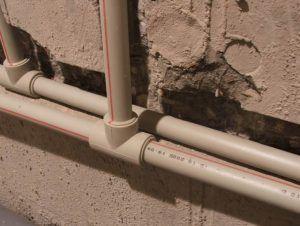 Polypropylene is criticized by many for the fact that it elongates when exposed to too high temperatures. Therefore, it becomes more difficult to organize the wiring.
A pipeline can become depressurized due to changes in its characteristics. This is especially true for pipes carrying hot fluids. Products are reinforced in several ways.
- Using aluminum foil. It is placed in the middle of the walls.
- With a polyethylene layer.
- Using fiberglass, it is bonded with polypropylene during the manufacturing process, creating a monolithic structure.
Fiberglass is the most widely used material. This type of reinforcement doesn't complicate installation at all. Polypropylene pipes for cold water supply, the diameters of which are indicated on the packaging, must also adhere to this rule.
Soldering is easier for pipes With a monolithic structure. Fiberglass is a good choice for applications where a large part is cut and divided. However, the material is more flexible than its counterparts.
If the section is straight and long, then professional Craftsmen will prefer aluminum reinforcementThe maximum possible Ø for installation work is also limited due to strong plasticity.
Video: Polypropylene for Water Supply
What else should be taken into account?
The maximum radius for fiberglass tubing is 63 centimeters. Aluminum foil allows for a radius twice that size. It's best to combine products with different characteristics in a single design.
The only limitation is the quality and quantity of fiberglass used. Identifying existing defects is not always possible after an external inspection.
Only mechanical impact is required. The optimal test is to strike the ground with a piece of pipeline several times. If the quality is poor, the ground will simply crack or fall apart.
To get a more thorough understanding of quality, we need to conduct research, examining everything under a microscope. Is the fiberglass high-quality? Then, under magnification, we'll see fibers of great length and thickness.

Their structure facilitates the formation of a continuous chain. They are characterized by a tight fit. Otherwise, only broken sections are visible, with open spaces between the parts.
Let's determine the length of the water supply system
First, you need to determine how many water connection points your house or apartment will have. Three is the minimum required. The next steps are as follows.
- Checking the distance between the nearest water supply and inlet points.
- It is important to note that polypropylene pipes are laid before the subfloor is poured.
- The layout becomes more complicated if it is necessary to lay the screed during renovation work, when the screed has already been installed.
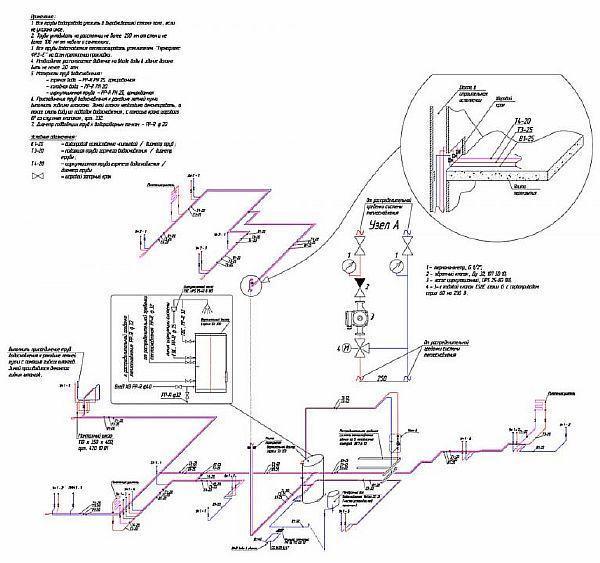
Most often, the direction chosen is, for example, in the direction of the arrow, from the inlet through all sources. This also affects the outer diameter of the polypropylene pipes.
Additional tips
Reinforced products have lower thermal elongation compared to solid polypropylene products. Reinforcement prevents oxygen from penetrating the structure. This is especially true for long, closed-loop pipelines.
The internal stress value in MPa is a mandatory part of the marking. 1 MPa is approximately equal to 10 kg/cm². For example, a designation like PP-R 63.63 means that at 20°C, the internal pressure reaches 6.3 MPa.
The manufacturer guarantees that the pipe will maintain its integrity for five decades. This property is called minimum long-term strength, designated as MRS. The pipe's strength increases as this value increases.
Video: Where polypropylene pipes can be used
The main requirement is that the pipes themselves meet the parameters typical for plumbing and heating systems. The best choice for high-quality installation is to purchase all components from the same manufacturer. This will ensure the best installation results.
When purchasing, there are several things to consider. The internal diameter is also selected according to specific rules.
- Absence of walls with different thicknesses.
- How geometrically correct is the shape? This applies to both the inside and outside diameters.
- Foreign inclusions, non-uniform structure, bubbles, chips and cracks are not allowed.
- How smooth are the inside and outside surfaces?
You should also ask the seller about how to store the product in the winter, or how to correctly determine the diameter. polypropylene pipes for water supply.