Living far from the comforts of civilization has its charm, but it also brings additional challenges when it comes to arranging your home. One of the most important and immediate tasks is installing a sewer system at your dacha yourself.
Countryside sewerage systems are becoming an integral part of comfortable living. In this article We will consider all aspects of arranging a country sewer system, how you can lay it yourself with minimal time and financial costs.
- Options for installing a country sewer system yourself
- Regulatory requirements for the installation of fecal sewerage in a country house
- Septic tank design rules
- Choosing a location
- Construction of an internal sewerage system
- Installation of an external sewerage system at a dacha
- Filter wells
- Aeration of wastewater
- How to install outdoor sewer pipes at your dacha yourself
- Self-installation of septic tanks of various types – from concrete rings, brickwork, from barrels and installation of ready-made plastic products
- How to waterproof a septic tank yourself
- How to connect internal and external sewerage systems and perform testing yourself
- The difference between a septic tank and a cesspool
- Biotoilet as an alternative to a septic tank
Options for installing a country sewer system yourself
How to choose a sewer tank for a private home - its advantages, do-it-yourself installation.
Sewerage systems for private homes come in various forms:
- drainage - for collecting and removing excess water from the site;
- storm drains - for draining water from natural precipitation, including melt water;
- fecal - for the removal of waste generated by human waste products.
Find out how to choose and install a sewage pump for a private home.
 Each of the listed types of drains, in its own way, prevents the occurrence of various problems and is characterized by independent functioning.
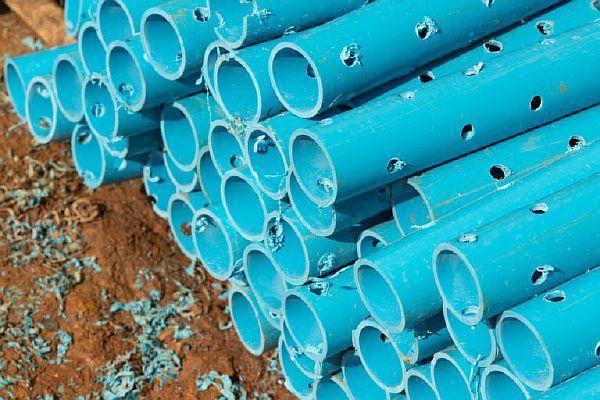
Drainage collectors reduce the risk of waterlogging and bogging of the soil on the site. Water is collected by perforated drainage pipes and removed through a system of sewer pipes and manholes.
Stormwater collection systems begin with the installation of a drain on a country house, gutters and storm drains, as well as a sewer water supply system.
Rainwater and meltwater can be simply discharged off-site, but are often collected in a special tank where they undergo simple purification through settling and filtration. After this, they are suitable for household use.
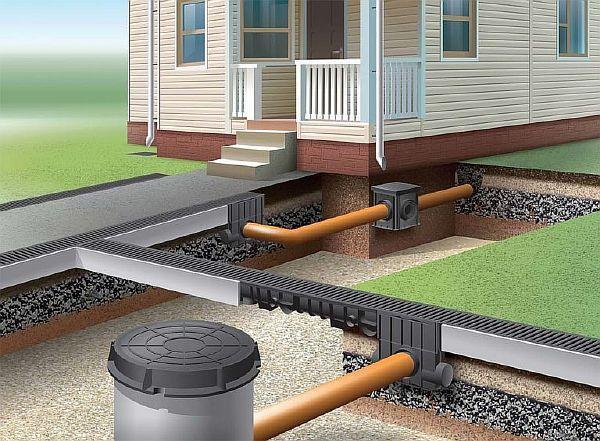
Fecal waste is transported through special pipelines to treatment systems or storage tanks, from which it must be pumped out periodically.
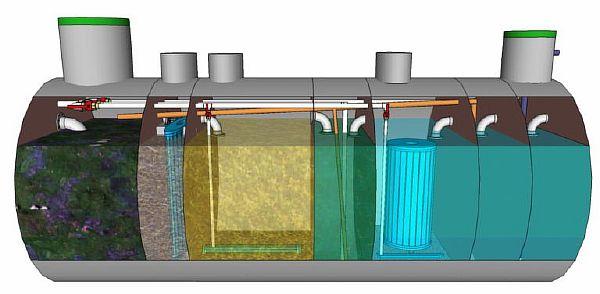
Wastewater treatment is carried out using biological and chemical methods, as well as settling and filtration. The goal is not complete disinfection of the wastewater, but rather its initial processing to a safe state.
In this form, it is poured onto the ground, and further purification occurs through filtration as it seeps into deeper aquifers.
Purifying contaminated water requires considerable expense, but it still needs to be done in order to drink clean water without fear of unwanted consequences.
Regulatory requirements for the installation of fecal sewerage in a country house
Before installing a sewer system on a summer cottage, it's necessary to draw up a detailed design for the structure. Its development takes into account a number of requirements set out in various regulatory documents.
Simply knowing all these rules isn't enough; you need to be able to use them correctly. Therefore, designing a sewer system for your dacha yourself is very difficult for a non-expert; it's best to hire a professional designer.
Construction of such a facility is only possible with permission from the local sanitary and epidemiological station, so the project must take into account SNiP requirements and comply with sanitary standards.
The primary document regulating the construction of even a simple cesspool is SanPiN 42.128.4690-8. The requirements set forth in SNiP 30-02-97 must also be taken into account.
All requirements can be summarized as follows:
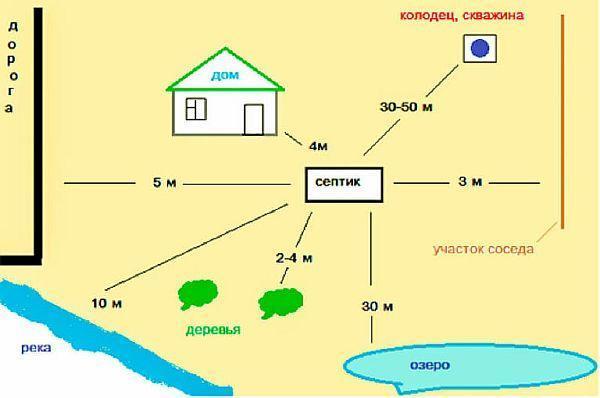
- The storage tank for domestic wastewater must be located on the territory in the immediate vicinity of the house.
- The distance from the nearest water supply must be at least 10 meters, and from the water intake device (well or borehole) – at least 20 meters. This requirement must be strictly observed.
- Storage cesspools are permitted to be installed at least 10 meters away from one's own and neighboring residential buildings. However, this distance is ambiguous—some documents allow for a distance of 5 meters.
- The distance to the border of the neighboring plot is not less than 3 meters.
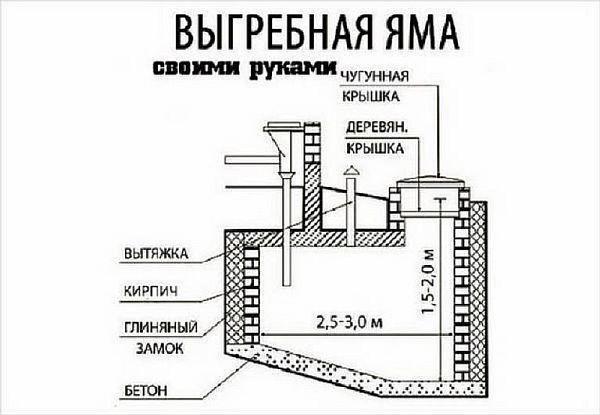
- The depth of the cesspool should be no more than 3 meters, provided that the nearest aquifer is at least a meter from the bottom of the pit.
In addition to the requirements for the location of the pit in relation to other objects on the site, there are instructions for the design of a septic tank or cesspool:
- the structure must be equipped with a hermetically sealed cesspool located above ground level;
- It is not permitted to fill the pit above a level of 35 centimeters to the top edge;
- the cesspool must be pumped out of its contents at least twice a year;
- When cleaning, the cesspool tank is thoroughly cleaned and disinfected.
For disinfection, special agents specifically produced by industry are used.
Septic tank design rules
A country sewer system is a serious project and its design requires an appropriate approach.
Watch the video
Choosing a location
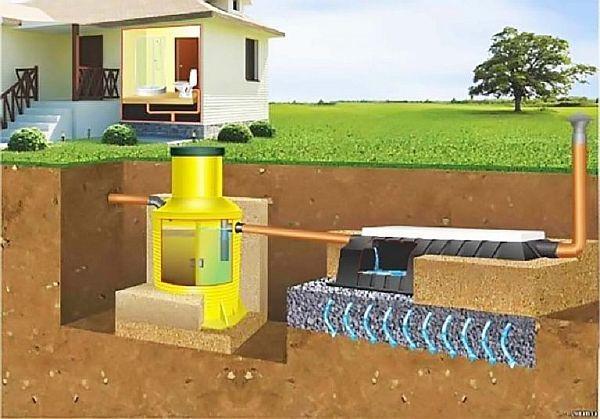
The relative positions of various objects relative to the storage device have already been described above. This device must be located at the lowest point of the site, while maintaining the required distance.
In addition, the septic tank must be located below the well or borehole to prevent wastewater from flowing into the water intake.
As for the distance from the storage tank to a residential building, it's best to set it at 10 meters. Some documents specify this minimum distance—no one knows which document an inspector will refer to when looking to replenish the state treasury or their own budget.
Construction of an internal sewerage system
The design of a domestic wastewater disposal system should be developed simultaneously with the development of the residential building's plans. This allows for the optimization of the layout of utility rooms and the most efficient connection of various utilities.
Watch the video
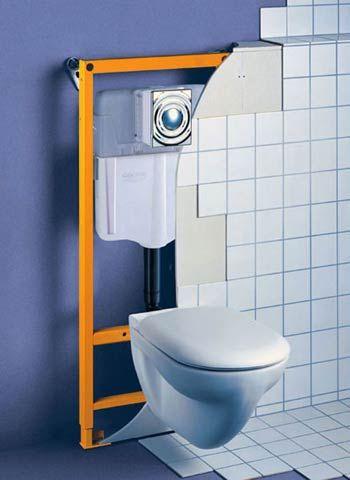
When it comes to sewerage systems in a summer house, they are laid out so that the drain centerline is straight. When designing a two-story building, the drainage system is arranged in parallel and converges on a single riser. This, in turn, combines wastewater from the various floors and discharges it outside through an opening in the foundation.
From this point on, the sewer network must be insulated, even though the pipe is initially located below the frost line. This is done in case of extreme weather conditions.
Insulation is provided by a special polystyrene foam casing. Heating cables, primarily designed for defrosting frozen pipelines, are also used.
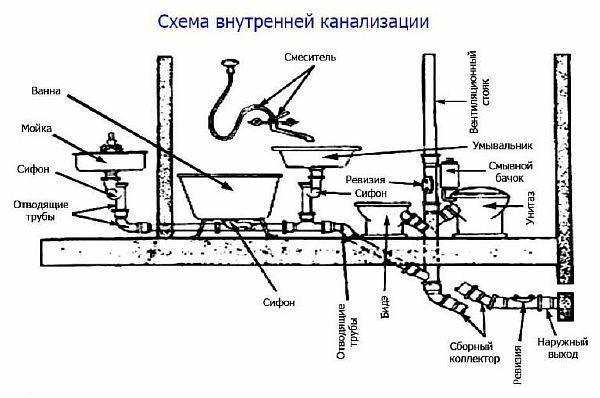
The riser is positioned strictly vertically, its extension upwards continues until it exits the roof, and is called a waste pipeThe upper end is equipped with a cap to protect against precipitation.
To service the system, inspection hatches are installed in several places along the drain pipe.
Installation of an external sewerage system at a dacha
The primary purpose of installing an outdoor sewer system is to disinfect household and commercial wastewater. Ultimately, every responsible homeowner strives for safe living conditions.
A septic tank is a necessary component of any sewer system. Its purpose is to accumulate waste, and in more advanced designs, to further process it.
Watch the video
[sociallocker]
The simplest storage tank can be installed in country houses with a wastewater volume of no more than 1 cubic meter per day. In this case, it is possible to comply with the Sanitary Rules and Regulations (SanPiN) requirement for cleaning such devices. at least once every six months.
Filter wells
This is the simplest device for primary wastewater treatment. It is installed directly behind the septic tank and connected to a sewer pipe. The well depth can be 2.5 to 3 meters. The distance from the bottom to the surface aquifer must be at least one meter.
Watch the video
Using a filtration well on clay soils with low permeability is simply impossible. The most likely outcome is that all the waste will remain with you.
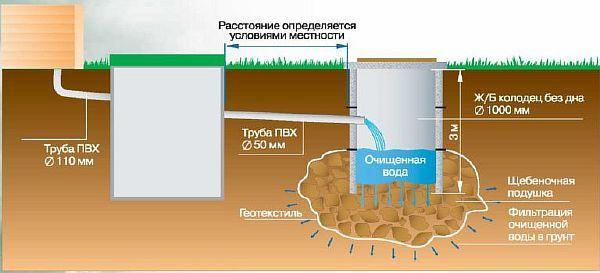
A filter well is made from reinforced concrete rings up to two meters in diameter. It is topped with a similar lid with a service opening. A brickwork well is also a popular option.
The filter section is filled with coarse river sand and 5-15 mm gravel. Many sources recommend using blast furnace slag for the bottom of the filter, followed by a layer of highly absorbent broken brick on top of the gravel.
A septic tank for this type of sewage system involves the primary sedimentation of solid wastewater components and biological digestion of its contents by aerobic bacteria in an air-free environment. Cassettes containing these biological cultures are available at hardware stores.
In the design of the sewerage system at the dacha, pumping is also necessary directly from a septic tank, see all the methods on how to pump it out correctlyBut the need for it arises much less frequently – once every 2-3 years.
Aeration of wastewater
For more effective wastewater treatment, a post-treatment method called air blowing is used. This is achieved using low-power compressors, specifically manufactured by the industry.
Watch the video
- Exposure to atmospheric oxygen causes active oxidation of many chemical elements contained in water, forming insoluble precipitates that settle to the bottom.
- The presence of increased amounts of oxygen in wastewater promotes the active development of anaerobic bacteria, which also contribute to the decomposition of pollutants.
Thus, the introduction of aeration into the wastewater treatment process significantly increases the degree of its purification, bringing it up to 90%.
As a result, the cleaning process looks like this:
- In the septic tank, wastewater is separated into solid and more liquid fractions, which are processed by biologically active substances.
- Aeration, which saturates wastewater with oxygen, deepens the degree of biological processing
- Additional treatment of wastewater with chemicals significantly more effectively cleanses water from contaminants.
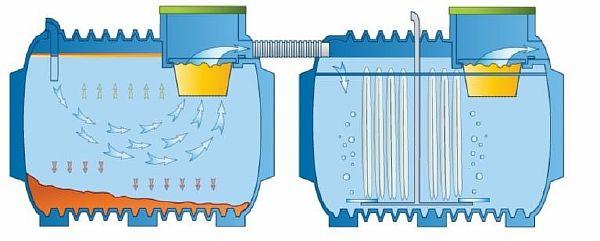
Using a combined method of wastewater treatment has a number of advantages:
- the use of such devices for purifying water from sewage in a summer house is possible at any groundwater level;
- no unpleasant odors occur during operation;
- high quality of wastewater treatment predetermines the creation of a favorable environmental situation in the place of residence;
- a simple installation process allows you to create such a cleaning system in a short time with your own hands;
- the operation of such a system requires virtually no intervention except for periodic inspection and maintenance to replace cartridges with bacterial cultures;
- The high quality of wastewater treatment means there is no need for frequent pumping; depending on operating conditions, it can be performed once every 5-10 years.
If we talk about the disadvantages, the increased cost of the equipment is noticeableHowever, this isn't a case where you can sacrifice your health for the sake of saving money. Furthermore, the smooth operation of such local sewerage equipment at a dacha requires a constant supply of electricity.
How to install outdoor sewer pipes at your dacha yourself
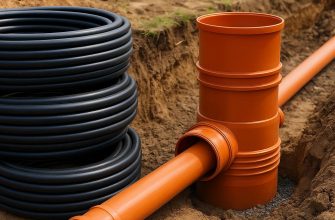
The external part of the drainage system consists of various equipment connected by pipes. It's important to understand that the sewer system at a dacha is a gravity-fed system.
Watch the video
[sociallocker]
Previously, cast iron pipes were the primary material used, but they are now being replaced by polyethylene ones. When laying external pipelines, socket-type pipes with a diameter of 80-100 millimeters can be used.
By making connections between individual units of the wastewater treatment system, The slope must be taken into account; it should be 2-3 millimeters per meter of pipeline length.At a higher value, water will drain faster than the solid fractions of contaminants, resulting in some of them not draining, creating a blockage.
Self-installation of septic tanks of various types – from concrete rings, brickwork, from barrels and installation of ready-made plastic products
Storage devices can be made from various materials:
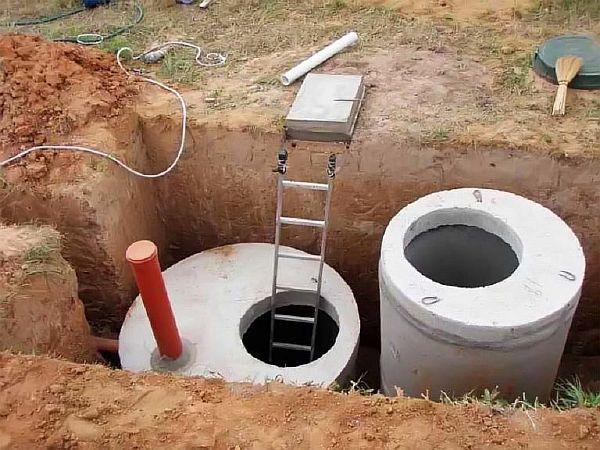
- Concrete rings, while the lower ring is taken with the bottom, the upper one with the hole for the lid. If you are interested in more detailed information about that How to build a sewer system from concrete rings yourself, see this articleWhen selecting rings, pay attention to the connection method—they must have centering grooves. A tight seal is ensured by cement mortar.
Watch the video
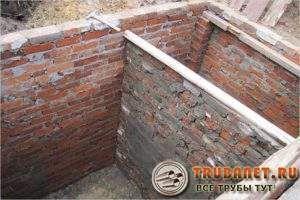
- Brick septic tanks For sewerage systems in summer cottages, they are used in the construction of multi-chamber structures. This requires a drainage layer of sand and gravel up to 15 centimeters thick, followed by a concrete screed up to 30 centimeters thick, and then brickwork using solid red brick.
Watch the video
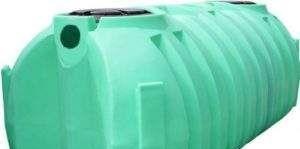
- Plastic ready-made septic tanks They are the most practical and easy to install. However, they have one peculiarity: the container is not heavy. If it is not full in the spring, it may float when the groundwater level rises.
Watch the video
- Septic tanks made from barrels They are used directly for installation in a summer cottage toilet. Plastic containers that are chemically resistant to harsh environments should be used. They are typically used as a temporary disposal solution.
Watch the video
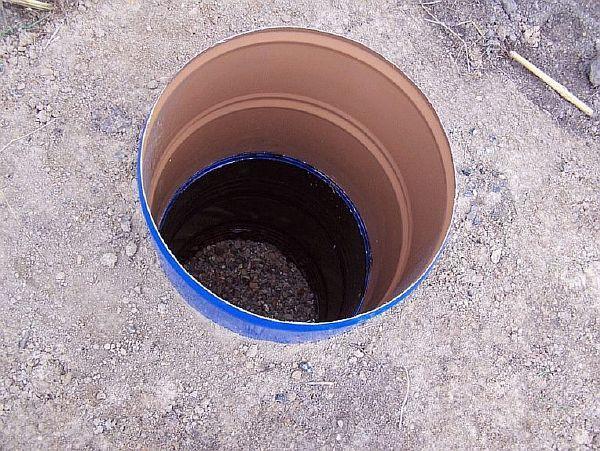
In addition to the materials listed above, other, sometimes unexpected, materials considered improvised can be used. These could include car tires or large-diameter pipe trimmings, both plastic and metal.
How to waterproof a septic tank yourself
The collection tank that collects wastewater from the domestic sewer system at your dacha must be sealed. Otherwise, the investment will be wasted—what should have been isolated and treated will flow through the soil to the aquifer and return to the well or borehole.
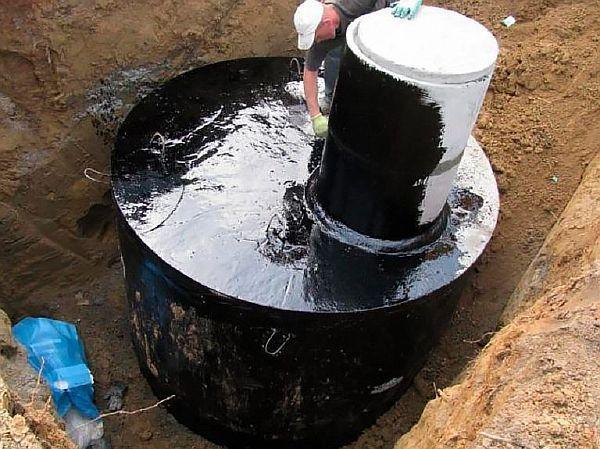
First, the outer surface of the septic tank must be sealed. This is done using bitumen mastic and roofing felt, and the process is carried out in the following order:
- The primer layer is applied to the surface of concrete or brick.
- roofing felt is glued with mastic in rings from bottom to top.
- The joint between the body and the drain pipe is sealed.
Given the importance of the facility, it is recommended to install a clay seal around the septic tank body. To do this, the following steps must be completed:
- The prepared clay must be soaked in water a day before use.
- Mix the clay mortar. Stir until it reaches the consistency of thick sour cream. Add fiber shavings as a reinforcing additive to the mortar.
- Fill the gap between the septic tank wall and the excavation pit soil with the resulting mixture. Compact the mixture with a mixer as you pour.
- After pouring the mortar, cover the surface with plastic film. To prevent cracking, keep the surface moistened daily.
The drying period of the sealing seal is not less than 7 days.
Of course, for plastic molded containers there is no need for such an operation.
How to connect internal and external sewerage systems and perform testing yourself
After installing the internal and external sewer systems at your dacha, the most critical step is connecting the two lines. Maintaining the correct slope is paramount.
Watch the video
Having placed the pipe in this position on a sandy base, it must also be filled with sand and carefully compacted.
Connecting the electrical power and control systems should be entrusted to an experienced technician—an installer from the equipment manufacturer. Otherwise, the supplier's warranty will be void. Upon completion, the installer must make a corresponding note in the warranty card.
The difference between a septic tank and a cesspool
Like any long-standing system, the sewer system at a dacha is constantly being improved. A cesspool, the simplest structure for disposing of household waste, requires regular pumping, which in itself entails additional costs. Moreover, it's not a particularly pleasant procedure.
For this reason, the idea of installing a filter well arose and was implemented. The time and cost of maintaining such a system were significantly reduced.
The introduction of aeration, biological, and chemical treatment into wastewater treatment technology ultimately led to the creation of a sewage system at the dacha that operates without pumping, significantly increasing the comfort and quality of life in rural areas.
Thus, an autonomous sewerage system at a dacha is a logical conclusion to the development of a conventional cesspool.
Biotoilet as an alternative to a septic tank
 A septic tank is a localized structure for treating wastewater from biological and chemical contaminants. Most of these devices require an insulated container with simple equipment. The resulting water is clean enough to simply be discharged into the ground.
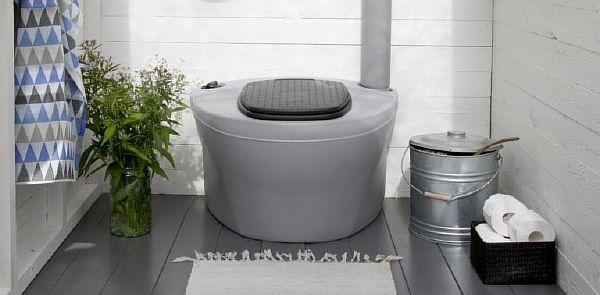
A biotoilet is a compact device for processing only fecal waste using sawdust, peat or other similar fillers.
Natural recycling produces ordinary compost suitable for gardening. However, for comfortable use, a composting toilet requires high-quality exhaust ventilation from the room where it is installed. Otherwise, the atmosphere will be somewhat polluted.
A composting toilet is a good temporary solution to waste disposal problems. A permanent solution to sewerage at a dacha can only be achieved with a modern septic tank.

It's best to plan the drainage system before building the house; then there will be fewer problems and everything can be quickly fixed at the initial stage. But in a finished house like ours, we had so much trouble planning and then fixing the mistakes (where a hole was drilled in the wrong place, where the dimensions were wrong). And we wasted a ton of time. I went over it a thousand times, and next time I'd rather hire a professional than do it myself.