The diameter of heating pipes determines their throughput, i.e., the volume of coolant passing through them per unit of time. To determine the correct pipe diameter for a radiator heating system, calculations must be performed using one of several methods: thermal power, resistance coefficient, or specialized tables. A preliminary estimate is that 16 mm diameter pipes are suitable for installing up to two radiators; 20 mm diameter pipes should be used when connecting radiators with a total capacity of up to 7 kW.
Even before building a house, it's important to decide on the type of heating system and install it in a way that avoids mistakes. Otherwise, a careless approach could negatively impact its operation in the future.
To select the appropriate components for a heating system, it's necessary to determine how the coolant will circulate. For separate heating, consider its type, design, and installation.
Selection of components
Today, the construction market offers a wide selection of samples from various materials:
- Steel pipes are rarely used for installation today. They are unreliable, as they are susceptible to corrosion and rupture when exposed to high temperatures;
- Metal-plastic pipes are not subject to corrosion, but they can also break down at bends under pressure and under the influence of pressure;
- Copper pipes are considered the most durable, aesthetic and convenient during repair work, but at the same time they are the most expensive of all;
- polymer products. In this The list includes polyethylene And polypropylene pipes. Plumbers consider this choice of plumbing to be the most reasonable in terms of price-quality ratio.
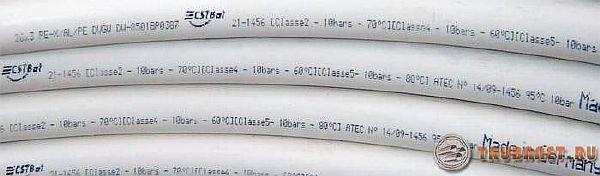
Selecting the necessary elements is not difficult if you study the markings, which indicate the permissible pressure and temperature of the coolant.
The importance of choosing the right pipe
The choice should be based not only on the material's properties, but also on determining the correct pipe diameter for the heating system in a private home. This will determine the hydrodynamics of the heating system, its efficiency, and its effective operation.
Common mistakesIf the sample cross-section is larger than required, this will likely lead to a drop in pressure, water will stop circulating properly, and room heating will be significantly reduced. Using components with a smaller cross-section than required will cause the system to produce unpleasant noise.
Selecting all the components for installing a heating system in a private home will be easier if you consider the fact that different materials require different cross-sectional measurements.
Cast iron and steel samples are measured by the inner diameter, while plastic and copper samples are measured by the outer diameter. This is especially important if you plan to install a combined heating system.
When using components made from different materials, to avoid errors, the best and most correct solution is to use the data in the diameter correspondence table, which is available on our website.
See how to install heating yourself.
Basic parameters and diameter calculation
There are three main diameters to consider. Namely:
- interior. It is taken into account as an indicator of the coolant’s throughput capacity;
- externalAn important indicator affecting the quality of installation of the heating system;
- conditional. A standard value that is rounded and displayed in inches.
When calculating the diameter of a heating pipe, it is worth remembering the scale of measurement of this value.
This figure is usually given in inches and is expressed as whole numbers or fractions.
To avoid making mistakes in calculations, you need to know that an inch is equal to 2.54 cm.
Calculating the appropriate diameter
When determining the cross-section diameter, it's essential to consider the heat load. It's estimated that heating one square meter of a standard room requires 100 watts of heat energy. Taking this into account, we perform the following calculations:
25x100 = 2500 W = 2.5 kW
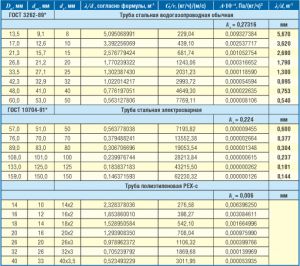
Therefore, to heat a 25-square-meter room, 2.5 kW would be required. The table then determines the optimal pipe diameter for heating a private home.
According to our calculations, the most suitable size is ½ inch and it is recommended to choose this diameter.
Optimal water temperature and pressure
When choosing an autonomous heating system, you'll need to independently select the appropriate coolant temperature and pressure. This depends not only on your preferences but also on the heat transfer rate of the integrated radiators.
Video about heating installation and piping
Remember that cast iron radiators have the lowest heat transfer coefficient, while aluminum models have the highest. The number of radiators and their sections is calculated based on the rated thermal output.
This parameter is set assuming that the liquid temperature will not exceed 75 degrees. This value is considered the most optimal.
However, if the outside temperature constantly fluctuates, the heating of the coolant in the autonomous system of a private house must be regulated in order to constantly maintain a comfortable temperature and not waste excess energy.
For high-quality operation, in addition to temperature, it's important to monitor the pressure in the pipes and select the optimal diameter. A pressure of 1.5-2 atmospheres is considered normal.
If this indicator rises to 3, then the entire circuit may malfunction and even leaks and breaks may occur.
To ensure regular pressure checks, allow space for pressure gauges in the circuit during installation. Pressure can be reduced by using expansion tanks.
Types of heating
Installation of an autonomous heating system in a low-rise building can be carried out using single-pipe or two-pipe systems.
The customer should choose the optimal option at the design stage to ensure comfortable living in their home.
It is worth choosing a method that will make laying heating pipes in a private house less expensive.
Financially, a single-pipe layout would be the most optimal, but if cost is not as important as efficiency, then a two-pipe layout is worth choosing.
Below we will consider each type of wiring in more detail.
One-pipe system
The main line of this design is constructed from heating units connected one after the other. The fluid passes through each element of the system in turn, gradually releasing its thermal energy, so it arrives at the final section at a lower temperature.
This will not affect the microclimate inside the house if the last battery in the circuit is equipped with a large number of sections.
Today, there are technologies that can improve the performance of single-pipe heating systems. These include:
- battery-powered regulators;
- valves for balancing the incoming coolant;
- thermostatic or ball valves.
The use of such equipment helps to maintain a certain temperature in a private house.
Often, in a low-rise building, a separate heating system is installed, which is mounted according to:
- horizontal scheme with a pump, which ensures the distillation of hot water by injection;
- vertical scheme, where the liquid flows naturally;
- vertical scheme with natural, forced or combined distillation.
Heating lines can be installed above or below the floor. Another important consideration is thermal insulation to retain more heat.
The horizontal main line is installed at a slight angle to allow the coolant to flow naturally. The radiators, on the other hand, are installed at the same level. To bleed air, the radiators are equipped with special valves.
This system does not need to be equipped with a pump, since the movement of liquid occurs naturally.
The disadvantage is the use of components with a large cross-section and the mandatory installation of the system at an angle.
Therefore, this type of wiring will not become an interior decoration.
Two-pipe system
The second type of heating system for a private home—a two-pipe system—requires more components during installation. This will also increase the amount of installation work and financial costs.
This design ensures uniform distribution of the coolant and facilitates setup and adjustment of the entire system.
Modern boilers from foreign manufacturers are recommended for a two-pipe system. The liquid is heated using a dual-circuit boiler using gas energy.
When installing a two-pipe system, it's crucial to install automatic bleed valves at the top of the system. If the house is single-story, these valves are required at the top radiator and at the heated towel rail.
The system you choose will determine the number of components required for installation. Large homes are best equipped with a two-pipe system. wiring and circulation pump.
The temperature can be maintained using thermostats. If the house's square footage does not exceed 100 square meters, a single-pipe system with natural coolant flow will be sufficient to heat all rooms.
To summarize all the above information, we can confidently say that during the design of a heating system and its installation, every detail must be taken into account.
Even the smallest error can affect the efficiency of the structure.
To avoid any potential inaccuracies, it's best to entrust the design and installation of any heating system to professionals who will correctly select the pipe diameter for heating a private home and perform all necessary calculations.