The kitchen is a shared space where the whole family spends a lot of time. It's important that it's comfortable and cozy, with an atmosphere conducive to friendly conversation.
Today, heated floors are commonplace; they're installed in bathrooms, living spaces, and even utility rooms. But many people wonder: is heated floors necessary in the kitchen and how to install them?
In this article, we'll discuss the different types of heated floors, which ones are best suited for kitchens, and cover installation in more detail.
Do you need underfloor heating in the kitchen?
Installing underfloor heating in the kitchen isn't always practical. Let's look at the pros and cons to help you determine whether additional heating is necessary in your situation.
The need for a heating device arises if:
- you like to walk barefoot - to maintain your health;
- you live on the ground floor or in a private house - the floor is not heated by conventional heating and remains cold;
- After the renovation, the kitchen was combined with the balcony - without an additional heat source, it is difficult to create the desired temperature level;
- If you plan to use tiles or laminate as a floor covering, it is a cold material.
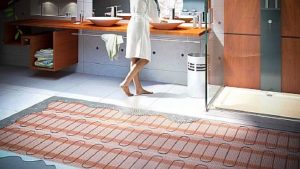
If your heating system is heating the room well, there's no point in installing additional heating. Also, if you're using warm materials like wood, cork, or linoleum as finishing materials, there's no need for additional heating.
Furthermore, constant heating will cause wood to dry out, causing cracks. And if linoleum is laid on a heated surface, it will release toxic substances. Another reason why heated floors are not necessary is that if the windows face south, the sun's rays will heat the room.
This means that the decision on whether to install a heating system should be made taking into account the layout and location of the kitchen, as well as your temperature preferences.
Find out, Is it possible to place a refrigerator on the floor? or other heavy objects.
Pros and cons
When deciding to install underfloor heating in the kitchen, you need to know all the advantages and disadvantages of this heating system.
Advantages of this heating:
- uniform heating of the room;
- the surface dries quickly after washing;
- there are no complicated settings and it is possible to regulate the temperature level;
- long service life - up to 40 years.
Among the disadvantages:
- difficulties with installing the heating system - it is necessary to dismantle the floor covering;
- Higher room temperatures can cause food to spoil faster;
- high cost of equipment;
- When using electrical structures, energy consumption increases.
What types are there?
There are several types of heated floors: water and electric, the latter in turn are divided into cable and infrared.
Water
A water-based system is a system of pipes with a circulating coolant. When installed in an apartment, water is supplied from a riser or central heating system. However, this requires special permission, as the connection may negatively impact the heating of neighboring apartments.
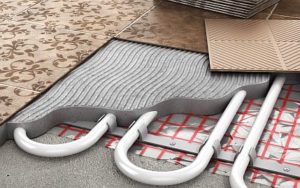
In a private house, the supply of hot coolant is possible from an installed autonomous boiler, which equipped with a pump for transporting liquid.
Installing hydronic underfloor heating in the kitchen is inexpensive, and it's also energy-efficient. However, it's worth noting the complexities involved: obtaining permits for connection, and the time-consuming and labor-intensive installation of the system. There's also the risk of flooding the neighbors below if a pipe bursts.
Electric
Electric heated floors are powered by electricity, which is converted into heat. The heating level is controlled by a thermostat.
Also, when placing the heating element, you should consider the future arrangement of furniture, as heavy objects cannot be placed on it - this will cause the system to overheat and fail.
Electric heated floors come in:
- Cable heating systems use a cable as the heating element, which is laid on surfaces according to a specific pattern. This type of system has a longer service life than water-based systems. The downside is expensive installation, but no permit is required. Electricity costs are also higher, but these are not significant given the small size of the room.
If even one wire is damaged, the entire device will have to be replaced.
A huge advantage of the cable is that it can be used with any finishing coating.
- Film - carbon heating filmCarbon paste is applied to the product in parallel stripes. In such systems, heating is achieved using infrared waves.
The film is not placed under the tiles, as its effect is reduced to zero.
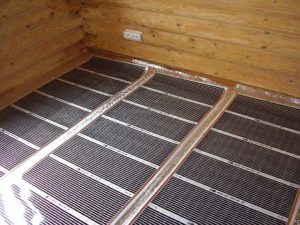
- Rod - also refers to the infrared systemThey are mats with parallel carbon rods attached. They are highly effective, durable, reliable, and cost-effective.
But its main advantage is self-regulation. This is the only electric underfloor heating model that can be installed under heavy furniture without fear of overheating. Furthermore, the rod mats can be laid under any surface, even in damp rooms.
The main disadvantage is the high price.
Which is better to choose?
When choosing a heating system for your kitchen, you should consider the following features:
- Installation - all types of electric floors are easy to install, but the construction of a water structure is a more complex process.
- The installation method is the most labor-intensive of the water-based installation methods, as it requires a screed of at least 3 mm. Rod-based screeds can be installed either in a screed or in a layer of tile adhesive. Cable-based and film-based screeds do not require a screed; the film is generally laid underneath the paving.
- Flooring – almost all models can be used with any type of flooring. The main thing is that it has a symbol indicating compatibility with heating devices.
- The water system has the lowest power at 110 watts per square meter, followed by cable systems at 160. The most powerful are infrared floors: film systems at 220 watts, and rod systems at 260 watts.
- Heating type - all models except cable systems can be used as the main heating source.
- The thickness of the "pie" without the finishing coating - the thickest structure is obtained when constructing a water-heated floor; electrical systems are quite thin, from 1 to 3 mm, if not mounted in a screed.
- Commissioning - only film can be turned on immediately after installation, cable and rod - after the adhesive has dried - this will take several hours, water - when the screed has hardened.
- Temperature range: for all floors up to + 70 degrees, except for rod floors, which have up to + 80.
- Saving energy consumption — film and water systems have a high degree of energy savings, cable floors occupy an average position, and rod mats have the lowest indicator.
- Uniform heating of the room - infrared systems (film and rod floors) are in the first place, cable and water devices provide comfortable air circulation.
- Mobility – film and rod flooring are easy to move, and the film can even be placed under carpet. Cable and water-based systems are not portable.
- Service life: water 10 years, cable 20 years, rod 25 years, film 30 years.
- Manufacturer's warranty: 10 years for hydrofloor, 15 years for film, 20 years for cable, and 25 years for rod floor.
Additionally, the location of residence—an apartment or a house—is also taken into account. Installing a hot-water heating system in an apartment requires a permit, which is often not issued for multi-unit buildings.
Moreover, apartments don't have very high ceilings, and underfloor heating significantly reduces them. Therefore, electric underfloor heating is a suitable option for an apartment kitchen.
For country houses with autonomous heating, it is more economical to install a water system in the kitchen.
Installation of water-heated floors in the kitchen
Despite the fact that Film electric floors are much easier to install It's faster, but more suitable for apartments. Since underfloor heating is most often installed in country houses, where hydrofloor heating is the optimal and most cost-effective option, let's take a step-by-step look at how to install underfloor heating under tiles in the kitchen:
- Drafting a project - a pipeline layout scheme is being developed ("snake" or "snail"), the area for mounting the collector unit is determined.
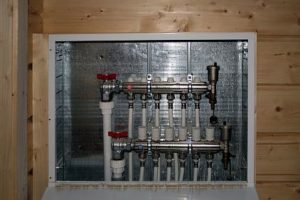
- Mounting the manifold: It is typically installed in a metal cabinet, which is mounted in a prepared niche in the wall. To avoid air exhaust problems, the manifold must be positioned above surface level.
- Preparing the base involves removing the old covering, leveling and cleaning the concrete floor.

- Thermal insulation - the material is laid end to end, and large gaps are sealed with polyurethane foam.
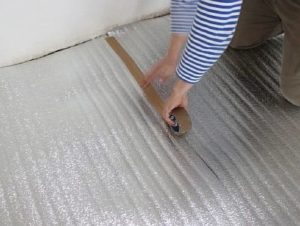
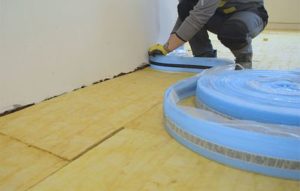
- Installing a damper tape - it is pasted around the kitchen perimeter; it prevents the screed from cracking when heated.
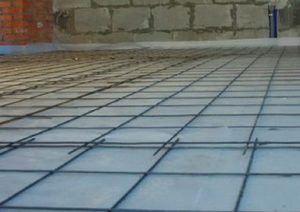
- Laying the reinforcing mesh; when using a mat with bosses as insulation, it can be omitted.
- Pipe placement: Pipes are laid according to the planned layout. The loop is installed at least 8 cm from the walls, and the spacing between loops is 10 to 40 cm. Pipes are secured to the fittings with clamps; do not overtighten.
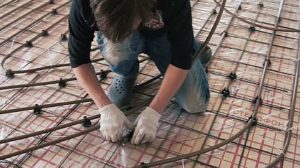
- Connection: The pipeline is connected to the manifold using compression fittings. One end is connected to the supply line, the other to the return line. A corrugated hose is fitted to the section of the pipe located at the expansion joint.
- Checking the system - water is supplied to the main line under a pressure of 5 - 6 barTesting is carried out over a 24-hour period. If no leaks appear during this time, then you can proceed to pouring the screed.
- Pouring the screed — The work is carried out with the pipeline filled and under operating pressure. A cement-sand mortar is used for the screed. After placing and leveling the mixture, it must be allowed to dry, which takes approximately four weeks.
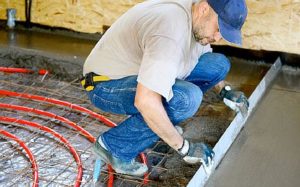
- Laying the finishing coating — only after the screed has completely hardened, the chosen floor covering is laid, for example tiles.
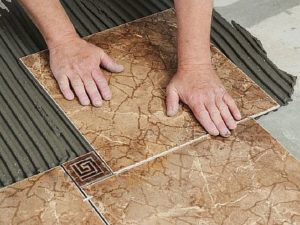
The system can be turned on only after the screed has dried, and when using ceramic tiles, the adhesive.
Choosing a coating
The kitchen is a special room in the apartment. The flooring there should not only be practical and beautiful, but also:
- hygienic - easy to clean;
- moisture-resistant - since the kitchen is the second most humid room after the bathroom;
- wear-resistant - increased resistance to abrasion;
- impact-resistant - to withstand the fall of heavy objects.
Not all materials used as finishing materials meet these requirements. Let's take a closer look at the acceptable types of coatings for underfloor heating systems.
Ceramic tiles
For the kitchen, tile is an ideal solution: it's environmentally friendly, doesn't crack, even at high temperatures, is moisture-resistant, and easy to clean. However, rapid heating isn't always kind to your feet.
When choosing tiles, pay attention to their hardness and porosity. The density shouldn't be too low.
The heated floor in the kitchen under the tiles is turned on only after the adhesive has completely dried.
Self-leveling floors
Self-leveling kitchen floors are gaining popularity. They require no additional screed, as they are self-leveling. Furthermore, they are easy to clean, moisture- and scratch-resistant, and last up to 50 years. They come in a huge variety of colors, and even a 3D effect is possible.
But this type of roofing is modern and relatively new, so it's quite expensive. Furthermore, installing it requires experience; otherwise, the quality will be poor, and it's best to entrust the job to a professional.

Cork
Cork flooring is suitable for kitchens, but only adhesive-backed models. Their advantages when used specifically in the kitchen:
- if dishes fall on such a floor, they will not break;
- It is pleasant to walk barefoot on such a surface, and it does not slip;
- Cork is a good heat and sound insulator;
- does not burn and does not emit toxic substances.
Of course, like any material, cork also has its disadvantages:
- it's expensive;
- requires special glue and varnish for finishing;
- The cork product can only be laid on a perfectly flat surface;
- easily damaged and scratched.
Installation of such a coating is complex and requires skills.
Laminate or parquet flooring can be installed over a heated surface, but this type of flooring is not ideal for kitchens. Linoleum is often used in such spaces because it's easy to clean, but the model must be labeled as suitable for installation over a heating device.
Recommendation! When choosing finishing materials for your kitchen, consider the design. If the room is decorated in a minimalist style, tile is a better choice.
If you have white cabinets, a black floor will look beautiful. If the kitchen is large, experts recommend using a combination of flooring: tile in the work area, and cork or parquet in the dining area.
Whether or not to install heated floors in your kitchen is up to you. The key is to choose the type that meets your needs and suits the characteristics of your space.


We usually walk around the apartment barefoot, plus the kids are always playing on the floor (including in the kitchen). Of course, the heated floors in the kitchen have been very useful for me personally. Moreover, the kitchen is a place where we often do wet cleaning after cooking, and the floor dries very quickly. The topic is well covered here; everyone can weigh the pros and cons and then make a decision.