Every day, I receive questions from suburban property owners about what kind of ventilation is needed for a gas boiler in a private home to avoid conflict with authorities.
I decided to dedicate a separate article to the topic of arranging air exchange in a technical room, where I will talk about the types, purpose, standards and requirements of the engineering systemLet me explain, What types of gas boiler hoods are there, and how to calculate duct cross-sections.
At the end of the article, we will look at the ventilation installation and commissioning work step by step.
- Purpose of ventilation in a boiler room, standards and requirements
- Types of ventilation
- Extractor hood and chimney for a gas boiler
- Calculation of ventilation for a gas boiler room
- Ventilation diagram
- Step-by-step installation of ventilation and chimney
- First launch
- Answers to frequently asked questions
- Video instructions
Purpose of ventilation in a boiler room, standards and requirements
In a gas boiler chamber, fuel burns in the presence of oxygen, and ventilation ensures oxygen is brought in from outside. A lack of air exchange results in poor combustion. The amount of oxygen in a closed boiler room quickly decreases.
When oxygen deficiency occurs, the gas in the firebox does not burn completely and settles as soot on the chimney walls. Boiler performance deteriorates, and the heating system's efficiency decreases.
Lack of ventilation is dangerous for homeowners. The boiler room becomes stuffy from carbon monoxide, which can lead to smoke inhalation. Soot buildup in the chimney can ignite, causing a fire.
Gas leaks often occur at gas pipeline connections. If they are not vented to the outside, an explosive mixture forms when the gas concentration reaches 5-15% of the air volume.

Ventilation, heating and air conditioning are covered SNiP 41-01-2003 And SP 60.13330.2020According to legislation, gas equipment with a capacity greater than 30 kW must be installed in a separate boiler room in a private home.
Any room chosen spontaneously won't do. The boiler room volume for a boiler up to 60 kW should be 13.5 m3.3If the heating appliance's power is greater than 60 kW, the recommended room volume is greater than 15 m3.3.
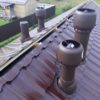
Small gas boilers with capacity up to 30 kW It is allowed to be placed in the kitchen, but the room must meet the following requirements:
- minimum area – 15 m2;
- the ratio of the total area of kitchen glazing to the walls is 3 cm2/1 m3 premises;
- minimum ceiling height – 2.2 m;
- the presence of transoms and vents on the windows;
- the boiler must be kept at least 10 cm away from the wall;
- finishing kitchen walls with fire-resistant materials;
- the presence of an exhaust hood and air supply.
Separate requirements apply to boiler room ventilation. The system must provide three natural air exchanges per hour.
SNiP sets out requirements for the ventilation of a separate boiler room in a private home.
Necessary:
- install separate ventilation ducts for the gas boiler, separate from the general system, through which air will be supplied and discharged;
- ensure tightness of air duct connections with heat-resistant sealant;
- cut feedthrough sleeves into the walls to connect gas pipes from the street to the boiler;
- Connect no more than two boilers to one chimney;
- ensure a distance of at least 300 mm between the end of the chimney on the street and the plane of the external wall.
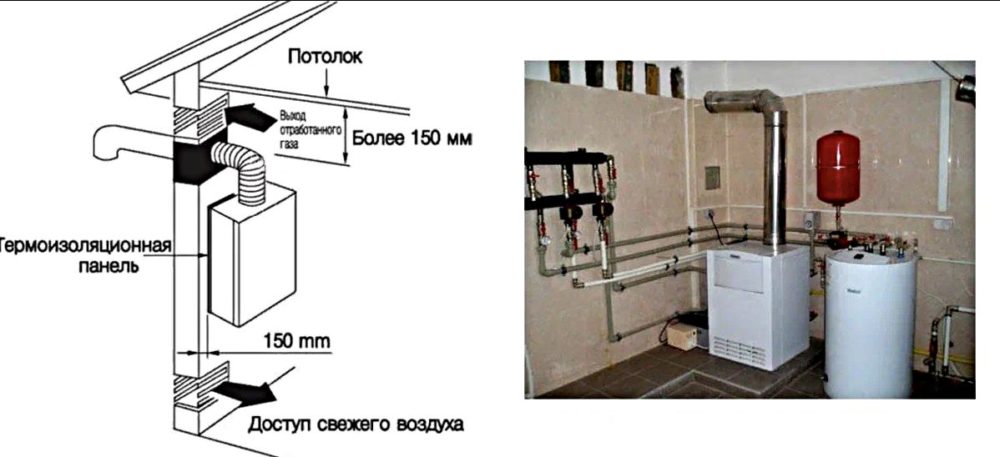
It is recommended to provide an air supply from outside. If the boiler room layout does not allow this, fresh air can be supplied from adjacent rooms through a gap under the door.
However, the living room is prohibited from being used as an adjoining room to receive air flow.
Types of ventilation
In a house with a gas boiler they are setting up 2 types of ventilation: natural And forced.
The first option is most common in the private sector. Natural ventilation is permitted for boilers with a capacity of up to 30 kW.
In a utility network, air exchange occurs due to temperature and pressure differences. Air masses circulate freely between the outside and the inside through air ducts.
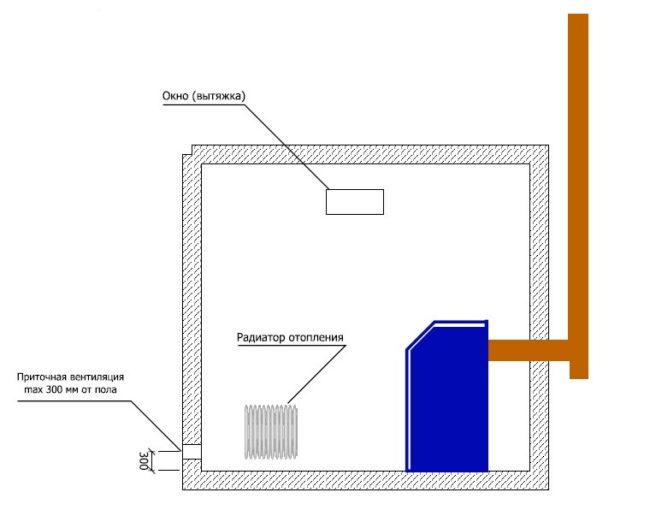
In forced ventilation, air flows are moved by mechanical force from operating fans. This type of ventilation system is especially suitable for large boiler rooms with powerful boilers.
Mechanical ventilation is installed for innovative heating equipment where the use of forced ventilation is recommended by the manufacturer.
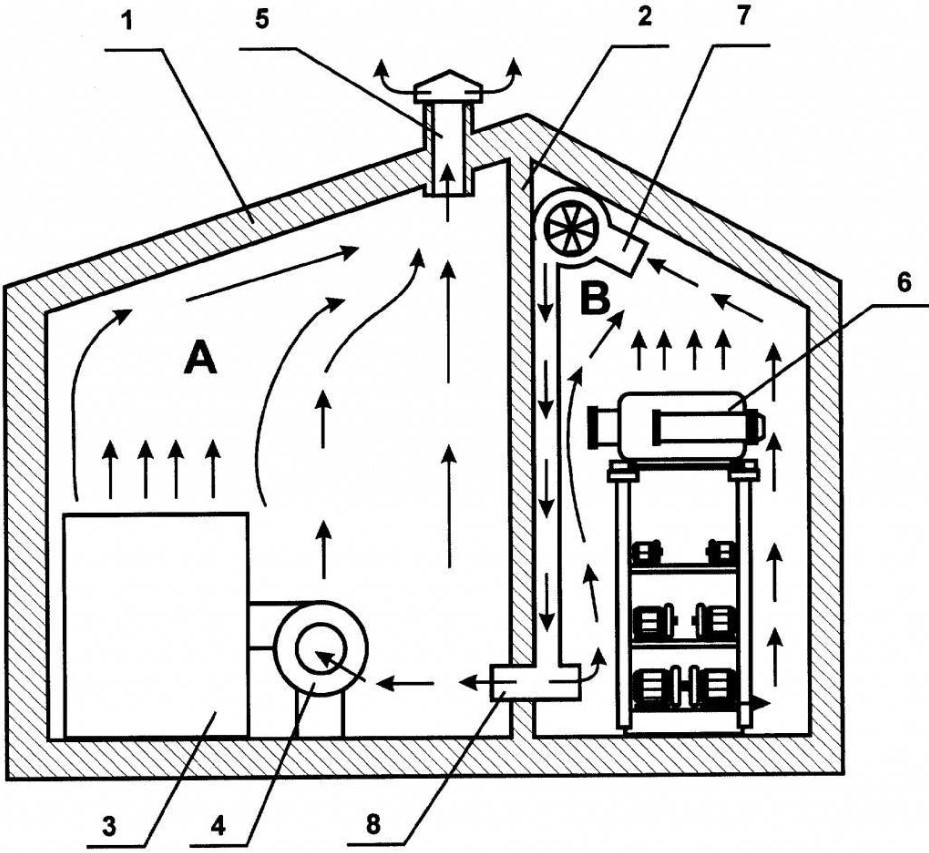
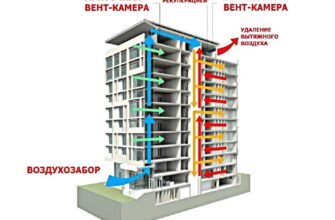
In the diagram of the forced system, where the fans are designated by numbers 4 and 7
Extractor hood and chimney for a gas boiler
Chimneys and exhaust ducts are covered by SP 402.1325800.2018. The document states that they must be made of non-flammable materials.
Ducts passing through cold areas of the building must be insulated. The use of porous materials in the installation is unacceptable.
Requirements for the installation of chimneys are reflected in DBN B.2.5-20-2001, SNiP 2.04.05-91The rules state that:
- A pipe correctly selected in terms of height and cross-section will ensure complete removal of exhaust air and combustion products;
- the diameter of the chimney cannot be smaller than the outlet on the boiler;
- For metal chimneys, a corrosion-resistant alloy steel pipe with a wall thickness of at least 0.5 mm is used;
- to clean chimneys from combustion products, pockets 250 mm deep must be created;
- Up to 3 turns are allowed on the chimney;
- To ensure normal draft, the height of the chimney cannot be less than 5 m.
Taking into account the rules and regulations, we will consider options for arranging shafts for the removal of combustion products and exhaust air:
- A brick chimney hood is durable but short-lived. Its disadvantages include labor-intensive and expensive installation. On the roof of a private house, a brick chimney looks beautiful, and that's its only advantage.
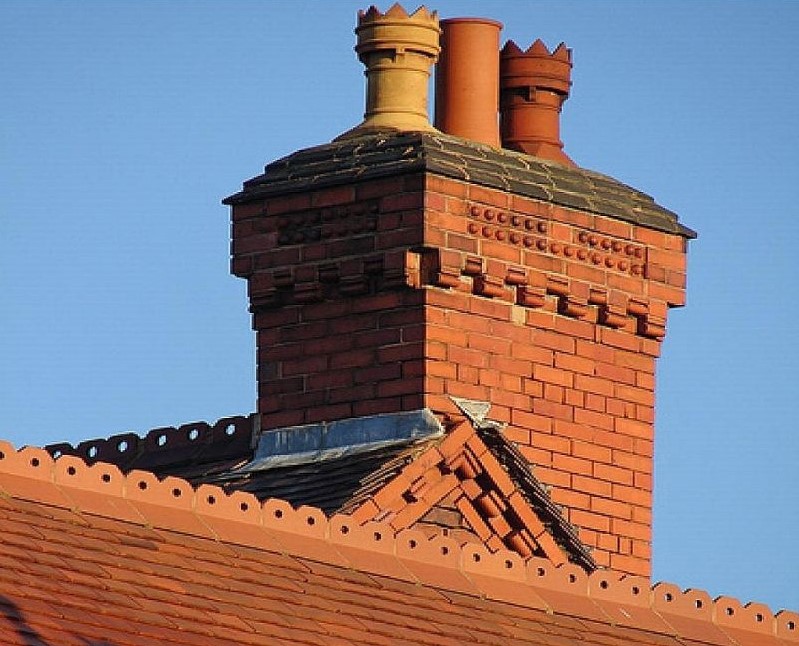
The inner walls of the channel are rough and quickly accumulate dust and soot. The brick and mortar are gradually destroyed by condensation, causing collapses that block the channel.
It's practical to build a chimney shaft out of brick and install galvanized or stainless steel pipes inside. However, the exhaust system doesn't justify the investment in cost and labor.
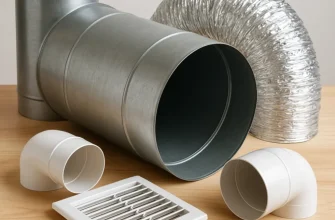
- You can make a steel hood from a regular and insulated pipe. In the first version Galvanized or stainless steel ducts with a wall thickness of at least 0.5 mm are suitable. I consider stainless steel to be more durable and safer.
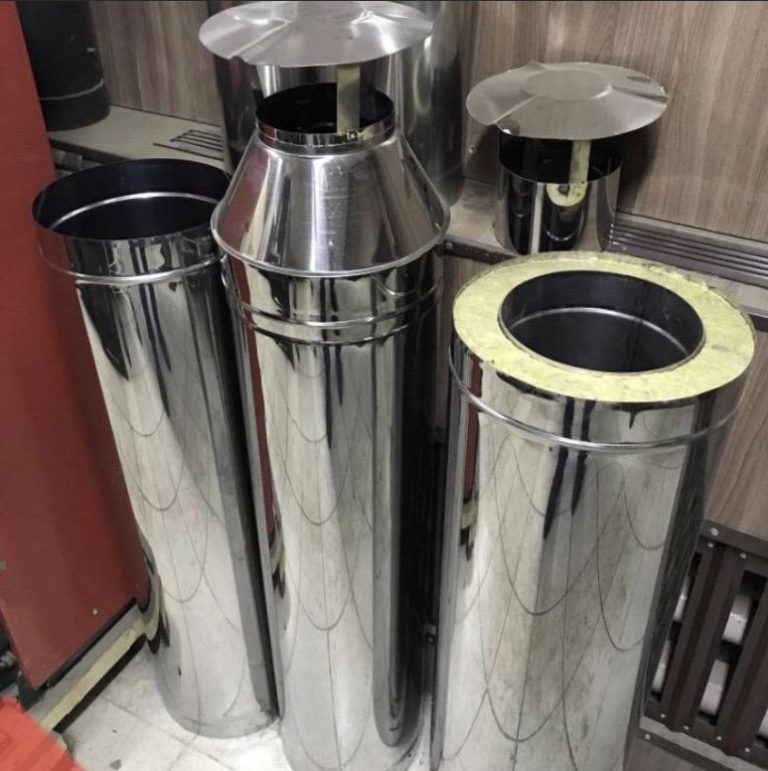
Over time, galvanized steel loses its zinc layer due to oxidation, clogging the duct. Ferrous metal begins to rot due to corrosion. Stainless steel will last a long time in ventilation and chimney systems, where the exhaust gases from a gas boiler reach temperatures of up to 450°C.OWITH.
In the second option An insulated duct is a sandwich pipe. Galvanized or stainless steel is also used for its manufacture. The advantage is the presence of thermal insulation between the walls of the two pipes, which prevents condensation.
- Ceramic hoods perform better than metal ducts in terms of performance. Ceramics offer high gas permeability and are durable. The ducts prevent toxic substances from entering the room.
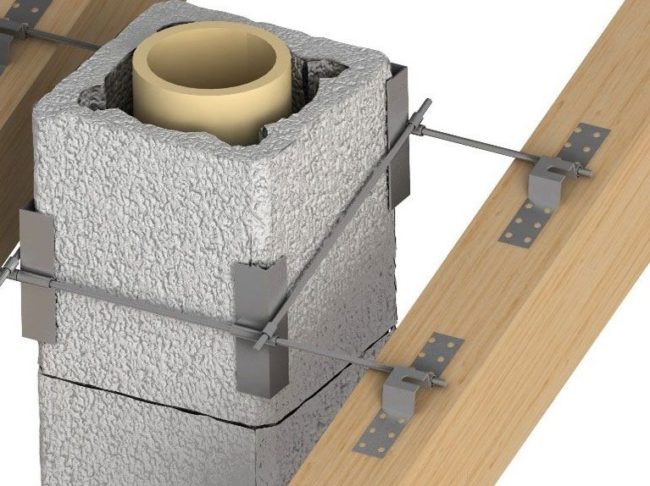
Dirt and soot buildup rarely occurs on the inner walls. Disadvantages include the ability of ceramic to absorb moisture. Ceramic ducts are heavy, expensive, and labor-intensive to install.
In chimneys, ceramics must be insulated with mineral wool, lined with stone or expanded clay concrete.
- A coaxial hood consists of two metal tubes of different diameters, with the smaller sleeve immersed within a larger cross-section element. A void is formed between the walls. Two channels run through each coaxial tube.
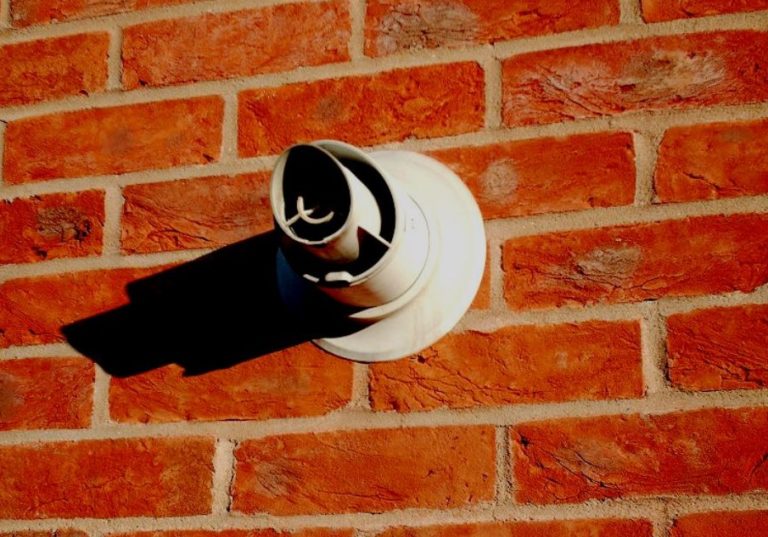
The internal liner vents combustion products from the gas boiler to the outside. An external duct supplies combustion air from the outside to the boiler. Warmed by the walls of the internal liner, the air enters the boiler warm, increasing heating efficiency.
A coaxial hood is a good option for a gas heating appliance, but several boilers cannot be connected to one pipe.
From the listed options for a hood for a gas boiler, I recommend choosing stainless steel, sandwich or coaxial pipe.
Calculation of ventilation for a gas boiler room
To ensure that the ventilation duct provides air exchange in accordance with established sanitary standards, it is necessary to select the correct pipe cross-section.
A gas boiler room requires a complete air exchange every 20 minutes (three times per hour). With ceilings 6 meters high, natural air exchange occurs without the need for complex ventilation systems.
To carry out the calculations, I will take as an example a standard boiler room of a private house measuring 3x4x3.5 m:
- We calculate the volume of the room v by multiplying the length of 3 m by the width of 4 m and the height of 3.5 m. We get the result of 42 m3.
- Determines the coefficient k for the correction for a low ceiling: (6 – 3.5 m) x 0.25 + 3 = 3.6.
- We calculate the air exchange volume V by multiplying the boiler room volume v by the coefficient k: 3.6 x 42 m3 = 151.2 m3.
- To calculate the cross-sectional area of the duct, we use the formula: S = V / (w x t). V is the air exchange volume, w is the flow velocity of 1 m/s, and t is the time of 3600 s. 151.2 / (1 x 3600) = 0.042. We convert the result from meters to square centimeters. This gives a chimney cross-section of 4.2 cm.2.
The boiler manufacturer usually specifies the recommended duct cross-section in the documentation. If this information is available, you can avoid complex calculations.
The chimney and exhaust duct from the boiler room must be properly routed to the roof to ensure proper draft:
- on a flat roof or a pitched roof with an indentation from the ridge of up to 1.5 m, the edge of the pipe must rise at least 0.5 m from the highest point of the roof structure;
- on a pitched roof, the end of the pipe should be located at the same level as the ridge or higher if the distance from the highest point of the roof is from 1.5 to 3 m;
- On a pitched roof with an indentation of more than 3 m from the ridge, the upper cut of the pipe should be located at an angle of 10O relative to a line drawn conditionally from the ridge girder.
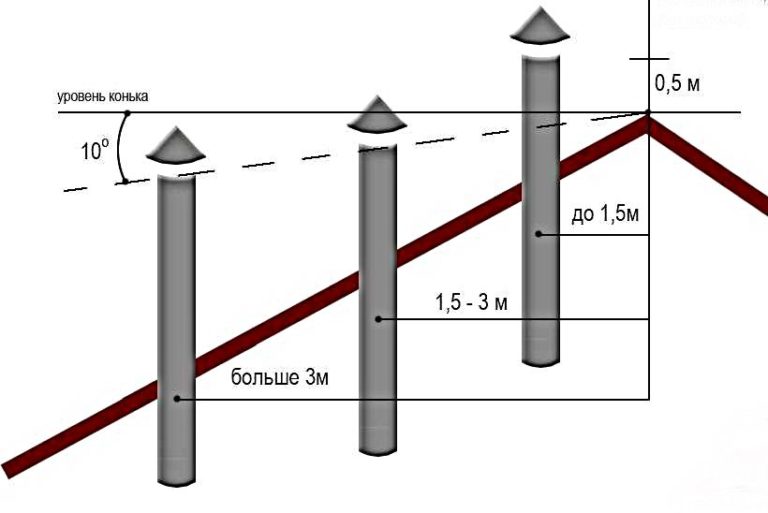
A nearby tall building can obstruct draft. The deflector mounted on the chimney should extend up to 0.5 m above the building. Soft roofing is a fire hazard. I recommend increasing the chimney height to 1–1.5 m.
Ventilation diagram
Professionally designed and installed ventilation ensures 100% fresh air supply to the boiler room. The layout of the utility system depends on the layout of the private home and the location of the boiler room.
Unobstructed air exchange is achieved when the supply and exhaust openings are positioned opposite each other. The supply is always from below, and the exhaust is from above.
A convenient location for the exhaust hood is through the ceiling above the boiler or in the center of the room. Alternatively, the exhaust vent can be located at the top of the wall above the heating appliance.
Move the hood at least 1 meter away from the boiler to prevent low temperatures from affecting the operation of the equipment in winter.
Step-by-step installation of ventilation and chimney
A boiler room in a private home requires supply and exhaust ventilation and a chimney to operate a gas boiler. At least three holes will need to be drilled in the wall: for the supply, exhaust, and exhaust of the heating appliance.
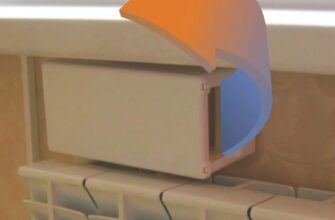
You can install a fresh air intake under the boiler room door, but this won't be sufficient. To ensure proper operation of the gas appliance, install an additional air intake valve on the wall opposite the appliance.
Install an exhaust vent at the top of the wall, near the ceiling. A convenient location is near the boiler chimney.
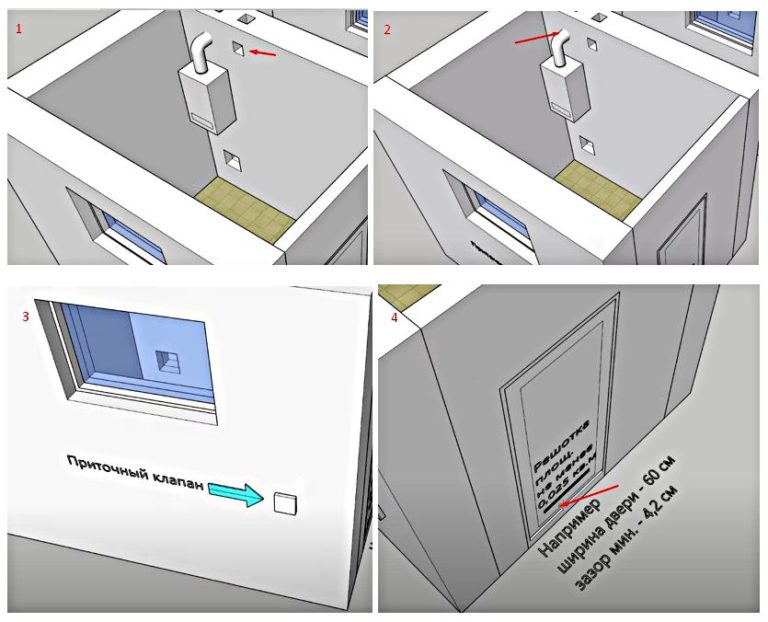 To install the ventilation elements, prepare 150 mm diameter stainless steel pipes, an inlet valve, mounting foam, and sealant. You'll need a hammer drill or an electric drill with a set of hole saws and drill bits. Also, be sure to have pliers, screwdrivers, a hammer, and a level handy.
I suggest we consider the step-by-step installation of a hood and chimney using a wall-mounted gas boiler as an example:
- The flue outlet for a wall-mounted gas boiler will be located at the top of the wall. An exhaust vent should be provided nearby.
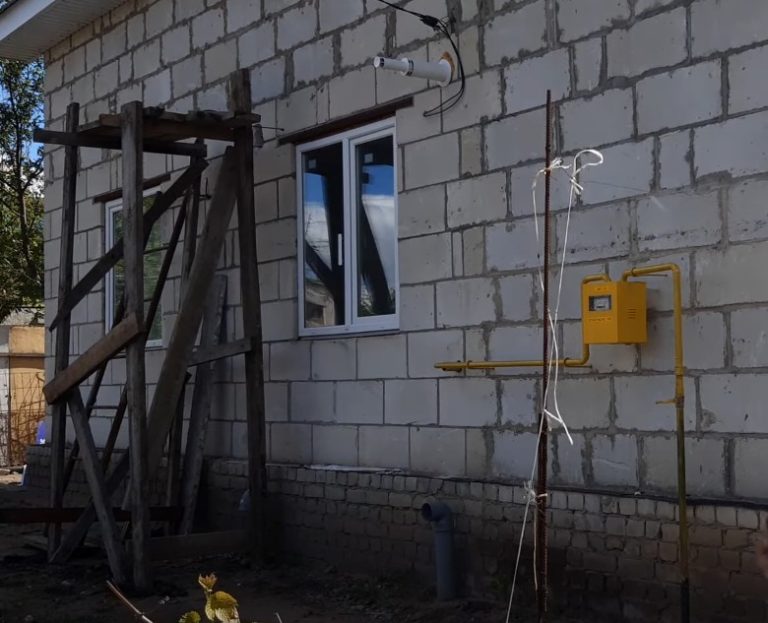
Mark the locations for drilling the two holes. Set up scaffolding or small platforms on the street side to facilitate the work.
- Prepare stainless steel pipe and fittings for the hood and chimney. You'll drill holes in the wall to match the diameter of the ducts.
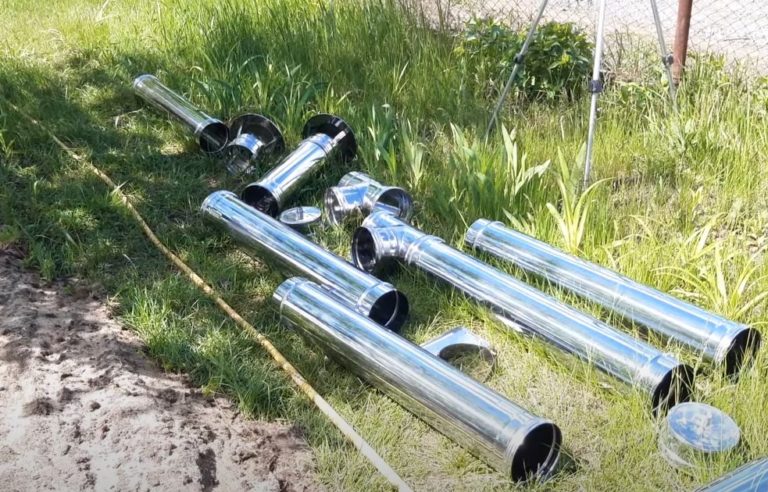
- Assemble the chimney and exhaust duct from pipes and fittings. Seal the joints with sealant before joining the parts, and reinforce them around the perimeter with screws. You should end up with two straight pipes.
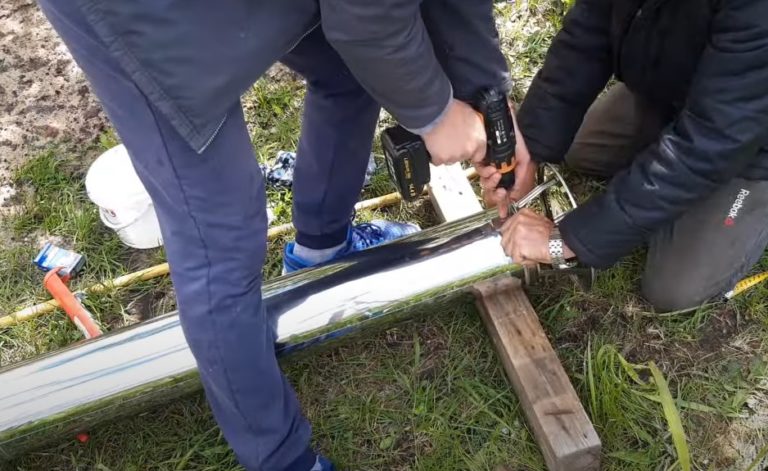
Install deflectors on the top section. Attach a tee to the bottom section. A duct will run from the side opening through the wall into the house. Close the remaining bottom opening of the tee with a plug.
The unit will act as a settling tank for condensate and accumulated dirt. When you need to clean the pipes, open the plugs.
- Drill through-holes in the wall along the markings. One hole should be directly opposite the flue outlet of the wall-mounted boiler. The other hole is the exhaust vent in the gas boiler room for natural air exchange.
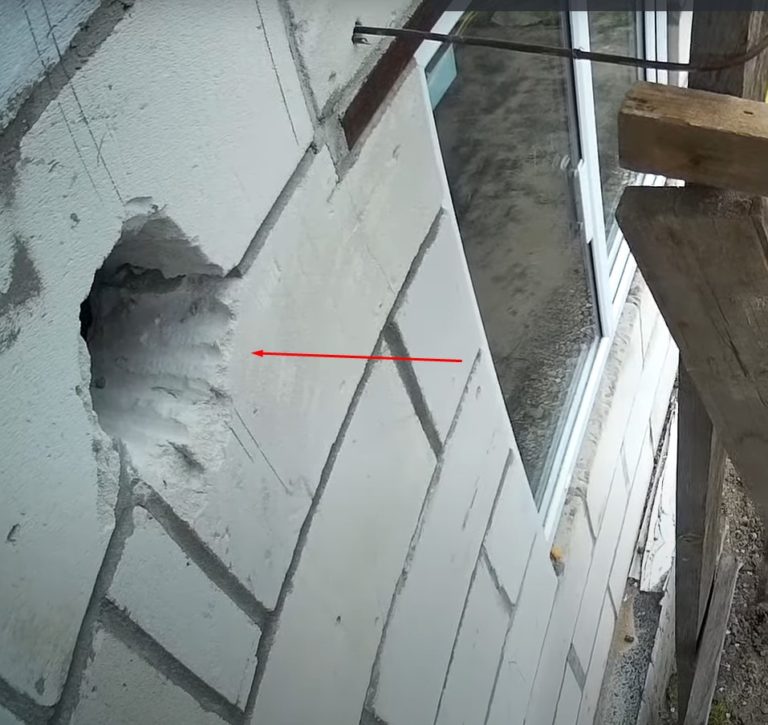
Drill it at a small distance from the chimney in a convenient place.
- Align the pipes at the installation location. Check their vertical alignment with a level. Ensure the side outlet of the tee is aligned with the through-hole in the wall.
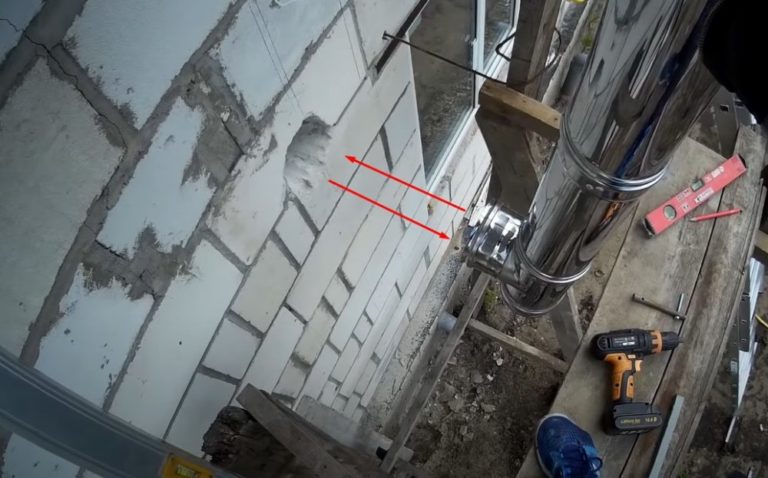
- Using clamps and fasteners, securely attach the pipes to the eaves of the house.
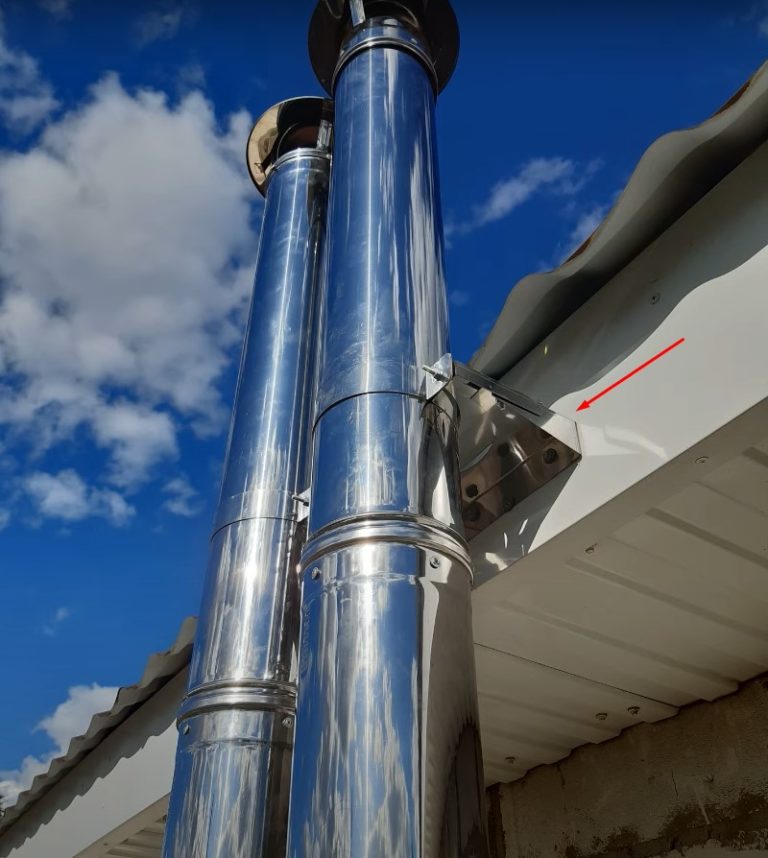
- After the vertical flue and exhaust duct are securely fixed, connect the horizontal ducts to the side outlets of the tees.
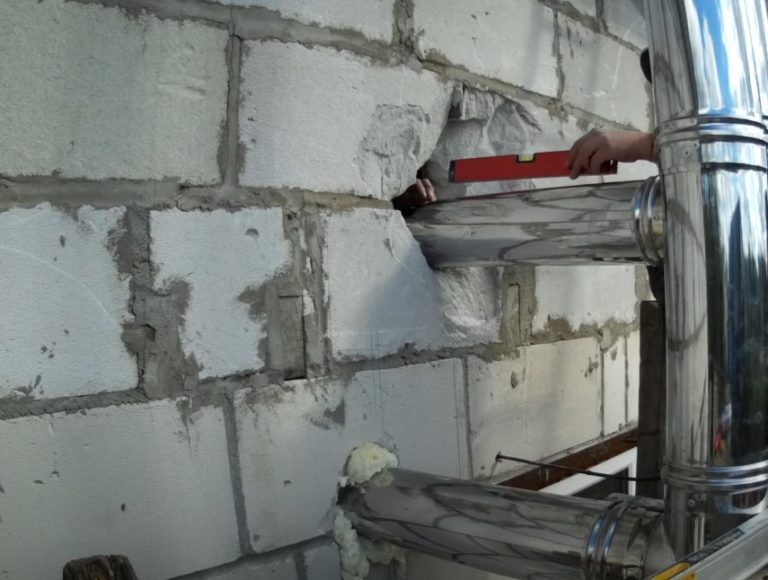
Bring the pipes into the house through the through-holes. Use a level to ensure that the horizontal ducts slope slightly toward the outside, otherwise condensation will flow indoors.
- Reinforce the horizontal channels passing through the holes in the wall with spacers made from pieces of wood or scraps of board. Fill the remaining gaps with foam.
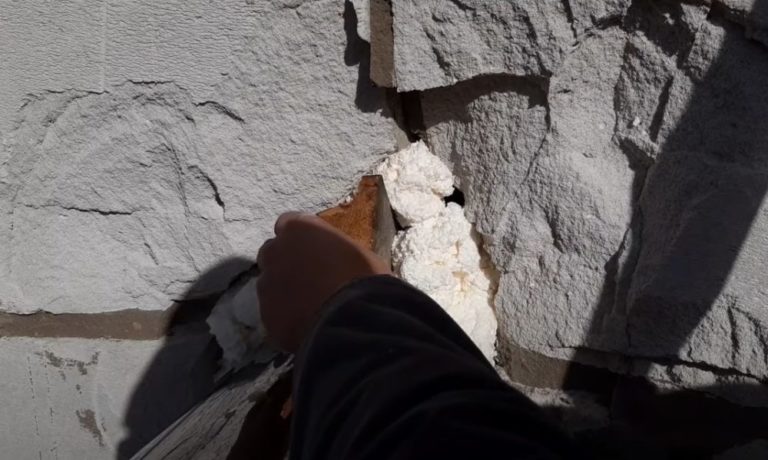
- After the foam has dried, trim off any excess with a knife until it's flush with the wall. Cover the top with cement mortar.
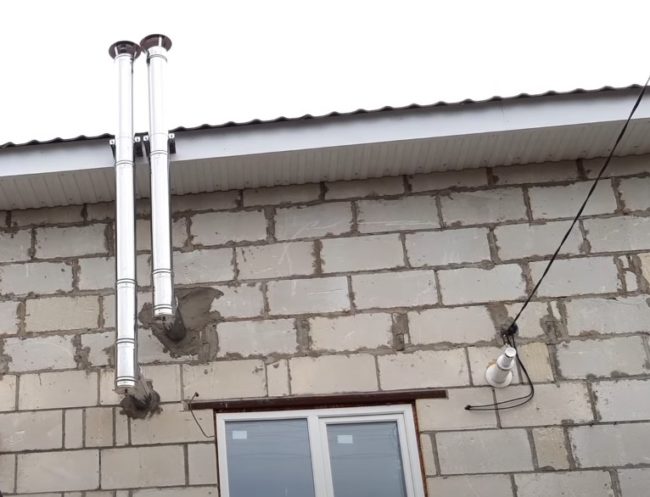
- In the house, cut the exhaust duct flush with the wall. Cover the opening with a decorative grille later. Test the exhaust ventilation by holding a smoking roll of lit paper to the duct. Smoke should be drawn into the opening.
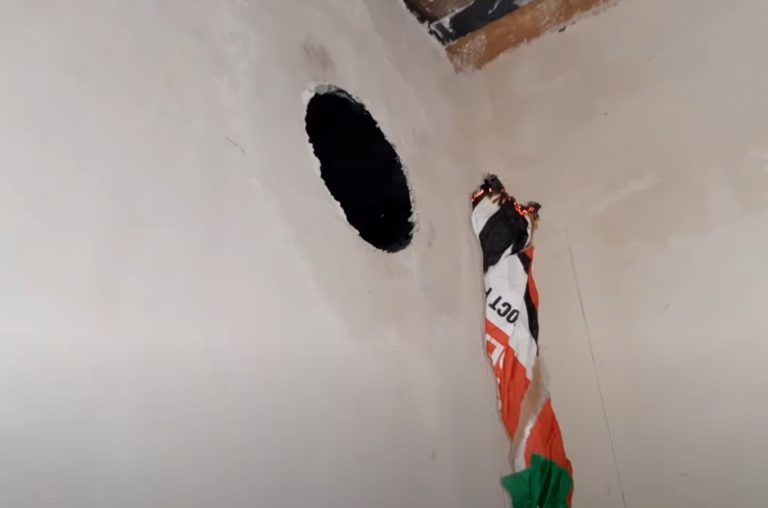
- After installing the chimney and hood, begin setting up the supply ventilation in the boiler room. A single gap under the door won't be enough. A gas boiler requires a large influx of air from outside to operate.
Solve the problem by installing a 150mm diameter inlet valve. This device consists of an insulated pipe, a filter cap, and a decorative outdoor grille. If the valve is smaller than the diameter recommended by the gas inspector, install two.
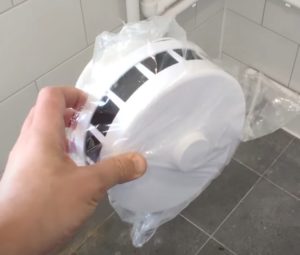
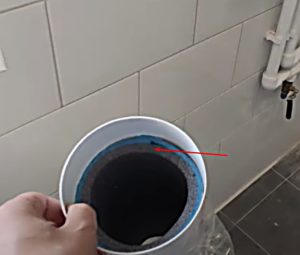
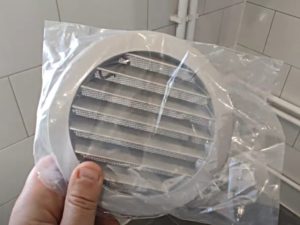
- Using a drill with a diamond core bit, drill two holes through the bottom of the wall. Vacuum the dust after drilling. Insert insulated valve sleeves into the drilled holes. Seal the gaps with sealant.
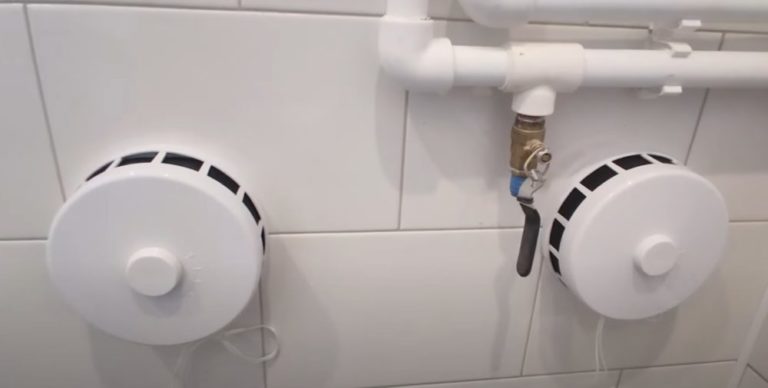
Attach filter caps to the indoor ducts. Cover the outdoor air inlets with decorative grilles.
Check the operation of the supply ventilation system with a piece of paper. It will be deflected by incoming airflow from the headwalls. Adjust the airflow intensity using the dampers on the air valves.
First launch
Check the efficiency of the ventilation in a boiler room with a gas boiler with the door closed. Air exchange should be provided by the supply and exhaust ducts 24/7.
After closing the boiler room door, place a paper towel against the vents one at a time. A properly functioning hood will stick to the towel, but it will deflect from the air intake.
To obtain accurate measurements of the speed of air and gases, use a device called an anemometer.
Answers to frequently asked questions
For every 10 kW of boiler output, an air flow rate of 0.01 m³/sec should be supplied. Ventilation capacity is calculated with a 30% reserve. To ensure adequate air exchange, the boiler room exhaust duct should be at least 130 mm in diameter.
The exhaust hood is located high under the ceiling, as far away as possible from the air intake. Ideally, it should be on the wall opposite the air intake. The exhaust duct may be routed through the ceiling and roof to the outside.
The recommended exhaust duct diameter for a private home with a gas boiler is 150 mm. The exact dimensions depend on the equipment and boiler room parameters. The chimney diameter is selected based on the boiler's power. The manufacturer provides these details in the appliance's instructions.
A private home with a gas boiler requires natural ventilation. The system must function reliably and provide three air changes per hour.
The recommended ventilation duct cross-section, excluding thermal insulation thickness, is 160 mm, but not less than 150 mm. The system should consist of an exhaust and supply duct.
The ventilation pipe diameter must be larger than the gas boiler's chimney cross-section. The equipment's power is taken into account in calculations. A pipe cross-section of 160 mm is recommended.
Vladimir, good afternoon! I have wide eaves in my wooden house. This makes it difficult to securely fasten the exhaust pipe in case of snow slides. Is it possible to simply make a 150 mm hole in the ceiling and install a grille/blind on the outside and a decorative grille on the inside? I have an 18 or 24 kW wall-mounted boiler. Could you please advise? Thank you.
Hello. I think I could try, but I'd need to insulate the hole.
Hello Vladimir. How can I call or email you?
Hello. You can ask a question on this page. https://fixit.washerhouse.com/en/zadat-vopros
Tell me, at what distance from the ceiling should the ventilation be located in a boiler room with a closed-type boiler?
Hello. For boilers with a closed combustion chamber, it is recommended to install ceilings in the boiler room at least 2.2 m high. Supply ventilation can be provided by 4-5 20 mm diameter openings at the bottom of the door. The exhaust vent should be installed at least 1-1.5 m above the boiler to prevent cold air from negatively affecting the heating unit's operation in winter.
The coaxial flue is raised above the boiler with a closed combustion chamber and turned 90°. The minimum distance between the pipe and the ceiling is 20 cm. The duct leading through the through-hole has a minimum extension of 30 cm from the wall.
Good afternoon. We installed a ventilation pipe from the basement to the roof of a two-story house. But the exhaust hood isn't working. It's even backdrafting. The gas isn't connected yet. Could you tell me who I can consult about this and how to get the exhaust hood working? Thank you.
Hello. Natural ventilation may not work if the chimney is installed at the wrong height relative to the wind direction and roof configuration. According to SNiP No. 41-01-2003, the upper edge of the hood should rise above the highest point: flat roof - 30-50 cm, pitched roof - from 50 cm with the distance of the pipe from the ridge up to 1.5 m.
If the chimney is 1.5 to 3 meters from the ridge purlin on a pitched roof, position the top edge of the hood flush with the ridge. If the distance is greater than 3 meters, draw an imaginary line at a 10-degree angle to the ridge purlin to determine the height from the top edge of the chimney.
Always vent the exhaust hood downwind of the house relative to the prevailing winds and its location on the property. Pay attention to nearby tall obstructions. Trees and adjacent multi-story buildings create wind barriers and turbulent airflow. To increase draft, install a turbo deflector on the exhaust pipe. If natural ventilation isn't sufficient, supplement it with an exhaust fan with a check valve.
Hello, I have ventilation in my private house. I want to install forced ventilation for my gas stove. How can I do this?
Hello. This is described in detail in the following articles: independent connecting the hood to the kitchen ventilation And types of ventilation in the kitchenHow to do it yourself
The documents you linked to don't specify what material the exhaust ventilation system inside the house, venting under the roof, and through the roof should be made of. Chimneys and outdoor hoods are all made of metal.
Hello, Vadim. The classification of air ducts by material, cross-sectional shape, standard size, and other parameters is defined by GOST R 70349-2022.
Clause 4.1.2 states: For ventilation, air conditioning and air heating systems, air ducts made of sheet steel, metal-plastic, metal foil, fabric, plastics, channels and shafts in a building design made of brick, concrete, reinforced concrete, panel, sandwich air ducts are used.
Clause 4.1.5 states: The material for the manufacture of air ducts is specified in the working documentation, taking into account the properties of the air medium transported in the air duct (temperature, humidity, presence of mechanical and other impurities) and the properties of the environment in which the air duct is located during operation.
Clause 4.1.6 states: For sections of the air duct network of ventilation, air conditioning and air heating systems within the serviced premises and which are decorative elements, other materials (copper, steel with nickel coatings, etc., plastics, etc.) may be used.
The text contains no reference to the brand of boiler installed in the heat generator room. Each boiler model has its own operating principles, so general conclusions without reference to the operating technology of the installed boiler may be erroneous. General statements and recommendations make it impossible to determine whether this applies to the boiler purchased by the owner for installation in their home.
Hello. The ventilation installation instructions are general for domestic gas boilers, both wall-mounted and floor-mounted, with an open combustion chamber. The specific model is not important as they operate on the same principle. The unit draws air from the room to ensure combustion, so it requires an intake and exhaust duct with the cross-sections specified in the article.
When installing a chimney, consideration must be given to the operating technology of a specific boiler model. If the boiler has a coaxial outlet, air is drawn into the closed combustion chamber and exhaust gases are removed through a dual-channel pipe supplied by the manufacturer. This article examines an example of a chimney outlet for any brand of wall-mounted boiler with an open combustion chamber. The installation principles for these models are the same. Only the chimney cross-section, specified by the manufacturer in the instructions, differs. The pipe diameter should not be smaller than the outlet pipe from the boiler.
Good afternoon! I bought a 31 kW boiler with a coaxial chimney. How do I install the ventilation correctly? Do you have galvanized pipes? Please advise.
Hello. A boiler with a closed combustion chamber operates without ventilation in the boiler room. Combustion air is supplied, and combustion products are removed through coaxial flue ducts. Ventilation is necessary in case of gas leaks and to remove moisture vapor, which can cause corrosion of the boiler's metal parts.
Create a simple natural ventilation system. Install a wall valve with a grate at the bottom of the wall for the inlet. Design the inlet airflow to the outside at a rate of 8 cm² per 1 kW of the boiler's rated power. You can also direct the inlet airflow from inside the house, from an adjacent room. Install a transfer vent at the bottom of a door or interior partition. Design the vent airflow to be 30 cm² per 1 kW of the appliance's power.
Route the exhaust vent through the wall with a sleeve at an angle toward the street to drain condensate. Position the opening at least 1 meter away from the boiler and close it. grille with a check valve Or install a diffuser. Connect galvanized pipes from the outside through a tee.
Make the top cut of the hood flush with the ridge if the indentation is up to 3 meters. If the indentation is greater than 3 meters, position the cut of the pipe relative to the ridge at a conditional projected angle of 10°. If bring the pipe out through the roof at the ridge, maintain a minimum height of 50 cm. Put on a protective cap or turbo deflectorClose the bottom opening of the tee with a plug; use it to drain condensate. Insulate the galvanized pipe facing the outside with polyurethane foam or other available insulation.
You can use galvanized pipes to create a ducted ventilation system with inlet and outlet ducts. The specific design should be chosen based on the boiler room's location in the house, the room's dimensions, and the presence or absence of general-purpose ventilation.
The article is a mixed bag, for example, why isn't the air flow under the door sufficient? Why is an additional valve installed? Why is the door size 600mm when the regulations require at least 800mm? And so on.
Read the documentation…
Hello. According to current SNiP 2.01.02-85, the door to a domestic boiler room must be at least 80 cm wide. Doorway dimensions are more strictly regulated for ease of equipment maintenance. This is confirmed by SP 31-106-2002, clause 6.3.8. The code of rules states that the dimensions of doorways in the heat generator room must ensure unimpeded equipment replacement. For this purpose, designs often specify a door width of 90-1000 cm. There is no strict restriction on a door width of 60 cm.
In practice, gas utilities pay the least attention to door dimensions. More important is the door material's compliance with fire safety requirements and the door's opening direction. The article doesn't recommend a 60 cm width, and the video and photo simply show an example of the air inlet valve layout, with the corresponding door width indicated in the diagram.
Regarding ventilation: the cross-section of the transfer vent at the bottom of the interior door is calculated based on 30 cm² per 1 kW of boiler output. The volume of air flow from the house into the boiler room may be insufficient when two open-chamber heat generators are installed or when the air flow direction changes due to the operation of the common-house ventilation system. A wall-mounted supply valve through the wall to the outside is installed to provide independent ventilation in the boiler room. The transfer grille on the interior door is closed.
If the boiler room has an outside door, the size of the air inlet grille is calculated based on 8 cm² per 1 kW of the boiler's nominal power. If the opening is insufficient, to ensure the required volume of outside air flows to both heat generators, the inlet is increased by installing an additional wall valve. The grille on the outside door does not necessarily need to be closed, but it should be included in the supply ventilation calculations.
Is it possible to vent a gas boiler's exhaust to the outside through the ceiling instead of the wall, even though the house is only one story?
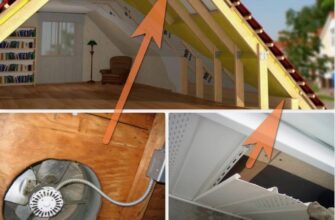
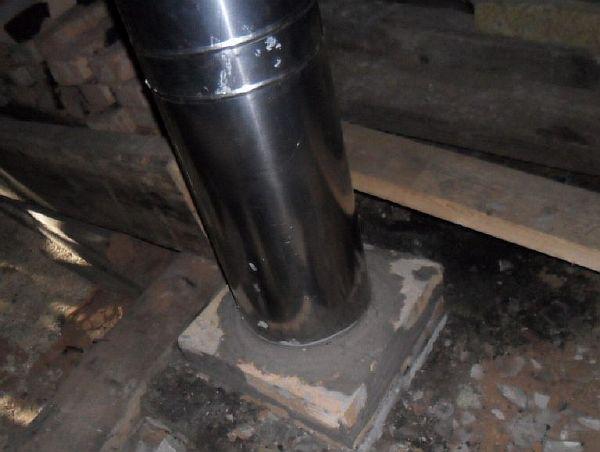
Hello. To exhaust the range hood through the ceiling and roof, you need to install a pass-through unit. This unit creates a sealed joint on the roof, preventing leaks during rain and snowmelt. The range hood should vent outside, not end in the attic.
Hello.
We gasify a house, boiler room, coaxial boiler.
We make ventilation along the facade.
Is it possible to make it galvanized or stainless steel?
Or is it necessary to make a sandwich and warm it up?
There is nothing about insulation in the gas service documents.
Thank you.
Hello. Ventilation ducts should be insulated where they pass through cold areas (uninsulated attics, outdoors, unheated rooms). Insulated ducts increase natural draft and prevent condensation. If you're using regular galvanized or stainless steel for your ventilation system, you'll need to insulate them. Sandwich pipe ducts are more expensive, but require less hassle with insulation.