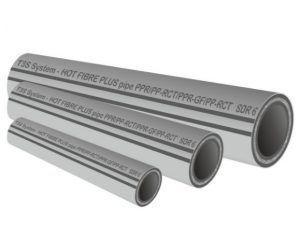
 Each product has its own letter and number designations. This is necessary to distinguish them from each other, both by visual characteristics and technical parameters. PVC pipes are no exception to this rule.
Manufacturer, terms, and operating characteristics are far from a complete list of what can be learned simply by looking at information such as polypropylene pipe markings.
- About digital and alphabetic symbols
- What about the areas of application?
- About product color and quality characteristics
- The purpose of the varieties and their features
- Choosing the Right Materials. Simplifying Installation
- Additional tips, some features
- Advantages of polypropylene
- Some installation tips
- Some installation tips
About digital and alphabetic symbols
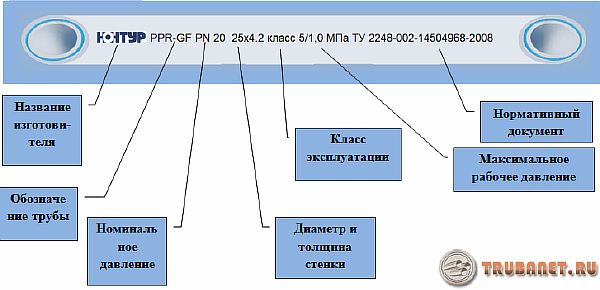
This material is marked with many letters and numbers. Manufacturers typically maintain official websites, which, among other things, provide information on the markings and the information they represent. However, it's best to translate these explanations into a language that's understandable to everyone.
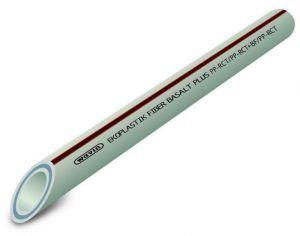
There are several characteristics that are indicated by the designation of polypropylene pipes.
- Pressure. Unit of measurement is kg/cm2. It is designated as PN. It shows how much time the pipe operates normally while maintaining certain characteristics.
The thicker the wall, the higher this indicator will likely be. For example, they produce brands PN20, PN25Such options are needed for hot water supply and heating systems.
Sometimes red or blue stripes are also applied. This will indicate what type of water the future pipelines are intended for.
- The markings for polypropylene heating pipes include information related to the materials and structure. Extensive tables are compiled to describe this parameter. However, a basic understanding of the symbols is sufficient to properly install heating systems in a typical building.
- Al — aluminum.
- PEX is the designation for cross-linked polyethylene.
- PP-RP. This is polypropylene that can withstand high pressure.
- PP - Common varieties of polypropylene material.
- HI – fire-resistant products.
- TI – thermally insulated version.
- M – designation of multi-layer.
- S – symbol for single-layer structures.
The marking of polypropylene pipes for water supply may also indicate data, which concern:
- Presence or absence of certificates.
- Batch numbers, serial designations, time stamps, and so on. These designations may consist of 15 characters or more.
- Manufacturers.
- Wall thicknesses and cross-sections.
Thanks to this information, every buyer will choose the water supply material that meets all his needs.
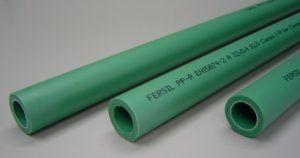
What about the areas of application?
There are other markings, too. Some of them can indicate where and how to install a pipeline made of a particular material.
Typically, such a designation takes the form of a schematic drawing. Marking reinforced polypropylene pipes not exception.
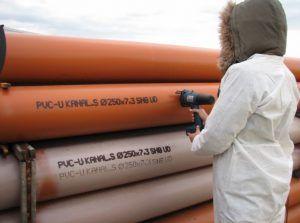
The complete list of areas of application is as follows.
- For systems providing fire protection.
- In the construction of ships
- For sports facilities.
- To irrigate agricultural land.
- For use in industrial infrastructure.
- For heating, warm floors and walls.
- In water supply systems.
- With heating pipelines.
- For drinking water pipelines.
Polymers have become particularly widespread and an integral part of our lives. They are also essential for the labeling of plastic water pipes.
About product color and quality characteristics
The construction market now offers a wide range of products made from PVC.
If the installation is planned to be concealed, color is not a factor. Furthermore, appearance will not affect the material's properties. The choice is purely a matter of personal preference.
The purpose of the varieties and their features
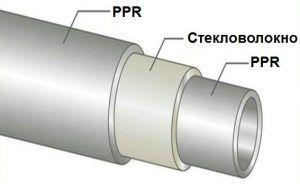
Rolled pipes can be reinforced (marking will be PPR-FB-PPR), or unreinforced.
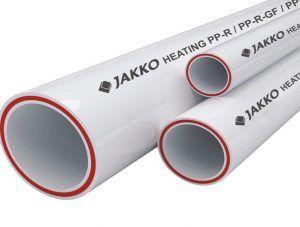
Thermal elongation is typical for any type of PVC material.This is the property of a pipe to change its dimensions when exposed to high temperatures.
But in this case, products with reinforcement differ from their non-reinforced counterparts. This is also indicated in the marking table. polypropylene pipes for heating.
Highest thermal expansion rates - for pipelines that are not provided with reinforcement.
For example, with a temperature difference of up to 100 degrees, it can reach up to 150 millimeters per 10 meters of pipeline. This factor must be taken into account by those performing the installation.
Pipes with fiberglass inside have proven to be the most stable in practice. In some products compensator for this characteristic aluminum foil is used.
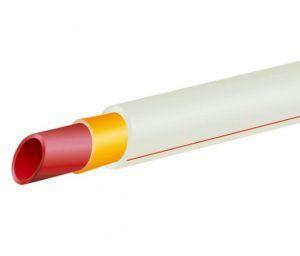
This is an important element for those installing heating systems. The markings make it easy to identify the types of materials used in their construction.
- There are polypropylene products reinforced with an outer layer, which is covered with an aluminum shell. This wrapping has ends, but they are never "welded." In some cases, internal reinforcement is present, strengthening the entire structure.
- There are also models that consist of equal parts polypropylene and reinforcement.
- Finally, hybrid versions are being produced, which have as many as three components. The outer layers are made of polypropylene. Then comes the foil, which acts as a compensator, made of polyethylene.
Marking will always help determine which material will be best for organizing a water supply or heating system.
Reinforced models are almost all equally strong. The key is to pay attention to how thermal expansion is compensated for.
They were no exception polypropylene pipes for hot water, the marking of which will always provide the necessary information.
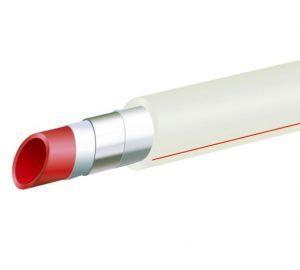
Choosing a simple polypropylene pipe is the most affordable option. Any DIYer can master the soldering process without much effort.
Choosing the Right Materials. Simplifying Installation
Unreinforced polypropylene-based tubing is the simplest and most convenient option to work with. Its uniform structure allows it to be installed with any type of connection.
Fiberglass-reinforced structures are also quite convenient. The material melts easily and requires no additional processing.
Here are some tips for those who are just about to purchase the products.
- Aluminum requires mandatory stripping if it's located on the outer layer, at the joint. Otherwise, a tight, high-quality connection cannot be created. The polypropylene layer on the outside cannot be bonded due to the compensating foil. However, this doesn't mean such pipes cannot be used at all. This inconvenience can be easily remedied with special tools.
- Tubes with internal reinforcement also require stripping. Simply remove the aluminum foil and make a right-angle cut to ensure successful operation. The exception is fiberglass-reinforced polypropylene pipes are becoming, marking which will give clues.
Additional tips, some features
Pipes with the thinnest walls are designated PN10. They are suitable only for underfloor heating systems or for supplying cold water.
At the same time they withstand nominal working pressure not less than 1.0 MPaThe outer diameter is equal to 20-100 millimeters.
With markings PN25 The pipelines are distinguished by the presence of a layer located on the outer side.
The use of glue is no longer necessary when joining layers, thanks to the perforated surface of the foil. This joint improves stability and strength. It can be used for hot water supply and heating.
The use of aluminum foil in PN25 pipes ensures a low coefficient of thermal expansion. However, installation is not without its challenges. They are ideal for heating and, consequently, hot water supply.
Advantages of polypropylene
Long service life – the main positive feature of such products. But only those who strictly follow the manufacturer's recommendations achieve such results.
Service life does not change if the system temperature rises, but only for a short period. Markings and dimensions also affect this.
Video: Designation of polypropylene pipes
Some installation tips
There are also a number of other advantages:
- Minimal maintenance. They don't require painting, and their appearance lasts for a long time.
- Its light weight minimizes transportation issues, and installation requires minimal labor.
- Reduced installation time compared to metal products.
- Good sound absorption, thanks to which the coolant passes through the system silently.
- Resistant to even the most extreme temperature fluctuations. Low thermal conductivity, virtually eliminating condensation.
- No corrosion on the inner surface. This allows the inner diameter to remain unchanged.
Video: Designation of PP pipe products
Some installation tips
Before installing the pipes, inspect them for contamination and damage. Installation should be carried out when the temperature remains at least 5°C (41°F).
Otherwise, it's impossible to achieve connections of sufficient quality. The ambient air temperature must be 15 degrees above zero if you want to bend pipes without the need for additional heating.
Maximum The radius is equal to 8 diameters for products of 16-32 millimeters. See how to calculate it correctly for water supply.Correct actions can be easily understood by studying a document such as the marking of fittings for polypropylene pipes.
Welding produces homogeneous seams, ensuring high-quality joints. Three types of welding are used:
- With electrical fittings.
- Butt.
- Coupling.
Video: Choosing polypropylene pipes for heating
You can't cut recesses in plastic fittings yourself. It's best to buy fittings from the same company as the pipes. Otherwise, the tightness of the plumbing fixtures cannot be guaranteed.
The main thing is to take into account thermal expansion factors when installing heating pipes. Two types of fasteners can be used. For example, a support without moving parts can be used.
In this case, the pipeline is simply unable to move along its axis. However, this option is only suitable for relatively short pipe sections.
Video: How to choose PP pipes for heating and water supply
The minimum slope for installation is 0.5 percent. This should be done where water can be drained. Wall elbows prevent torsional stress when installing water intake equipment. This can also be indicated on the markings on polypropylene pipes.